Lord Vishnu
Jagannath Temple Puri: History, Legends, Architecture & Mysteries
- Published date
- 29 Sept 2026
- Author
- Admin
- Category
- Lord Vishnu
The Jagannath Temple Puri, located in Puri, Odisha, is one of India’s most important Hindu pilgrimage centres and one of the four traditionally recognised Char Dham sites. The temple is dedicated to Lord Jagannath, a form of Vishnu/Krishna, who is worshipped alongside his elder brother Balabhadra and sister Devi Subhadra.
For devotees, Jagannath Puri is a sacred destination. For travellers, it is also an extraordinary example of Odisha’s temple architecture and living heritage. From its centuries-old rituals to the annual Jagannath Rath Yatra, the temple combines history, faith, art and tradition in a way few monuments can.
Jagannath Temple History
The present temple belongs primarily to the 12th-century period and is traditionally associated with the Eastern Ganga king Anantavarman Chodaganga Deva. The temple complex continued to receive additions and changes in subsequent centuries.
Historical tradition and religious literature also preserve older stories about the worship of Jagannath. These traditions should be distinguished from firmly documented architectural history, because the temple’s religious origins extend into mythology and oral tradition.
According to the sacred traditions surrounding the temple, Lord Jagannath's wooden form has a special connection with the worship of the Lord in Puri. The central deities are not carved permanently in stone; their wooden bodies are periodically renewed through Nabakalebara.
Jagannath Temple Architecture
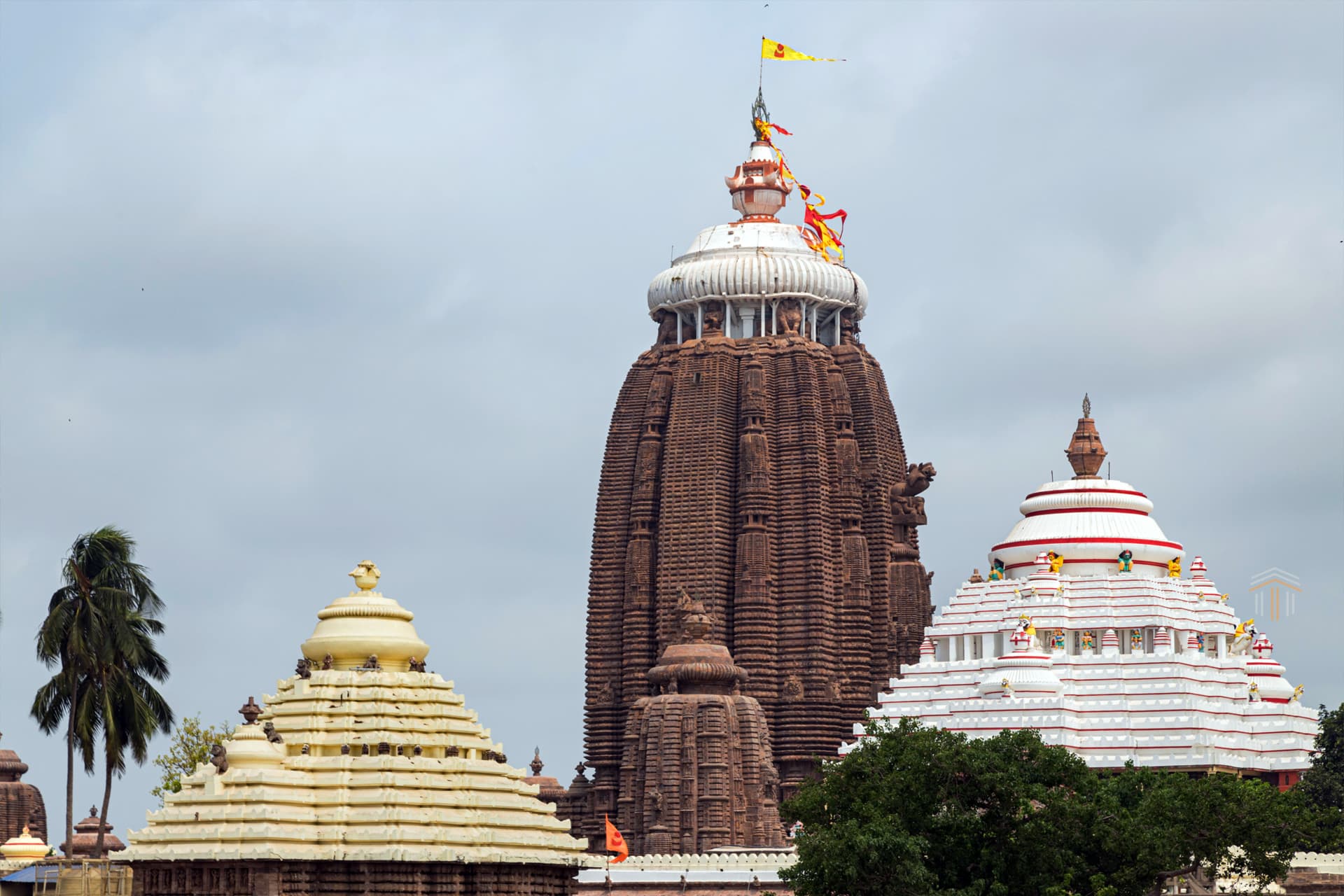
The Jagannath Temple architecture is a magnificent example of Odisha's Kalinga tradition.
The main temple rises approximately 65 metres above its elevated platform. The complex is enclosed by two substantial concentric walls, while the principal entrance is the Singhadwara, or Lion Gate, on the eastern side.
Important features include:
-
Vimana: the towering sanctum structure
-
Jagamohan: the assembly hall
-
Nata Mandapa: the dance or festival hall
-
Bhoga Mandapa: associated with offerings
-
Nilachakra: the sacred wheel mounted near the top of the temple
-
Singhadwara: the principal eastern entrance
The Nilachakra, or Blue Wheel, is traditionally regarded as highly sacred. Odisha Tourism notes that it is made from an alloy of eight metals, known as ashtadhatu.
Aruna Stambha
Another prominent feature outside the Lion Gate is the Aruna Stambha, a monolithic pillar about 33 feet high. Odisha Tourism records that it was originally associated with the Konark Sun Temple before being moved to its present location.
Jagannath Temple Mystery: Faith, Tradition and Observation
The temple has inspired many stories about phenomena described as mysteries. Some are better understood as religious traditions or observations than as scientifically established supernatural events.
Jagannath Temple Flag Mystery
One of the most famous traditions concerns the Patitapabana flag atop the temple.
According to Odisha Tourism, temple servitors change the flag around sunset every day, and the traditional ritual involves climbing the structure without modern climbing equipment. The direction in which the flag appears to move has long attracted attention because it can sometimes seem contrary to the surrounding wind.
Rather than presenting this as proof of a supernatural phenomenon, it is more accurate to describe it as a long-standing temple tradition and an intriguing visual observation.
The Sudarshan Chakra
The Jagannath Temple Sudarshan Chakra, also called the Nilachakra when referring to the sacred wheel atop the temple, is another distinctive feature.
Its position high above the temple has contributed to numerous devotional stories. For visitors, the wheel is particularly striking because of its prominent silhouette above Puri's skyline.
Jagannath Temple Mahaprasad
Food is an integral part of Jagannath worship.
The Jagannath Temple Mahaprasad is prepared in the temple kitchen using traditional methods. Odisha Tourism describes the distinctive practice of cooking food in earthen pots arranged one above another over a wood-fired hearth.
The offering is subsequently treated as sacred food and is an important part of the spiritual and cultural experience of Puri Jagannath Temple.
For pilgrims, Mahaprasad is more than a meal-it represents the temple's longstanding connection between worship, community, and food traditions.
Jagannath Rath Yatra
The annual Jagannath Rath Yatra is the temple's most famous public festival.
During the procession, the principal deities are taken outside the temple in their ceremonial chariots. The three major chariots are:
-
Nandighosha - Lord Jagannath's chariot
-
Taladhwaja - Lord Balabhadra's chariot
-
Darpadalana - Devi Subhadra's chariot
The festival normally takes place around June or July, according to the Hindu calendar. Odisha Tourism describes the procession as a major expression of Odisha's religious and cultural traditions.
For travellers planning to attend, expect very large crowds, traffic restrictions and significant changes to normal movement around central Puri.
Jagannath Temple Nabakalebara
One of the most unusual traditions is Nabakalebara, meaning the renewal or acquisition of a new body.
Because the principal images are made from sacred wood, they are periodically replaced. Nabakalebara takes place when the lunar calendar produces two Ashadha months in the same year. The interval can therefore vary rather than occurring on a fixed annual schedule.
The process includes the selection of specially qualified neem trees, preparation of new wooden forms, and elaborate rituals known only to designated temple servitors.
This tradition symbolises renewal while preserving continuity with the older forms of the deities.
Jagannath Temple Timings & Visitor Tips
Odisha Tourism currently lists the temple's general visiting hours as approximately 5:00 AM to 11:00 PM, but individual rituals can affect when devotees can enter or obtain darshan.
Before visiting:
-
Check the latest local temple information, especially during major festivals.
-
Cameras, electronic gadgets, and other restricted items are not permitted inside the temple premises, according to Odisha Tourism.
-
Dress modestly and follow temple instructions.
-
Festival days can be considerably more crowded than ordinary days.
-
Puri is well connected by rail and road, while Bhubaneswar is the nearest major airport, roughly 60-62 km away.
For pilgrims and first-time visitors, Templeviews recommends allowing extra time rather than planning a rushed temple visit.
The enduring appeal of Jagannath Puri lies not only in its legends and mysteries, but in the fact that its traditions remain part of everyday religious life. For devotees, families, and curious travellers visiting Odisha, understanding that living tradition can be far more meaningful than simply seeing an ancient monument.
Frequently Asked Questions
The temple is famous for Lord Jagannath worship, its wooden deities, Rath Yatra, Mahaprasad, Kalinga architecture, and distinctive temple traditions.
The principal deity is Lord Jagannath, traditionally understood within Vaishnava traditions as a form of Vishnu/Krishna. He is worshipped with Balabhadra and Devi Subhadra.
The Rath Yatra is held annually, generally in June or July according to the Hindu lunar calendar. The exact date changes each year.
Nabakalebara is the ritual renewal of the wooden forms of Jagannath, Balabhadra, Subhadra, and Sudarshan. It occurs in years when the traditional lunar calendar has two Ashadha months.
Entry is governed by temple rules and traditions, so visitors should check the latest official guidance before travelling. Restrictions on items such as cameras and electronic gadgets apply inside the premises.