
26°C
North 24 Parganas
Dakshineswar Kali Temple
 North 24 Parganas, West Bengal, India
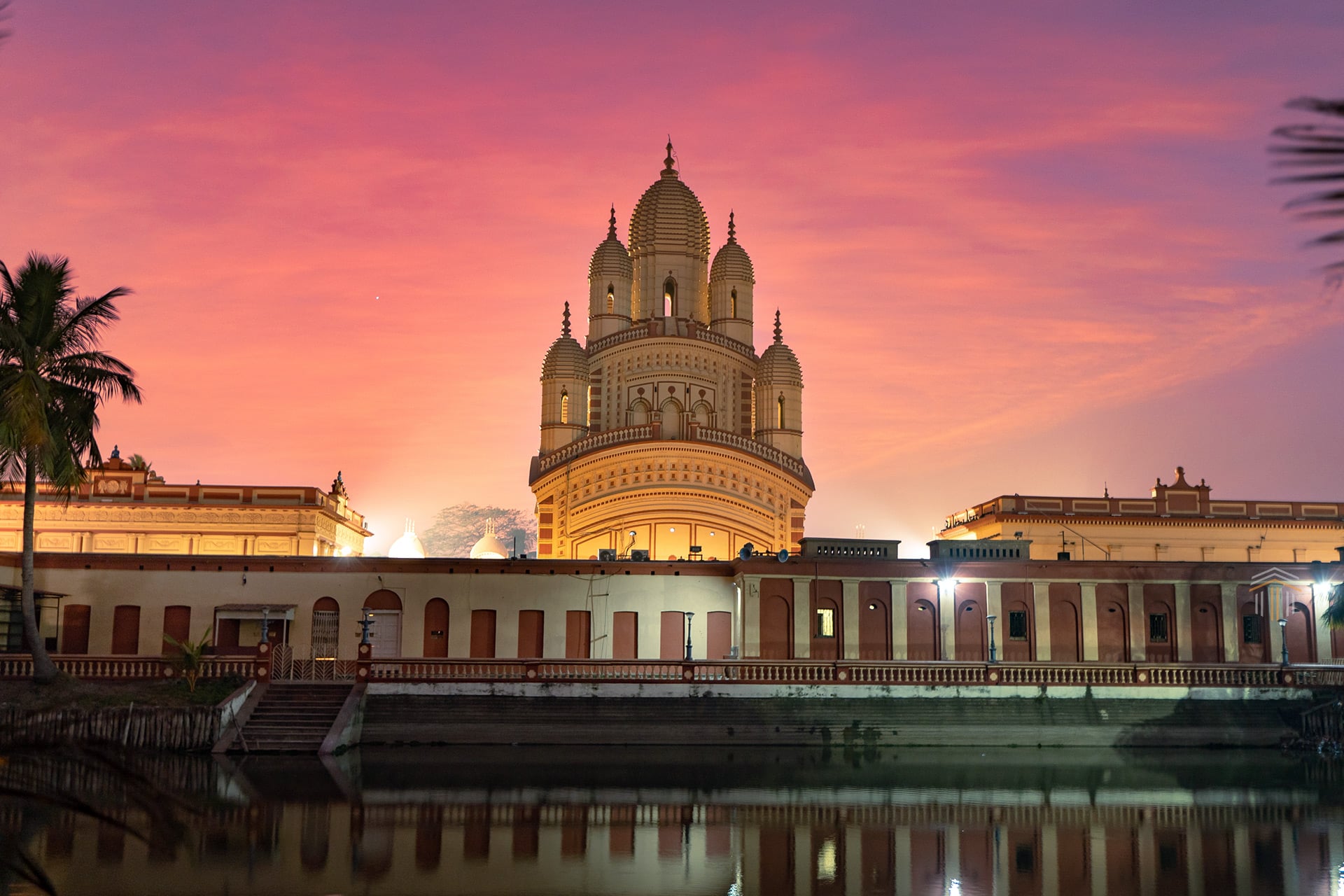
Dakshineswar Kali Temple is the riverside shrine of Maa Bhavatarini on the Hooghly, built by Rani Rashmoni and consecrated in 1855, and made famous by the life and teachings of Sri Ramakrishna.
- ReligionHindu
About the temple
About the temple
Dakshineswar Kali Temple is one of the most revered Kali temples in India, standing on the eastern bank of the Hooghly (Ganga) at Dakshineswar, on the northern edge of Kolkata. The temple is dedicated to Goddess Kali as Bhavatarini, 'she who liberates her devotees from the ocean of worldly existence'. It was built between 1847 and 1855 by Rani Rashmoni, the philanthropist zamindar of Janbazar, at a cost of about nine lakh rupees, and consecrated on 31 May 1855, the day of Snana Yatra. The temple is inseparable from Sri Ramakrishna Paramahamsa, who served as its priest from 1856 and lived in the temple garden for about thirty years, making Dakshineswar the cradle of a spiritual movement carried worldwide by Swami Vivekananda. Religion: Hindu Deity: Maa Bhavatarini (Sri Sri Jagadishwari Mahakali) Timings: Morning: 06:00 AM - 12:30 PM, Evening: 03:00 PM - 08:30 PM (October - March) / 03:30 PM - 09:00 PM (April - September) Seasonal: No
Dakshineswar Kali Temple
Dakshineswar Kali Temple
The Sacred Legacy of Dakshineswar Kali Temple in Numbers
Discover the history and devotion of Dakshineswar Kali Temple, the riverside shrine of Maa Bhavatarini built by Rani Rashmoni and made world-famous by Sri Ramakrishna. From its nine-spired temple to its twelve Shiva shrines, the complex connects more than 170 years of faith, art and spiritual heritage.
- Year the Goddess Was Installed, on Snana Yatra, 31 May
- 1855
- Time Taken to Build the Temple Complex (1847-1855)
- 8 years
- Approximate Cost of Construction in Rupees
- 9 lakh
- Area of the Temple Garden on the Hooghly
- 20 acres
- Spires (Ratnas) of the Navaratna Main Temple
- 9
- Approximate Height of the Main Temple
- 100 ft
- Shiva Temples Along the Riverfront
- 12
- Length of the Dakshineswar Skywalk, Opened in 2018
- 340 m
- Approximate Visitors per Year
- 1.4 crore
Year the Goddess Was Installed, on Snana Yatra, 31 May
Time Taken to Build the Temple Complex (1847-1855)
Approximate Cost of Construction in Rupees
Area of the Temple Garden on the Hooghly
Spires (Ratnas) of the Navaratna Main Temple
Approximate Height of the Main Temple
Shiva Temples Along the Riverfront
Length of the Dakshineswar Skywalk, Opened in 2018
Approximate Visitors per Year
Historical Background
Dakshineswar Kali Temple was founded by Rani Rashmoni, the widow of zamindar Babu Rajchandra Das of Janbazar, who is said to have been inspired by a dream in 1847 to build a temple to Kali beside the Ganga. She bought a 20-acre plot at Dakshineswar from John Hastie, and the temple complex was built over eight years at a cost of about nine lakh rupees. The Goddess, worshipped as Sri Sri Jagadishwari Mahakali and popularly as Bhavatarini, was installed on Snana Yatra, 31 May 1855, with Ramkumar Chattopadhyay as head priest. After his death in 1856, his younger brother Gadadhar, later Sri Ramakrishna Paramahamsa, became priest, and over the next three decades his spiritual practices and teachings drew disciples such as Swami Vivekananda; his conversations were later recorded in the Sri Sri Ramakrishna Kathamrita. Rani Rashmoni died on 19 February 1861, a day after endowing property in Dinajpur for the temple's upkeep. Her descendants have continued to manage the temple through the Dakshineswar Kali Temple and Debottar Estate, and the complex has been modernised with the Dakshineswar Skywalk (2018) and the Dakshineswar Metro Station (2021).
1847 CE
1847 CE
Rani Rashmoni, preparing for a pilgrimage to Kashi, is said to have been instructed in a dream to build a temple of Kali on the Ganga; arrangements for the temple began.1847-1855 CE
1847-1855 CE
A 20-acre plot, the Saheban Bagicha, was bought from John Hastie, and the temple complex was built over about eight years at a cost of about nine lakh rupees.31 May 1855 CE
31 May 1855 CE
The Goddess was installed on Snana Yatra (Jaishtha 1262 BS), with Ramkumar Chattopadhyay as head priest and more than one lakh guests invited.1856 CE
1856 CE
After Ramkumar's death, his younger brother Gadadhar (Sri Ramakrishna) became priest of the Kali temple.19 February 1861 CE
19 February 1861 CE
Rani Rashmoni died, a day after endowing her Dinajpur property for the temple's maintenance; her son-in-law Mathur Mohan Biswas continued to support Sri Ramakrishna.1861-1865 CE
1861-1865 CE
Sri Ramakrishna practised Tantric sadhana under the Bhairavi Brahmani (1861-1863), and was later initiated into sannyasa and Advaita Vedanta by Totapuri at the Panchavati (1864-1865).1872 CE
1872 CE
Sarada Devi came to Dakshineswar in March; on Phalaharini Kali Puja night, 5 June 1872, Sri Ramakrishna worshipped her as the Divine Mother (Shodashi Puja).1881-1882 CE
1881-1882 CE
Narendranath Datta (Swami Vivekananda) met Sri Ramakrishna in November 1881 and soon began visiting him at Dakshineswar.1885 CE
1885 CE
Sri Ramakrishna left Dakshineswar for treatment in Kolkata and moved to Cossipore on 11 December 1885; he passed away there on 16 August 1886.1902-1932 CE
1902-1932 CE
Mahendranath Gupta published the Sri Sri Ramakrishna Kathamrita in five volumes, recording conversations from 1882 to 1886, many held at Dakshineswar.5 November 2018 CE
5 November 2018 CE
The 340-metre Dakshineswar Skywalk opened, linking the railway station with the temple.22 February 2021 CE
22 February 2021 CE
Dakshineswar Metro Station opened as the northern terminus of the Blue Line, directly connected to the railway station and skywalk.


Synopsis
Dakshineswar Kali Temple in North 24 Parganas, West Bengal, on the northern edge of Kolkata, is the shrine of Goddess Kali as Bhavatarini, built by Rani Rashmoni and consecrated in 1855. Set in a 20-acre riverside garden, the complex includes the nine-spired navaratna Kali temple, twelve Shiva temples, the Radhakanta temple, the Nahabat and Sri Ramakrishna's room. Sri Ramakrishna lived here for about three decades, first as the temple's priest, and his disciples, including Swami Vivekananda, made Dakshineswar a centre of modern Hindu spirituality. A skywalk opened in 2018 now links the temple with Dakshineswar railway and metro stations.
Dakshineswar Kali Temple was built by Rani Rashmoni of Janbazar, a wealthy widow and philanthropist, who according to tradition was instructed in a dream in 1847 to build a temple of the Divine Mother on the banks of the Ganga instead of travelling to Kashi. She bought a 20-acre plot at Dakshineswar from an Englishman, John Hastie, and the complex was built over eight years at a cost of about nine lakh rupees.
The Goddess was installed on 31 May 1855, the day of Snana Yatra (Jaishtha 1262 BS), with Ramkumar Chattopadhyay as the first priest. The temple's later history is documented in detail in the Sri Sri Ramakrishna Kathamrita by Mahendranath Gupta ("M"), which records conversations from 1882 to 1886, and in biographies of Sri Ramakrishna, which describe the temple garden, its worship and daily life in the 1870s and 1880s.
Rani Rashmoni founded and endowed the temple, transferring her Dinajpur estate for its upkeep on 18 February 1861, the day before her death. Her son-in-law Mathur Mohan Biswas managed the temple and was a devoted patron of Sri Ramakrishna. The temple is administered today by the Dakshineswar Kali Temple and Debottar Estate.
The temple is one of the most important Kali shrines in Bengal and a major pilgrimage site of Shakti worship. Through Sri Ramakrishna, Sarada Devi and Swami Vivekananda, it is also the spiritual birthplace of the Ramakrishna movement, linking it closely with Belur Math across the river.
The temple complex is a heritage landmark of the Kolkata region and one of its most visited sites, drawing about 1.4 crore visitors a year and up to about 1 lakh a day on festivals. The Dakshineswar Skywalk (2018) and the metro station (2021) were built to ease access, and the complex is maintained by the Debottar Estate.
Sacred significance
Maa Bhavatarini - Liberator from Worldly Bondage
The presiding deity is Kali as Bhavatarini, "she who carries devotees across the ocean of worldly existence". The black stone image stands on the supine Shiva upon a silver thousand-petalled lotus, expressing the union of Shakti and Shiva, and devotees come to her for protection, courage and liberation.
The Seat of Sri Ramakrishna's Sadhana
Sri Ramakrishna served the Goddess here as priest and practised many spiritual disciplines in the temple garden, experiencing what he described as direct visions of the Divine Mother. For his followers, Dakshineswar is the place where his realisation and teachings took shape, making it one of the holiest sites of the Ramakrishna tradition.
Kali Puja and Shakti Worship
The temple is one of the foremost centres of Kali worship in Bengal. On Kali Puja, the new-moon night of Kartik, the Goddess is worshipped through the night with special rituals, lamps and offerings, drawing huge crowds of devotees.
"As Many Faiths, So Many Paths"
In the temple garden, especially at the Panchavati, Sri Ramakrishna followed Tantric, Vaishnava and Vedantic disciplines and also the paths of Islam and Christianity, teaching that all sincere paths lead to God. This message of harmony of religions, later spread by Swami Vivekananda, is closely tied to Dakshineswar.
Shakti, Shiva and Krishna in One Complex
The temple brings together the three great streams of Hindu worship: Shakta worship of Kali in the main temple, Shaiva worship in the twelve Shiva temples along the river, and Vaishnava worship of Radha and Krishna in the Radhakanta temple, making Dakshineswar a meeting place for devotees of all traditions.
Architecture
Dakshineswar Kali Temple is built in the Bengal navaratna ("nine-jewel") style, in which nine spires rise in two tiers above a square sanctum on a high platform. The main temple is about 14 metres square and rises more than 30 metres (about 100 feet). It faces south across a large paved courtyard with a spacious natmandir in front, and is flanked by the Radhakanta temple and a row of twelve identical Shiva temples along the riverfront. The 20-acre temple garden also includes a bathing ghat, two nahabats (music towers), Sri Ramakrishna's room, the Panchavati and Rani Rashmoni's kuthi, combining traditional Bengal temple forms with features of 19th-century riverside estates.
Layout
Layout of the Temple Garden
The main temples stand in a rectangular paved courtyard. The Kali temple faces south, the Radhakanta temple stands to its north facing the river, and the twelve Shiva temples line the western edge beside the Ganga, facing east, six on either side of the chandni (roofed terrace) above the bathing ghat.
Spire
Navaratna Shikharas
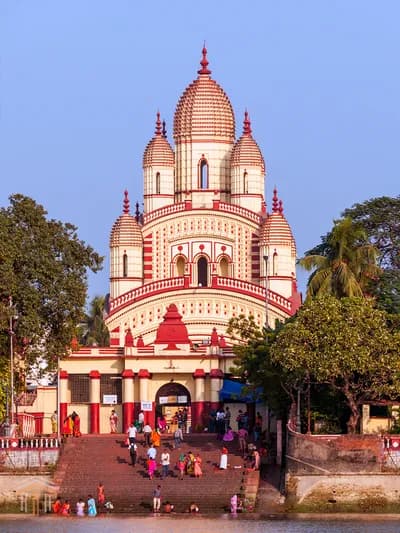
Nine spires crown the main temple, four at each corner of the lower and upper tiers and one at the centre, a hallmark of the Bengal navaratna style, making the temple a landmark visible from the river.
Sanctum
Garbha Griha of Bhavatarini
The sanctum houses the image of Kali as Bhavatarini, standing on the breast of the recumbent Shiva, both placed on a thousand-petalled silver lotus throne. Devotees take darshan from the doorway of the sanctum.
Natmandir
Natmandir (Pillared Hall)
A spacious pillared hall in front of the Kali temple, used for devotional music, performances and gatherings during festivals and Kali Puja. Devotees gather here to watch the aartis.
Shiva Temples
Twelve Aatchala Shiva Temples
Twelve identical Shiva temples built in the Bengal aatchala ("eight-roofed") style stand in a row along the river, facing east, six on each side of the chandni. Each houses a Shivalinga.
Vishnu Temple
Radhakanta Temple
A temple dedicated to Krishna as Radhakanta, with images of Krishna (about 21.5 inches) and Radha (about 16 inches). It stands north of the Kali temple and faces the river.
Nahabat
Nahabats (Music Towers)
Two nahabats (music towers) stand in the temple garden, from which music was played at sunrise, noon and sundown. The small ground-floor room of the northern Nahabat is where Sri Ramakrishna's mother and later Sri Sarada Devi lived.
Ghat
Bathing Ghat and Chandni
A wide flight of steps leads from the chandni down to the Hooghly, where devotees bathe before worship. Ferries to Belur Math and Uttarpara leave from the jetty nearby.
Heritage
Sri Ramakrishna's Room
The room at the north-west corner of the courtyard, just north of the twelve Shiva temples, with a semicircular verandah facing the river, where Sri Ramakrishna spent much of his life, preserves his beds and personal items and is open to visitors.
Interesting facts

Rani Rashmoni was about to set off for Kashi when, according to tradition, the Goddess told her in a dream to build a temple on the Ganga instead. She abandoned the journey and built Dakshineswar, giving Bengal its own riverside shrine to the Divine Mother.
Deities & Shrines
Twelve Shiva Temples (Dwadash Shiva)
Twelve identical aatchala temples along the riverfront, six on each side of the chandni, each enshrine a Shivalinga. Devotees offer water, milk and bel leaves to Shiva here, and the shrines are especially busy on Mondays and during Maha Shivaratri and the Shravan month.
Radhakanta (Radha-Krishna) Temple
North of the Kali temple, the Radhakanta temple enshrines Krishna and Radha. Sri Ramakrishna served as priest of this temple before becoming priest of the Kali temple, and devotees worship the divine couple for love, devotion and harmony.
Shiva beneath Bhavatarini
In the main sanctum, Shiva lies beneath the feet of Kali, representing pure consciousness on which the Divine Mother's power plays. Devotees honour both in a single darshan.
Sri Sarada Devi Shrine (Nahabat)
The small ground-floor room in the Nahabat where the Holy Mother lived is now a shrine dedicated to her. Devotees pray here for her blessings and grace.
Sri Ramakrishna's Room
Sri Ramakrishna's room, at the north-west corner of the courtyard, is revered as a shrine. Many devotees sit here in silent meditation.
Rani Rashmoni Shrine
A shrine honouring the temple's founder, Rani Rashmoni, stands in the complex. Pilgrims pay their respects to her for building the temple.
Panchavati and Sacred Trees
The grove of five sacred trees (banyan, peepal, neem, amalaki and bel) planted by Sri Ramakrishna, where he practised meditation and austerities, is a place of quiet pilgrimage. Devotees sit here in meditation and prayer.
Gazi Tala
Gazitala is a tree beside the path near the ghat, between the temple's main gate and the Kuthi. Its name recalls a Muslim pir (Gazi), a reminder of the site's older history, as part of the land was once a Muslim burial ground.
Darshan & Service Offerings
| Service | Timing | Price | Notes |
|---|---|---|---|
| Free Darshan | 6:00 AM - 12:30 PM and 3:00 PM - 8:30 PM (October - March) / 3:30 PM - 9:00 PM (April - September) | Free | Entry and darshan are free for all visitors. Devotees queue in the courtyard to see Maa Bhavatarini from the sanctum doorway; waiting times are short on quiet weekdays and can run to several hours on Tuesdays, Saturdays, Sundays and festivals. |
| Shiva and Radhakanta Darshan | General temple hours | Free | Devotees can visit the twelve Shiva temples along the river and the Radhakanta temple without a separate queue or ticket, offering water, flowers and bel leaves. |
| Puja Offerings (Dala) | General temple hours | Varies | Devotees commonly offer a dala (basket) of red hibiscus flowers, sweets, incense and sindoor to the Goddess. Puja baskets are sold by shops on the approach and the skywalk; buy from established shops and agree the price beforehand. |
| Mangala Aarti (Early-Morning Aarti) | 5:00 AM (October - March) / 4:00 AM (April - September) | No ticket listed | The first worship of the day, performed before general darshan begins. Access for devotees depends on the temple's arrangements; check with the temple office. |
| Bhog Aarti (Midday Aarti) | 12:00 PM | Free | Cooked bhog is offered to the Goddess, and devotees present in the courtyard can witness the aarti before the temple's afternoon closure. |
| Sandhya Aarti (Evening Aarti) | 6:30 PM (October - March) / 7:00 PM (April - September) | Free | The evening aarti with lamps, bells and conch shells is the most popular time for visitors. Arrive early to find a place in the natmandir. |
| Bhog Prasad Coupon | Book before 9:00 AM; bhog served around midday | About ₹50 per person (confirm current rate) | Devotees can purchase coupons at the temple counter to receive the Goddess's cooked bhog (anna prasad) after it is offered at noon. |
| Special Puja and Sankalpa | By arrangement with the temple office | As fixed by the temple | Devotees can arrange special puja, sankalpa or offerings in their name on birthdays, anniversaries and other occasions by contacting the temple office in advance. |
| Sri Ramakrishna's Room and the Nahabat | General temple hours | Free | Visitors can enter Sri Ramakrishna's room and see the Nahabat where Sri Sarada Devi lived. Silence is requested in both places. |
| Kali Puja Night Darshan | Through the new-moon night of Kartik (October - November) | Free | On Kali Puja, the temple stays open through the night for special worship of Maa Bhavatarini. Crowds are extremely large, with long queues from the evening; police and temple volunteers manage barricaded queues. |
| Foundation Day Worship (Snana Yatra) | On Snana Yatra (May - June) | Free | Special worship marks the anniversary of the temple's consecration on 31 May 1855. Devotees can take darshan and attend the celebrations. |
| Poila Baisakh (Bengali New Year) Puja | 14 - 15 April, from early morning | Free darshan; offerings vary | Traders and families come to worship the Goddess at the start of the Bengali year, often bringing new account books (halkhata) to be blessed. Expect long queues from before opening time. |
| Shiva Abhishek at the Twelve Temples | General temple hours | Free; offerings vary | Devotees pour water and milk and offer bel leaves at the twelve Shiva temples, especially on Mondays, during Shravan and on Maha Shivaratri. |
Visitor information
Location
Dakshineswar Kali Temple stands on the eastern bank of the Hooghly at Dakshineswar, North 24 Parganas, Kolkata 700076, West Bengal, India, at the eastern end of Vivekananda Setu (Bally Bridge).
Temple Opening Hours
The temple is generally open from 06:00 AM to 12:30 PM and from 03:00 PM to 08:30 PM between October and March, and from 06:00 AM to 12:30 PM and 03:30 PM to 09:00 PM between April and September. Timings change on festival days.
Darshan Arrangements
Darshan of Maa Bhavatarini is from the sanctum doorway in a single queue. Darshan pauses during the noon bhog and the afternoon closure.
Entry and Ticket Information
Entry is free for all visitors and there is no paid darshan. Bhog coupons and special pujas are available through temple counters.
Dakshineswar Skywalk
A 340-metre covered skywalk with escalators and lifts connects Dakshineswar railway station with the temple gate, avoiding the busy road below. The Dakshineswar metro station is connected to the railway station.
Dress and Attire
Modest, traditional clothing is expected. Avoid shorts, short skirts and revealing or sportswear clothing.
Security and Prohibited Items
Mobile phones, cameras, leather items such as belts and wallets, and large bags are not allowed inside the main temple courtyard. Photography inside the shrines is prohibited. Visitors pass through security checks at the entrance.
Locker and Shoe Facilities
Free lockers are available at the entrance for phones, cameras and bags, and shoe-deposit counters operate at the temple gates.
Temple Office
The temple office can be contacted at 033-2564-5222 for timings, puja arrangements and visitor queries.
Official Website
Information on the temple and its history is available on the official website, dakshineswarkalitemple.org.
Accessibility
The skywalk has lifts and escalators, and the courtyard is level, but the main temple stands on a raised platform with steps. Elderly visitors should visit on quieter weekday mornings.
Getting There
Dakshineswar railway station is connected to the temple by the skywalk, and the Dakshineswar metro station (Blue Line terminus) adjoins the railway station. Netaji Subhas Chandra Bose International Airport is about 12 km away, and ferries connect the temple jetty with Belur Math and Uttarpara.
Important Visitor Notice
Timings and arrangements change during Kali Puja, Snana Yatra, Poila Baisakh, eclipses and other occasions. Confirm the latest information with the temple office before travelling.
Location
North 24 Parganas, West Bengal, India
Best Time to Visit
Ideal Time to Visit (October-March)
The months from October to March bring cooler, drier weather to Kolkata, with the most pleasant days from November to February, when average temperatures range from about 14°C to 27°C. It is ideal for walking around the temple garden and the ghat, but it is also the festival season, so expect crowds on holidays.
Kali Puja (October-November)
Kali Puja, on the new-moon night of Kartik that coincides with Diwali, is the temple's biggest festival, with all-night worship and lights. It is spectacular but extremely crowded.
Snana Yatra (May-June)
The temple's foundation day is celebrated on Snana Yatra with special worship, marking the consecration on 31 May 1855.
Sri Ramakrishna Jayanti and Kalpataru Day
Sri Ramakrishna's birth anniversary (Phalgun Shukla Dwitiya, February-March) and Kalpataru Day (1 January) draw large numbers of devotees of the Ramakrishna movement to Dakshineswar and nearby Belur Math and Cossipore.
Tuesdays and Saturdays
These days are considered especially auspicious for Kali worship and draw more devotees, as do Sundays and public holidays.
Summer Visit (April-June)
Kolkata summers are hot and humid, with temperatures often above 35°C and sometimes over 40°C in May and June. Visit early in the morning, carry water and avoid the midday heat on the open courtyard.
Monsoon Visit (June-September)
Most of Kolkata's rain falls in these months, heaviest in July and August. Heavy rain can cause waterlogging and slippery ghat steps, and ferries may be suspended in rough weather. Plan flexibly and check local conditions.
Off-Peak Visit and Darshan Planning
For a quieter visit, arrive at opening time on a weekday morning, avoid public holidays, Poila Baisakh and the Durga Puja and Kali Puja season, and combine the visit with Belur Math by ferry.
Nearby places
Sri Ramakrishna's Room and the Panchavati
Within the temple garden
- The room at the north-west corner of the courtyard where Sri Ramakrishna spent much of his life, and the Panchavati, the grove of five sacred trees (banyan, peepal, neem, amalaki and bel) he planted and where he practised his spiritual disciplines.
Nahabat (Sri Sarada Devi's Room)
Within the temple garden
- The music tower whose small ground-floor room was home to the Holy Mother, now kept as a shrine dedicated to her.
Kuthi Bari
Within the temple garden
- The two-storey riverside house used by Rani Rashmoni's family when visiting the temple, where Sri Ramakrishna also stayed in his early years at Dakshineswar.
Festivals & culture
Dakshineswar Kali Temple follows a rich calendar of Shakti worship and Bengali festivals. Kali Puja is the temple's greatest festival, while Snana Yatra marks its foundation day and Phalaharini Kali Puja recalls Sri Ramakrishna's worship of Sri Sarada Devi. Observances linked to Sri Ramakrishna, along with Bengali New Year and Maha Shivaratri, draw large crowds. Festival dates follow the Bengali and Hindu lunar calendars and vary each year.
Kali Puja (Shyama Puja)
October-November (Kartik Amavasya; coincides with Diwali)
The temple's most important festival, with all-night worship of Maa Bhavatarini, special bhog, lamps and decorations. The temple stays open through the night and receives very large crowds.
Snana Yatra (Temple Foundation Day)
May-June (Jaishtha Purnima; varies)
The temple was consecrated on Snana Yatra, 31 May 1855, and the day is celebrated each year as its foundation day with special worship and offerings.
Additional information
Dakshineswar Kali Temple and Debottar Estate
The temple is administered by the Dakshineswar Kali Temple and Debottar Estate, the trust that has managed the temple and its endowment since the time of its founder, Rani Rashmoni.
Dakshineswar Kali Temple Address
Dakshineswar Kali Temple, Dakshineswar, Kolkata 700076, North 24 Parganas, West Bengal, India.
Temple Office
Phone: 033-2564-5222 - For inquiries about timings, puja arrangements and visitor services.
Official Website
Website: dakshineswarkalitemple.org.
Free Entry
There is no entry fee or paid darshan; bhog coupons and special pujas are booked at the temple counters.
Bhog Coupon Booking
Coupons for the noon bhog are sold at the temple counter in the morning, before about 09:00 AM, and are listed at about ₹50 per person.
Items Not Allowed
Mobile phones, cameras, leather items and large bags are not allowed in the main courtyard; lockers and shoe counters are available at the entrance.
Dakshineswar Skywalk
A 340-metre covered skywalk with escalators, lifts and vendor stalls connects Dakshineswar railway station with the temple gate; the Dakshineswar metro station adjoins the railway station.
Ferry to Belur Math
Ferries from the Maa Bhabatarini jetty near the temple connect Dakshineswar with Belur Math and Uttarpara, subject to weather and river conditions.
Important Visitor Advisory
Verify timings, bhog availability, festival arrangements and parking immediately before travel, and use only official temple counters for bookings and donations.
Temple facilities
Temple Office
The temple office assists with puja arrangements, bhog coupons and visitor queries. Contact 033-2564-5222.
Lockers
Free lockers at the entrance hold phones, cameras, leather items and bags, which are not allowed inside the main courtyard.
Shoe-Deposit Counters
Shoe-deposit counters operate at the entrance, as footwear is not allowed in the temple premises.
Dakshineswar Skywalk
A 340-metre, 10.5-metre-wide covered skywalk with 14 escalators, 4 lifts and 137 stalls connects Dakshineswar railway station with the temple; the metro station adjoins the railway station.
Lifts and Escalators
Lifts and escalators on the skywalk ease access for elderly and differently-abled visitors, although the main temple has steps to the sanctum.
Bhog Coupon Counter
Coupons for the Goddess's cooked bhog are sold at the temple counter in the morning, before about 09:00 AM.
Toilets and Drinking Water
Toilets and drinking water are available for visitors in the temple area; ask temple staff for directions.
Bathing Ghat and Ferry Jetty
The riverside ghat allows devotees to bathe in the Ganga, and the nearby Maa Bhabatarini jetty offers ferries to Belur Math and Uttarpara.
Security and Crowd Management
Security checks at the gates and managed queues help control crowds, with additional police and volunteers on Kali Puja, Poila Baisakh and other festival days.
Puja and Prasad Shops
Shops on the approach and the skywalk sell puja baskets, flowers, sweets, photographs and devotional items.
Emergency services
India Emergency Response
Not location-specific
Contact
112
- Call 112 for urgent police, medical (ambulance) or fire assistance through India's integrated emergency response system.
Top picks
Kochuri and Aloo Torkari
Hot fried kochuri served with spiced potato curry, a classic Bengali breakfast sold fresh from early morning at stalls on Rani Rashmoni Road and the temple approach.
Luchi and Cholar Dal
Soft, puffed fried luchi with mildly sweet Bengal gram dal cooked with coconut, a festive Bengali favourite served at eateries around Dakshineswar and Baranagar.
Visitor guide
Netaji Subhas Chandra Bose International Airport (CCU)
Approximately 12 km
- Kolkata's airport, with domestic and international connections. Taxis and app-based cabs reach the temple in about 30-45 minutes depending on traffic.
Gallery
Videos
Third-party videos may include ads or external commentary.
Frequently Asked Questions
It stands on the eastern bank of the Hooghly at Dakshineswar, North 24 Parganas, on the northern edge of Kolkata, West Bengal.
Goddess Kali as Bhavatarini, "she who liberates her devotees from the ocean of worldly existence".
Rani Rashmoni of Janbazar built the temple between 1847 and 1855.
On 31 May 1855, the day of Snana Yatra.
Sri Ramakrishna served as priest here from 1856 and lived in the temple garden for about thirty years; his room is preserved.
Generally 06:00 AM-12:30 PM and 03:00 PM-08:30 PM (October-March), and 06:00 AM-12:30 PM and 03:30 PM-09:00 PM (April-September). Timings change on special days.
No. Entry and darshan are free for all visitors.
No. Phones, cameras, leather items and large bags are not allowed in the main courtyard; lockers are available.
Modest, traditional clothing is expected; avoid shorts and revealing clothes.
Buy a bhog coupon at the temple counter in the morning, usually before about 09:00-10:00 AM.
By Kolkata Metro (Blue Line) or local train to Dakshineswar, both linked to the temple by a skywalk, or by ferry from Belur Math.
About 20 minutes by ferry across the Hooghly, or about 5 km by road.
Kali Puja, Snana Yatra (foundation day), Phalaharini Kali Puja, Sri Ramakrishna Jayanti and Poila Baisakh.
Contact the temple office at 033-2564-5222 or check dakshineswarkalitemple.org, especially before festivals.