

1°C
Rudraprayag
Tungnath Temple
 Rudraprayag, Uttarakhand, India
Tungnath Temple, located in the Rudraprayag district of Uttarakhand in the Garhwal Himalayas, is the Tritiya (third) Kedar of the Panch Kedar. Its name means "Lord of the Peaks." At an altitude of about 3,680 m (12,073 ft), it is the highest of the five Panch Kedar temples and is widely regarded as one of the highest Shiva temples in the world.
- ReligionHindu
- DeityLord Shiva (as Tungnath)
- TimingsVaries by season and temple schedule
About the temple
About the temple
Shri Tungnath Mahadev Temple is one of the most revered Shiva shrines of the Himalayas and the third (Tritiya) of the five Panch Kedar temples. It stands at about 3,680 m (12,073 ft) on the Chandranath mountain above Chopta in the Rudraprayag district of Uttarakhand. It is the highest of the Panch Kedar and is widely regarded as one of the highest Shiva temples in the world. According to tradition, Shiva took the form of a bull to avoid the Pandavas and vanished into the earth at Guptkashi. His body parts then reappeared at five places, and at Tungnath his arms (bahu) are worshipped. The Pandavas are said to have built a shrine here. The stone temple is believed to be around 1,000 years old. It is reached by a stone-paved trek of about 3.5 km from Chopta. The temple stays open for roughly six months a year, from late April or early May until early November, shortly after Diwali. The dates are fixed each year by the Badri-Kedar Temple Committee. In winter, Lord Tungnath is worshipped at his winter seat, the Markateshwar Temple in Makkumath.
Tungnath Temple
Tungnath Temple
The Sacred Legacy of Shri Tungnath Mahadev Temple in Numbers
Discover the sacred history and Himalayan setting of Shri Tungnath Mahadev Temple, the Tritiya Kedar and one of the highest Shiva temples in the world. Located above Chopta in Rudraprayag district, the temple is a centre of Panch Kedar pilgrimage, connecting ancient legend, seasonal ritual and mountain devotion.
- Approximate Elevation of the Temple (12,073 ft), Making It the Highest of the Panch Kedar
- 3680 m
- Tritiya (Third) Kedar in the Panch Kedar Pilgrimage
- 3 of 5
- Traditionally Believed Age of the Temple
- About1000 Years
- Approximate Trek Distance from Chopta to the Temple
- About3.5 km
- Approximate Length of the Annual Opening Season
- About6 Months
- Pilgrims Reported by BKTC for the 2025 Season
- 1.5 Lakh+
- Kapat Opening Date for the 2026 Season
- 22 April 2026
- Tilt of the Main Temple Reported by the ASI in 2023 (Smaller Structures About 10 Degrees)
- 5-6 Degrees
Approximate Elevation of the Temple (12,073 ft), Making It the Highest of the Panch Kedar
Tritiya (Third) Kedar in the Panch Kedar Pilgrimage
Traditionally Believed Age of the Temple
Approximate Trek Distance from Chopta to the Temple
Approximate Length of the Annual Opening Season
Pilgrims Reported by BKTC for the 2025 Season
Kapat Opening Date for the 2026 Season
Tilt of the Main Temple Reported by the ASI in 2023 (Smaller Structures About 10 Degrees)
Historical Background
Shri Tungnath Mahadev Temple in Rudraprayag district, Uttarakhand, is an ancient Himalayan Shiva shrine and the third of the Panch Kedar temples. Tradition links its origin to the Pandavas after the Mahabharata war. The temple is believed to be around 1,000 years old, although its exact construction date is unknown. Its stone construction belongs to the North Indian Himalayan (Katyuri) style, which it shares with Kedarnath and Madhyamaheshwar. Adi Shankaracharya is credited with the tradition of a local priest here, unlike the South Indian priests at the other Kedar temples. The Maithani Brahmins of Makkumath are said to serve as priests. The shrine follows a seasonal cycle, and the deity is moved to Makkumath each winter. Today the temple is managed by the Shri Badarinath Kedarnath Temple Committee (BKTC), constituted under the 1939 Act. In 2023, an Archaeological Survey of India study reported that the main temple was tilting by about five to six degrees, with smaller structures in the complex tilting by about ten degrees, and recommended protection as a monument. The Centre has since designated it a Monument of National Importance, and conservation work is under way. The BKTC and local stakeholders had earlier objected to the ASI's proposal.
Traditional (Mahabharata era)
Traditional (Mahabharata era)
The Pandavas are believed to have built the Panch Kedar shrines, including Tungnath, after the Kurukshetra war to worship Shiva and seek forgiveness. This is religious tradition and cannot be dated historically.8th century (traditional date of Adi Shankara)
8th century (traditional date of Adi Shankara)
Adi Shankaracharya is credited with the tradition that Tungnath's priest is a local Brahmin, unlike the South Indian priests at other Kedar temples. Some popular sources also say he discovered or revived the temple, which could not be confirmed in reliable references.Katyuri period
Katyuri period
The temple's North Indian Himalayan (Katyuri) stone style is shared with Kedarnath and Madhyamaheshwar. Popular and news sources describe it as built in the 8th century, but its exact construction date is unknown. It is commonly said to be around 1,000 years old.Medieval to early modern period
Medieval to early modern period
Tungnath continues as a seasonal Himalayan pilgrimage shrine. The Maithani Brahmins of Makkumath are said to serve as priests, and worship moves to Makkumath each winter.1939
1939
The Shri Badarinath Kedarnath Temple Committee (BKTC) is constituted under a state Act. Tungnath is among the temples it manages today.1972
1972
The Kedarnath Wildlife (Musk Deer) Sanctuary is established in the region around Chopta and Tungnath.16 September 1997
16 September 1997
Rudraprayag district is formed from parts of Chamoli, Tehri and Pauri districts. The Chopta-Ukhimath area comes under it.9 November 2000
9 November 2000
Uttarakhand (then Uttaranchal) becomes a separate state.2023
2023
An Archaeological Survey of India study reports that the main temple is tilting by about 5-6 degrees and smaller structures by about 10 degrees. It recommends monument protection. The BKTC and local stakeholders object to the proposal, and the process of declaring the temple a monument of national importance begins.2025
2025
The temple opens on 2 May. It closes for winter on 6 November, when the BKTC president reports over 1.5 lakh pilgrims for the season. The doli leaves for Makkumath.2026
2026
The opening date is announced on Baisakhi. Most sources report 22 April, with the doli reaching Chopta on 21 April, though some trek sites say 2 May. The Centre has designated the temple a Monument of National Importance, and CBRI Roorkee has taken charge of conservation. The closing date is tentatively early November.


Synopsis
Shri Tungnath Mahadev Temple, near Chopta in Rudraprayag district, Uttarakhand, is the Tritiya (third) Kedar of the Panch Kedar and one of the highest Shiva temples in the world, at about 3,680 m (12,073 ft). Tradition holds that Shiva's arms (bahu) appeared here, and the temple is associated with the Pandavas, who are said to have built it. It is also linked to Adi Shankaracharya through the tradition of a local priest instead of a South Indian one. Built in the North Indian Himalayan (Katyuri) stone style, the temple is managed by the Shri Badarinath Kedarnath Temple Committee and is traditionally served by local Maithani Brahmin priests associated with Makkumath. The shrine opens seasonally. It is reached by a stone-paved trek of about 3.5–4 km from Chopta, which many pilgrims continue another 1.5 km to Chandrashila peak.
Shri Tungnath Mahadev Temple, dedicated to Lord Shiva as Tungnath ("Lord of the Peaks"), is the third (Tritiya) of the five Panch Kedar shrines. It stands at about 3,680 m on the Chandranath mountain in Rudraprayag district, Uttarakhand. Tradition traces its origin to the Pandavas, who are believed to have built the shrine where Shiva's arms appeared. The temple is believed to be around 1,000 years old, although its exact construction date is unknown.
Much of Tungnath's history is preserved in Panch Kedar tradition, the Kedara Khanda tradition associated with the Skanda Purana, and local accounts. Modern records come from the Shri Badarinath Kedarnath Temple Committee (BKTC), which announces the annual opening and closing dates, and from studies such as the 2023 Archaeological Survey of India assessment of the temple's structure.
Tradition credits the Pandavas with founding the shrine, and some accounts name Arjuna. Adi Shankaracharya is credited with the tradition of a local priest at Tungnath, unlike the South Indian priests of the other Kedar temples. The Maithani Brahmins of Makkumath village are said to serve as its priests. The BKTC, constituted in 1939, manages the temple today and announces its opening and closing dates.
As the Tritiya Kedar, Tungnath is an essential stop on the Panch Kedar pilgrimage. In the numbering of the five Kedars, Kedarnath is first, Madhyamaheshwar second, Tungnath third, Rudranath fourth and Kalpeshwar fifth. The usual trekking route from Rishikesh, however, visits them in the order Kedarnath, Tungnath, Rudranath, Madhyamaheshwar and Kalpeshwar. Its altitude, its association with Shiva's arms and its setting just below Chandrashila give it a unique place in Shaiva worship in the Himalayas.
In 2023 the Archaeological Survey of India reported that the main temple was tilting by about five to six degrees and smaller structures in the complex by about ten degrees. The ASI fixed glass scales to monitor movement and recommended monument protection. The BKTC and local stakeholders initially objected to the proposal. The central government has since designated the temple a Monument of National Importance, and conservation work is under way. According to trek and travel sources, the temple lies in the Kedarnath Wildlife Sanctuary area.
Sacred significance
Tritiya Kedar - Where Shiva's Arms Appeared
Tungnath is revered as the third (Tritiya) of the five Panch Kedar shrines. According to tradition, Shiva took the form of a bull to avoid the Pandavas and disappeared into the earth near Guptkashi. His body then reappeared in five parts, and at Tungnath his arms (bahu) are worshipped. The shrine is one of the five that make up the Panch Kedar pilgrimage.
One of the Highest Shiva Temples in the World
At about 3,680 m (12,073 ft), Tungnath is the highest of the five Panch Kedar temples and is widely described as one of the highest Shiva temples in the world, sometimes as the highest. Its setting among the high peaks draws pilgrims who wish to worship Shiva in the mountains he is believed to inhabit.
Atonement and Liberation from Sin
According to the Panch Kedar legend, the Pandavas sought Shiva's forgiveness for the deaths of their kin and of Brahmins in the Kurukshetra war. Tungnath is associated with this story of atonement and with Shiva's blessing.
The Panch Kedar Pilgrimage
In the numbering of the five Kedars, Kedarnath is first, Madhyamaheshwar second, Tungnath third, Rudranath fourth and Kalpeshwar fifth. The usual trekking route from Rishikesh visits them in the order Kedarnath, Tungnath, Rudranath, Madhyamaheshwar and Kalpeshwar. Pilgrims undertake the circuit of all five shrines as part of the Shaiva tradition of Uttarakhand.
Lord of the Peaks
The name Tungnath is commonly explained as Lord of the Peaks. The temple stands on the ridge that divides the Mandakini and Alaknanda valleys, just below Chandrashila. Hindu tradition holds that Shiva and Parvati, the Daughter of the Mountain, reside in the Himalayas.
Chandrashila and Lord Rama's Penance
According to tradition, Lord Rama meditated on the Chandrashila peak above the temple to seek release from the sin of killing Ravana, a Brahmin. A small shrine known as Chandra Shila stands above Tungnath, and many pilgrims and trekkers continue from the temple to the summit.
Adi Shankaracharya and the Priestly Tradition
The 8th-century teacher Adi Shankaracharya is credited with the tradition that Tungnath's priest is a local Brahmin, unlike the South Indian priests of the other Kedar temples. Tourism and travel sources also describe an image of Adi Shankaracharya in the temple.
Shiva and Parvati in the Himalayas
Himalayan tradition holds that Shiva and Parvati make their home among these peaks. A shrine to Goddess Parvati stands among the smaller shrines of the Tungnath complex.
Architecture
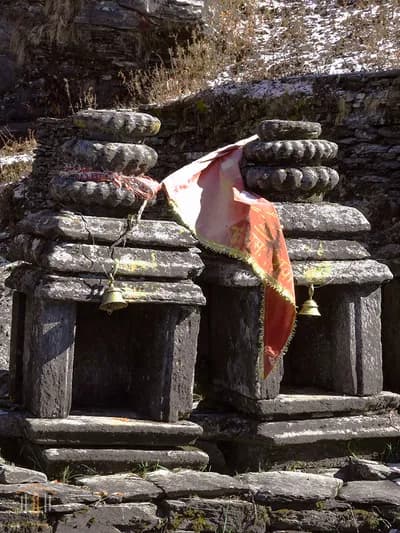
Tungnath Temple is built in the North Indian Himalayan style, often called the Katyuri style, which Kedarnath and Madhyamaheshwar share. It is a small stone temple with stone slab roofs, and the sanctum can barely hold ten people. About a dozen small shrines of various gods surround it, including one dedicated to Goddess Parvati. The stone structures carry decorations painted on the outside that depict tall towers.
Layout
Layout
The temple stands at about 3,680 m, just below Chandrashila peak. The sanctum abuts the hillside, and the pilgrim path from Chopta leads to the temple entrance. The entrance has a richly decorated arch with "Tungnath" painted on top.
Spire
Shikhara (Tower)
The tower follows the North Indian Himalayan (Nagara/Katyuri) tradition. The exterior has painted decoration depicting tall towers, typical of the region's temple style.
Sanctum
Garbha Griha (Sanctum Sanctorum)
The sanctum holds a standing black rock about 1 ft (0.3 m) high. It is worshipped as the self-manifested Shiva linga, representing Shiva's arms. Ashtadhatu (eight-metal) idols of sage Vyas and Kala Bhairav are also installed here, along with images of the Pandavas and silver plaques of the other four Kedar shrines. The chamber can hold about ten people at a time.
Mandapa
Roof
The temple roofs are made of stone slabs. This is a practical construction for a site that is snowbound for about six months each year.
Nandi
Nandi Facing the Sanctum
A stone image of Nandi, Shiva's vehicle, stands at the entrance facing the sanctum.
Shrines
Subsidiary Shrines
About a dozen small shrines of several gods surround the main temple. One is dedicated to Goddess Parvati. An image of Lord Ganesha stands to the right of the entrance.
Materials
Stone Craftsmanship
The temple is built mainly of local stone, including its slab roofs. The austere, heavy construction suits the harsh climate at 3,680 m.
Conservation
Structural Monitoring
A 2023 Archaeological Survey of India (ASI) study found the main temple tilting by about five to six degrees and smaller structures in the complex by about ten degrees. The ASI fixed glass scales on the main temple walls to monitor movement. It said it would identify the cause and prepare a detailed work programme after inspection, and it suggested protected-monument status. Officials did not rule out subsidence.
Interesting facts

At about 3,680 m (12,073 ft), Tungnath is widely described as the highest Shiva temple in the world, and it is the highest of the five Panch Kedar temples. It sits just below Chandrashila peak, and the final approach from Chopta is on foot only.
Deities & Shrines
Goddess Parvati
Among the small shrines around the main temple, the central one is dedicated to Goddess Parvati, Shiva's consort. In Hindu tradition she is also called Shailaputri, "Daughter of the Mountain", because she is said to reside in the Himalayas.
Lord Ganesha
An image of Lord Ganesha stands to the right of the temple entrance. In Hindu tradition he is invoked as the remover of obstacles.
Nandi
A stone image of Nandi, the bull and vehicle of Lord Shiva, stands at the entrance facing the sanctum. In the Panch Kedar legend, Shiva took the form of a bull to hide from the Pandavas.
Kala Bhairav
An ashtadhatu (eight-metal) idol of Kala Bhairav, described as a fierce form of Shiva or his attendant, is installed in the sanctum. Several sources list him alongside sage Vyas as a disciple of Shiva.
Sage Vyas
An ashtadhatu idol of sage Vyas is installed in the sanctum. One source says the Pandavas built the Panch Kedar temples on his advice.
Adi Shankaracharya
An image of Adi Shankaracharya is listed among the idols in the sanctum. He is credited with discovering and reviving the temple in the 8th century, and with setting the tradition of a local priest at Tungnath.
The Five Pandavas
Images of the Pandavas are kept within the temple. By legend they built the Panch Kedar shrines, and some accounts credit Arjuna in particular with laying the foundation of Tungnath.
The Other Four Kedars
Silver plaques representing the other four Kedar shrines (Kedarnath, Rudranath, Madhyamaheshwar and Kalpeshwar) are kept in the temple.
Shiva's Disciples
Sources describe images of Shiva's disciples and attendants in the sanctum, including Vyas and Kala Bhairav. I could not find a detailed list of the other figures.
Darshan & Service Offerings
| Service | Timing | Price | Notes |
|---|---|---|---|
| General Darshan (Free Darshan) | During temple opening hours, subject to the aarti schedule and the commonly published afternoon break | Free | General darshan of Lord Tungnath has no mandatory entry fee. The sanctum is small and holds only about ten people at a time. The busiest hours are generally 9:00 AM to 1:00 PM, when most trekkers arrive, and early morning is quieter. |
| Morning Aarti Darshan | Around 6:00 AM - 7:00 AM (some sources give 6:30 AM start) | Free to attend (no fee reported) | Devotees who reach the temple early can attend the morning aarti performed by the temple priests. Many start the trek from Chopta before dawn to reach it, which also gives a quieter darshan before most trekkers arrive. |
| Evening Aarti Darshan | Around 6:30 PM - 7:00 PM | Free to attend (no fee reported) | The evening aarti is held before the temple closes at about 7:00 PM. Descending the trail after dark is risky, so plan your stay in advance (many pilgrims base themselves at Chopta) and ask locally about options near the temple. |
| Rudrabhishek and Abhishek Pooja | Not published; ask the temple priests | Not published; confirm with the temple priests | Abhishek is the ritual bathing of the Shiva linga with chanting. I found no published schedule, rate list or booking process for abhishek at Tungnath, so confirm availability and any dakshina with the local priests. |
| Personal Pooja and Archana | During temple opening hours | Offering-based; confirm locally | Devotees can make offerings and request an archana or sankalp through the temple priests. I found no published details on the services offered or their rates, so confirm locally. |
| Kapat Opening Ceremony Darshan | Annual opening day (22 April in 2026) | Free | Lord Tungnath's utsav doli leaves Makkumath on the days before opening. In 2026 it left on 20 April, stayed at Bhootnath Temple, reached Chopta on 21 April, and arrived at the temple on 22 April. The doors opened at about 11:00 AM, with devotees from India and abroad attending. Plan accommodation ahead. |
| Kapat Closing Ceremony Darshan | Annual closing day (expected around early November, after Diwali) | Free | On closing day, a havan puja is held, the self-manifested Shivling is ceremonially placed in samadhi, and the portals are closed (at 11:30 AM in 2025). The deity's palanquin then travels to its winter seat at Makkumath. Exact dates are announced by BKTC, and the weather is cold, so carry heavy woollens. |
| Winter Darshan at Makkumath | November - April, while the main temple is closed | Free | During winter, Lord Tungnath is worshipped at the Markandeya (Markandeshwar) temple in Makkumath village, a lower village on the Ukhimath side of Chopta. This allows worship to continue while the high temple is snowbound. |
| Pony-Assisted Pilgrimage | Daytime during the season | Rates are reportedly fixed by the local administration each season; check the posted rate boards at the starting point | Elderly devotees and those who cannot walk the full trail can hire ponies (and palanquins) at Chopta in season. Ponies carry people, not large suitcases or duffel bags. I found no published 2026 rate list for the Tungnath route. |
| Online Pooja and Donation (BKTC) | As available on the BKTC portal | As listed on the portal | BKTC's portal at badrinath-kedarnath.gov.in offers online registration, pooja booking and donations. Prior registration is mandatory, using a working mobile number and email ID verified by OTP. The services I could confirm are for Badrinath and Kedarnath, so check whether Tungnath-specific services are listed before booking. |
Visitor information
Location
Shri Tungnath Mahadev Temple stands on the Chandranath mountain above Chopta, in Rudraprayag district, Uttarakhand, at about 3,680 m. It lies just below Chandrashila peak, within the Kedarnath Wildlife Sanctuary.
Temple Opening Hours
During the season, the temple is commonly open from about 6:00 AM to 7:00 PM, with an afternoon break from about 12:00 PM to 3:00 PM that some sources list and others do not. I found no official timetable, so confirm locally. Timings can change with weather and on the opening and closing days.
Opening Season
The temple opens in late April or early May and closes in early November, after Diwali. In 2026, the doors opened on 22 April. The opening date is announced around Baisakhi in the presence of the Tungnath priest and the temple committee, and the closing date is announced closer to the end of the season.
Entry Information
There is no mandatory entry fee for general darshan. For abhishek or personal poojas, ask the temple priests about availability and any dakshina, as I found no published rates.
Trek from Chopta
The temple is reached by a stone-paved trek of about 3.5 km from Chopta (some sources say up to 4 or 5 km), rising from about 2,900 m to 3,680 m. Most visitors take roughly 2 to 4 hours to climb and about 2 hours to descend. There are benches and a few tea stalls along the way.
Chandrashila Extension
Chandrashila summit is about 1 to 1.5 km beyond the temple on a steep trail (some sources say up to 2 km). Start early if you plan to continue, and avoid the summit in poor weather.
Weather
Days are cool even in summer, and temperatures can drop below freezing at night early and late in the season. The monsoon (June to September) brings rain, slippery trails and low visibility. Tungnath and Chandrashila are snow-covered from December to March.
High-Altitude Visit
Walk at a steady pace, take breaks and drink water. Watch for headache, nausea or breathlessness, and descend if symptoms worsen.
Dress and Attire
I found no official dress code. Modest clothing is appropriate for a temple. Wear warm layers and sturdy trekking shoes, and carry rain protection.
Ponies and Assistance
Ponies and palanquins are available at Chopta in season for devotees who cannot walk the full distance. Rates are reportedly fixed by the local administration each season, so check the posted rate boards before starting.
Mobile Network and ATMs
Mobile network is patchy around Chopta and Tungnath, and BSNL is reported to work best. There are no ATMs in Chopta or on the trail. The nearest ATMs are in Ukhimath and Rudraprayag, so carry enough cash, since UPI and cards often fail.
Temple Committee Enquiry
BKTC's official help-desk page lists +91 7302257116 for office-related enquiries and 0135-2741600 for general enquiries and online prasad services. Both are the BKTC head office in Dehradun, not a Tungnath-specific line.
Check Before Travel
Landslides, road closures and snowfall can affect access to Chopta. Check the latest updates from BKTC and the Rudraprayag district administration before setting out.
Location
Rudraprayag, Uttarakhand, India
Best Time to Visit
Ideal Time to Visit (May-June)
May and June are the most popular months for Tungnath, with pleasant days, cool nights and clear, open trails. This is also the peak season, so expect crowds on weekends and holidays and book accommodation early.
Clear Views (September-October)
After the monsoon, skies are often at their clearest and the meadows are green, giving good views of the Himalayan peaks from Tungnath and Chandrashila. Early to mid-September is usually quieter, while crowds build up again by October.
Kapat Opening (April-May)
The opening date is announced each year and varies. The arrival of Lord Tungnath's doli brings devotees and special worship. Snow may still lie on parts of the trail at this time, so carry warm clothing.
Shravan Month (roughly late July-August)
Shravan is sacred to Lord Shiva, and devotees come for jalabhishek, especially on Mondays. Exact dates vary by calendar. It falls in the monsoon, so plan extra time for road delays.
Monsoon Caution (July-September)
Heavy rain, fog and landslides can affect the roads to Chopta and the trail, especially near Rudraprayag and Karnaprayag. Check weather forecasts and road updates before travel and avoid the trek during heavy rain.
Kapat Closing (early November)
The closing date is announced at Vijayadashami and has fallen in early November in recent years. The closing ceremony and the doli's departure for Makkumath are special occasions for devotees. Temperatures are very low by then, so carry warm clothing.
Winter (November-March)
The temple is closed and the area is covered in snow, and the road to Chopta can close after heavy snowfall. Snow treks to Tungnath and Chandrashila are popular but suit experienced trekkers with snow gear and a guide. Devotees can have darshan at the winter seat, the Markandeshwar (Markateshwar) Temple in Makkumath.
Rhododendron Bloom (March-April)
The forests around Chopta bloom in red and pink in spring, with the peak usually from mid-March to mid-April. The temple stays closed through March and usually until late April or May, so check the opening date if darshan is your goal.
Best Time of Day
Early morning offers quieter darshan, clearer mountain views and more time for the descent. Allow roughly 2 to 4 hours for the climb from Chopta, and start early in the morning. Confirm temple timings before you go.
Nearby places
Chandrashila Peak
About 1-1.5 km above the temple
- A steep climb to the summit (about 4,000 m), associated with Lord Rama's meditation and a "moon rock" legend. On a clear day it offers panoramic views of Nanda Devi, Trishul, Chaukhamba, Kedarnath and other peaks.
Festivals & culture
Shri Tungnath Mahadev Temple follows a seasonal calendar of Shaiva worship shaped by the Himalayan climate. The main occasions at the temple itself are the kapat opening with the arrival of the utsav doli, the Shravan month and the kapat closing. Maha Shivaratri falls during the winter closure, when worship is held at the winter seat in Makkumath. Festival dates follow the Hindu lunar calendar and vary each year, so confirm them with BKTC or at the temple.
Kapat Opening and Utsav Doli Arrival
April-May (22 April in 2026)
Lord Tungnath's utsav doli leaves the Markandeshwar (Markateshwar) temple at Makkumath a couple of days before opening and is carried in procession, with halts along the way, to the temple. In 2026 the doli left Makkumath on 20 April, set out from Chopta at 8 AM on 22 April, and the doors opened at about 11 AM for the first darshan of the season.
Kapat Closing Ceremony
Early November (date announced at Vijayadashami)
A yagna-havan is held at the temple the day before closing. On closing day the temple opens in the early morning for puja and darshan. From about 10 AM the sanctum rites begin, the self-manifested linga is covered with local flowers and ash into its winter (samadhi) form, and the doors are closed at about 11 AM. The doli then leaves in procession with dhol and damau, halting at Chopta and Bhankun before reaching Makkumath about three days later.
Additional information
Shri Badarinath Kedarnath Temple Committee (BKTC)
The temple is administered by BKTC, a corporate body of the Uttarakhand government constituted under the 1939 Act. BKTC also manages Badrinath, Kedarnath and 45 other temples in Uttarakhand.
BKTC Office Address
Shri Badarinath Kedarnath Temple Committee, Saket, Lane No. 7, Canal Road, Dehradun, Uttarakhand - 248001, India. Email: ceo.bktcddn@gmail.com.
BKTC General Enquiry
Phone: 0135-2741600 - for general enquiries and online prasad services. Confirm by phone before relying on the number.
BKTC Office Enquiries
Phone: +91-7302257116 - for office-related enquiries.
Official Portal
badrinath-kedarnath.gov.in - for announcements, pooja booking and donations. Pooja booking requires prior registration with an Indian mobile number. Pilgrim yatra registration is on a separate state portal (registrationandtouristcare.uk.gov.in), so check whether it applies to your visit.
Temple Priests
Worship is performed by the local Maithani Brahmins of Makkumath village, the traditional priests of Tungnath.
Winter Seat
From early November until the temple reopens in spring (22 April in 2026), Lord Tungnath is worshipped at the Markandeshwar (Markateshwar) temple in Makkumath village, reachable by road.
2026 Season
The temple opened on 22 April 2026. The closing date is decided each year at Vijayadashami by the priests and the committee at Makkumath, and it has usually fallen in early November in recent years. Confirm the date with BKTC.
Heritage Status and Conservation
The Archaeological Survey of India found a tilt in the main temple (about 5-6 degrees) and in smaller structures (up to 10 degrees). A July 2026 report says the Centre has designated the temple a Monument of National Importance and that CBRI Roorkee is carrying out conservation work. Confirm any access restrictions with BKTC.
Kedarnath Wildlife Sanctuary
Tungnath lies within or on the edge of the Kedarnath Wildlife Sanctuary, and Chopta is inside it. Overnight camping on the alpine meadows is banned under a High Court order, and the forest department regulates waste, plastics and drones. Confirm the rules locally before you travel.
District Emergency Cell
Rudraprayag District Disaster Emergency Operation Cell: 01364-233727. Toll-free: 1077 (district emergency centre), 112 (national emergency) and 1070 (state emergency centre). Use these for disasters, road blockages and weather emergencies.
Temple facilities
Darshan and Priest Assistance
General darshan is open to all devotees, and the temple priests may assist with abhishek, archana and sankalp poojas. Timings can vary by season and day, so confirm them locally. Pooja availability and rates are set by the temple priests and BKTC.
Puja Material Shops
Small shops at Chopta and near the temple sell basic puja items such as incense and prasad. Availability varies, so confirm what you need locally or carry it with you.
Stone-Paved Trail with Benches
The trail from Chopta is stone-paved, with benches and rest points at intervals. It is steep in places, especially near the top, and well defined in good weather. In winter the paved path can be covered in snow and slippery.
Tea Stalls and Dhabas
A few seasonal tea stalls and dhabas along the trail and near the temple serve tea, snacks and Maggi. Carry water and snacks, since availability depends on the season and weather.
Pony, Mule and Doli Services
Ponies and mules are commonly hired at Chopta for those who cannot walk the full trail, and doli carriers are also reported. Ponies reportedly stop short of the temple, so the last stretch is on foot. The trail has steps and slopes, and no wheelchair-accessible route is confirmed. Agree the rate before hiring.
Stays Near the Temple and at Chopta
Near the temple, options are limited and basic, including the Mandir Committee Guest House and the Baba Kali Kamli Dharamshala. Advance booking is not always possible. Camps, hotels and homestays are available around Chopta, Duggalbitta, Sari and Ukhimath, so book early in peak season. Camping on the meadows is banned.
Basic Medical Assistance
Medical facilities at high altitude are limited. The nearest government health centre is the Primary Health Centre at Ukhimath, with the District Hospital at Rudraprayag (01364-233542) for serious cases. Tungnath is above 3,500 m, so acclimatise by spending a night at Chopta, carry personal medicines, and call 108 for an ambulance.
BKTC Online Services
Pooja booking, donations and announcements are available on the BKTC portal, which requires registration with an Indian mobile number for pooja booking. Helpline: 0135-2741600 (general enquiries and online services). Office enquiries: +91-7302257116. Confirm by phone before relying on the numbers.
Emergency services
India Emergency Response
Not location-specific
Contact
112
- Call 112 for urgent police, medical or fire assistance through India's integrated emergency response system.
Top picks
Garhwali Cuisine
Try traditional Garhwali dishes such as mandua roti, kafuli and jhangora kheer at local eateries and homestays.
Visitor guide
Jolly Grant Airport, Dehradun (DED)
Approximately 225-250 km by road to Chopta
- The nearest airport, with domestic flights. Taxis continue via Rishikesh, Devprayag, Srinagar, Rudraprayag and Ukhimath to Chopta, a drive of roughly 7-9 hours depending on traffic and road conditions.
Gallery
Videos
Third-party videos may include ads or external commentary.
Frequently Asked Questions
It is on the Chandranath mountain above Chopta in Rudraprayag district, Uttarakhand.
Lord Shiva is worshipped as Tungnath, the Lord of the Peaks.
Yes. It is the Tritiya (third) Kedar.
About 3,680 m (12,073 ft) above sea level.
It is widely described as the highest Shiva temple in the world.
About 3.5-4 km uphill.
Usually 2-3 hours up and 1.5-2 hours down.
No. Vehicles stop at Chopta. Ponies are available.
From late April or May to early November. In 2026 it opened on 22 April.
Commonly about 6:00 AM to 7:00 PM, with a break from about 12:00 PM to 3:00 PM.
No. Darshan is free.
At the Markandeya temple in Makkumath village.
The Shri Badarinath Kedarnath Temple Committee (BKTC).
About 1-1.5 km uphill.
May-June and September-October.
Yes, mainly at Chopta, near the temple and in Ukhimath.
Check BKTC's official portal (badrinath-kedarnath.gov.in) or call +91 7302257116.
It is generally considered easy to moderate. The path is steep in places but stone-paved, and most reasonably fit visitors complete it at a steady pace.
Yes, with care. Ponies are available at Chopta, and devotees should rest often and watch for altitude symptoms.
Basic dharamshalas and lodges near the temple offer simple rooms in season. Book or confirm locally, especially in May-June.