
-4°C
Chamoli
Badrinath Temple
 Chamoli, Uttarakhand, India
Badrinath Temple, in Uttarakhand's Garhwal Himalayas, is a sacred shrine dedicated to Lord Vishnu as Badrinarayan, situated beside the Alaknanda River and revered as a Char Dham pilgrimage site.
- ReligionHindu
- DeityLord Vishnu (as Badri Narayan)
- TimingsMorning: 06:00 AM - 01:00 PM, Evening: 04:00 PM - 09:00 PM

About the temple
About the temple
Badrinath Temple, also known as Badrinarayan Temple, is one of the most sacred shrines of Lord Vishnu. It stands on the bank of the Alaknanda River at about 3,133 metres in the Garhwal Himalayas of Chamoli district, Uttarakhand. Lord Vishnu is worshipped here as Badri Narayan, in a black Shaligram stone image seated in a meditative posture. The temple lies between the Nar and Narayan mountains beneath the Neelkanth peak. It is counted among the four Char Dhams of India, the Chota Char Dham of Uttarakhand, and the 108 Divya Desams. Tradition credits Adi Shankaracharya with reviving worship here, and the chief priest, the Rawal, is traditionally from the Nambudiri Brahmin community of Kerala. Because of heavy snowfall, the temple stays open only for about six months, from late April or May to November each year.
Badrinath Temple
Badrinath Temple
The Sacred Legacy of Badrinath Temple in Numbers
Discover the history and devotion of Badrinath Temple, the Himalayan abode of Badri Vishal on the Alaknanda. From its altitude to its pilgrim numbers, Badrinath unites centuries of faith, Himalayan geography and the living traditions of the Char Dham.
- Approximate Altitude of Badrinath Temple Above Sea Level
- 3133 m
- One of the Four Char Dhams of India
- 1 of 4
- One of the 108 Divya Desams Praised by the Alvars
- 1 of 108
- Approximate Height of the Temple
- 15 m (50 ft)
- Reported Year-Round Temperature of the Tapt Kund Hot Spring
- About55°C
- Approximate Length of the Annual Pilgrimage Season
- 6 months
- Pilgrims Who Visited in 2025, as Reported by the Temple Committee
- Over16.5 lakh
- Year of the Act That Placed the Temple under a Temple Committee
- 1939
- Opening Date of the 2026 Season
- 23 April 2026
Approximate Altitude of Badrinath Temple Above Sea Level
One of the Four Char Dhams of India
One of the 108 Divya Desams Praised by the Alvars
Approximate Height of the Temple
Reported Year-Round Temperature of the Tapt Kund Hot Spring
Approximate Length of the Annual Pilgrimage Season
Pilgrims Who Visited in 2025, as Reported by the Temple Committee
Year of the Act That Placed the Temple under a Temple Committee
Opening Date of the 2026 Season
Historical Background
Badrinath has been revered since ancient times as Badarikashram, the hermitage of Nar and Narayan, and is mentioned in the Mahabharata and several Puranas. Tradition holds that Adi Shankaracharya revived worship at the site in the 8th-9th century by recovering the image of Badri Narayan from the Narad Kund, and that he established Jyotirmath nearby as one of his four mathas. The Alvar saints, including Periyalvar and Thirumangai Alvar, praised Badrinath in their hymns, making it one of the 108 Divya Desams. In the 16th century a King of Garhwal is said to have moved the murti to the present temple, and the Garhwal kings expanded it in the 17th century. The temple was damaged repeatedly by avalanches and earthquakes. After the great Garhwal earthquake of 1803 it was largely rebuilt by the King of Jaipur. Its chief priest, the Rawal, is traditionally a Nambudiri Brahmin from Kerala. The temple is administered by the Shri Badrinath-Kedarnath Temple Committee, constituted under the Shri Badrinath and Shri Kedarnath Temples Act, 1939. Since around 2022 a master plan has been under way to redevelop the temple precinct, town and Alaknanda riverfront. In recent years the shrine has drawn roughly 16 to 18 lakh pilgrims a season, depending on the agency's count.
Ancient period
Ancient period
Badrinath is revered as Badarikashram, the hermitage of Nar and Narayan, in the Mahabharata and Puranas; the date of the earliest shrine is not established.8th-9th century CE (traditional attribution)
8th-9th century CE (traditional attribution)
Adi Shankaracharya is credited with recovering the murti from the Narad Kund (some accounts say Tapt Kund), reviving worship and establishing Jyotirmath nearby as one of his four mathas.7th-9th century CE
7th-9th century CE
The Alvar saints, including Periyalvar and Thirumangai Alvar, praised Badrinath in hymns later collected in the Naalayira Divya Prabandham, making it a Divya Desam.16th century CE
16th century CE
A King of Garhwal is said to have moved the murti to the present temple.17th century CE
17th century CE
The Garhwal kings expanded the temple.1776 CE
1776 CE
According to temple records, after the last Dandi Sanyasi priest died without a successor, the local king invited a non-ascetic Nambudiri Brahmin to serve as priest with the title Rawal; Nambudiri Rawals from Kerala have served since, and tradition links the custom to Adi Shankaracharya.1803 CE
1803 CE
The great Garhwal earthquake badly damaged the temple, which was largely rebuilt by the King of Jaipur.1939 CE
1939 CE
The Shri Badrinath and Shri Kedarnath Temples Act (U.P. Act 16 of 1939) established the temple committee that became the BKTC; Kedarnath was brought under it later.2013 CE
2013 CE
The June floods destroyed roads leading to Badrinath and stranded pilgrims; the yatra was disrupted and footfall stayed low in 2014 while repairs continued.2020-22 CE
2020-22 CE
A master plan to redevelop Badrinath town and the Alaknanda riverfront was prepared in 2020, and works were under way by 2022; reported costs range from ₹250 crore to ₹481 crore.2024 CE
2024 CE
The Centre approved renaming Joshimath tehsil as Jyotirmath, after the town made news in 2023 for land subsidence.25 November 2025
25 November 2025
The temple closed for winter at 2:56 PM, ending the Char Dham Yatra; pilgrim numbers for the season are reported between about 16.5 lakh (All India Radio) and 17.78 lakh.23 April 2026
23 April 2026
The temple reopened at 6:15 AM for the 2026 season; the closing date is announced each year on Vijayadashami, with mid-November the tentative estimate.


Synopsis
Badrinath Temple in Chamoli district, Uttarakhand, is the Himalayan shrine of Lord Vishnu as Badri Narayan, set beside the Alaknanda River between the Nar and Narayan ranges. It is one of the four Char Dhams and a Divya Desam praised by the Alvar saints. Tradition links it to Vishnu's penance as Nar-Narayan and to Adi Shankaracharya, who is traditionally said to have recovered the deity from Narad Kund. The temple has a colourful Singhdwar gateway and the natural hot spring of Tapt Kund at its foot. It is open from about April-May to November each year, and the Shri Badrinath-Kedarnath Temple Committee manages it. In 2025 it received over 16.5 lakh pilgrims.
Badrinath is one of the oldest pilgrimage sites of Lord Vishnu, described in the Mahabharata and Puranas as Badarikashram, the hermitage where Vishnu as Nar and Narayan performed penance. The present worship is traditionally traced to Adi Shankaracharya, who is said to have recovered the black Shaligram image of Badri Narayan from the Narad Kund (some accounts say Tapt Kund) and reinstalled it. Some accounts hold that the site was a Buddhist shrine until the 8th century, so its early history is uncertain.
The Alvar saints, including Periyalvar and Thirumangai Alvar, praised Badrinath in the Divya Prabandham. Later accounts record that a King of Garhwal moved the murti to the present temple in the 16th century, that the Garhwal kings expanded the temple in the 17th century, and that the great 1803 earthquake damaged it before it was rebuilt. The sanctum has a conical roof about 15 m (roughly 50 ft) high, topped by a small cupola with a gilded cover.
The Kings of Garhwal were the traditional patrons and protectors of the shrine and endowed villages to meet its expenses. The King of Jaipur largely rebuilt it after the 1803 earthquake. Through the Rawal tradition, Kerala supplies the head priest, a Nambudiri Brahmin selected in consultation between the Garhwal and Travancore royal families.
Badrinath is one of the four Char Dhams of India and the only Chota Char Dham shrine that is also one of them. It is one of the 108 Divya Desams and the principal temple of the Panch Badri. Pilgrims also perform pind daan for their ancestors at Brahma Kapal, believing it brings them peace and liberation.
The temple is administered by the Shri Badrinath-Kedarnath Temple Committee, which was constituted under the 1939 Act. A master plan to redevelop the town, riverfront and pilgrim facilities was prepared in 2020, and works were under way by 2022. It has drawn criticism from local residents over demolition and consultation, and the state declared the area around the temple a no-construction zone in 2006.
Sacred significance
Abode of Badri Vishal
Badrinath is revered as the earthly abode of Lord Vishnu as Badri Narayan, seated in padmasana in meditation. Devotees believe that a darshan of Badri Vishal frees the soul from rebirth, and a popular pilgrim saying holds that one who has seen Badrinath does not have to enter the womb again.
One of the Four Char Dhams
Badrinath is the northern Dham of the four Char Dhams of India, with Puri, Rameswaram and Dwarka, a circuit traditionally linked to Adi Shankaracharya. It is also part of Uttarakhand's Chota Char Dham with Yamunotri, Gangotri and Kedarnath, and is the only one of the four that is also a Char Dham.
A Divya Desam of the Alvars
Badrinath is one of the 108 Divya Desams, the sacred Vishnu shrines praised by the Tamil Alvar saints in the Naalayira Divya Prabandham, which makes it especially dear to Sri Vaishnava devotees from South India.
Pind Daan at Brahma Kapal
Rites for ancestors performed at Brahma Kapal, a flat platform on the bank of the Alaknanda, are believed to bring them peace and liberation, and many families come to Badrinath to perform shraddha and pind daan.
Panch Badri
Badrinath (Vishal Badri) is the principal shrine of the Panch Badri, five temples of Vishnu in the Badri Kshetra region with Yogdhyan Badri, Bhavishya Badri, Vriddha Badri and Adi Badri.
Architecture
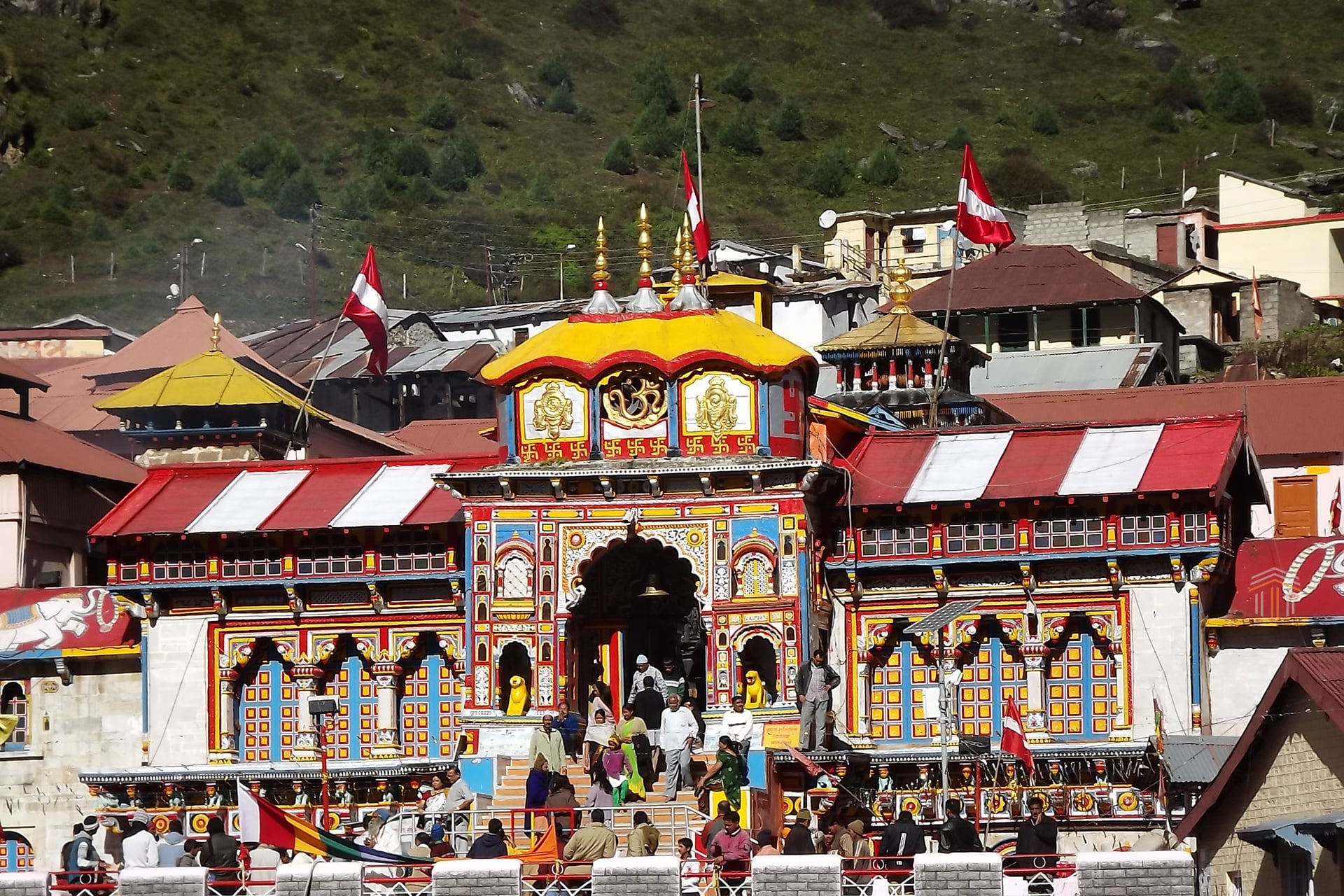
Badrinath Temple is built of stone and stands about 15 metres (50 feet) high, with the sanctum's conical roof crowned by a small cupola covered in gold gilt. Its architecture resembles a Buddhist vihara, with arched windows and a brightly painted facade, and some accounts hold that the site was a Buddhist shrine until the 8th century. The most striking feature is the arched main gateway, known as the Singhdwar, reached by a broad stairway and painted in vivid colours that stand out against the snow peaks. The temple has three parts: the Garbha Griha (sanctum), the Darshan Mandap where rituals are performed, and the Sabha Mandap where devotees gather. Damaged by earthquakes and avalanches over the centuries, it was largely rebuilt by the King of Jaipur after the 1803 earthquake, with renovations continuing into the 1870s.
Layout
Layout
The temple stands on the right bank of the Alaknanda, approached by a footbridge over the river and a flight of steps. Tapt Kund lies at its foot, Narad Kund is just below it, and Brahma Kapal is about half a kilometre away on the riverbank.
Gateway
Singhdwar
The tall, arched main gateway painted in bright colours is the temple's best-known feature and leads into the courtyard and halls.
Sanctum
Garbha Griha
The sanctum houses the black Shaligram murti of Badri Narayan, about 1 ft tall in most descriptions (some temple sources say about a metre), seated in padmasana. Two raised hands hold the conch and discus and the other two rest on the lap, under a gold canopy shaped like a badri tree.
Mandap
Darshan Mandap and Sabha Mandap
The Darshan Mandap is where the priests perform the rituals before the deity, while the Sabha Mandap is the larger hall where devotees gather. The walls and pillars are carved and painted.
Roof
Gilded Cupola
The sanctum's conical roof, about 15 metres tall, is crowned by a small cupola covered with a gold gilt covering.
Hot Spring
Tapt Kund
A natural hot spring just below the temple, measured at about 54°C (130°F) in an early analysis, where pilgrims bathe before darshan.
Ghat
Narad Kund and Brahma Kapal
Narad Kund is the pool in the Alaknanda from which the murti is said to have been recovered, and Brahma Kapal is the riverside platform where pind daan is performed.
Redevelopment
Badrinath Master Plan
A redevelopment master plan, prepared in 2020 and under way by 2022, has been widening approaches, building a riverfront and improving pilgrim facilities around the temple.
Interesting facts

The Rawal, the chief priest of Badrinath, is traditionally a Nambudiri Brahmin from Kerala, more than 2,000 km away in a straight line. He must be a bachelor with a postgraduate degree in Sanskrit, and tradition links the custom to Adi Shankaracharya, who was born in Kerala; temple records date the present line of Rawals to 1776.
Deities & Shrines
Badri Narayan
The presiding deity is Lord Vishnu as Badri Narayan, a black Shaligram murti about 1 ft tall in most descriptions, seated in padmasana in meditation. Two raised hands hold the conch (Panchajanya) and discus (Sudarshana) while the other two rest on the lap, and the image is considered one of Vishnu's eight self-manifested forms. Devotees pray to him for liberation, peace and the welfare of their families.
Nar and Narayan
The twin sages Nar and Narayan, forms of Vishnu whose penance at Badarikashram is described in the Bhagavata Purana, are enshrined in the sanctum. Nar Parbat rises opposite the temple and Narayana Parbat lies behind Neelkanth peak.
Kuber
Kuber, the god of wealth, is enshrined in the sanctum. At the winter closing his festival image is taken in procession to Pandukeshwar, and it returns to the sanctum when the temple reopens.
Narad Muni
The sage Narada, the great devotee of Vishnu, is enshrined in the sanctum. Local tradition says the image of Badrinarayan was first served by Narada, and the Narad Kund, from which the deity is said to have been recovered, bears his name.
Uddhav
Uddhav, the friend and devotee of Lord Krishna, is enshrined in the sanctum. His festival image travels with Kuber to Pandukeshwar for winter worship and is seated back in the sanctum at the reopening.
Goddess Lakshmi
A separate temple to Goddess Lakshmi stands in the complex. At the winter closing the Rawal, dressed in woman's attire as per tradition, seats her in the sanctum beside the Lord, and at the reopening she is brought out in procession and returned to her own temple.
Garuda
Garuda, Vishnu's eagle mount, sits with folded hands in a murti directly opposite the main idol, as in many Vishnu temples.
Adi Shankaracharya and Other Shrines
The temple has fifteen additional images, including Lakshmi, Garuda and Navadurga, and shrines to Lakshmi Narasimha, Adi Shankaracharya, Nar and Narayan, Ghantakarna and the acharyas Vedanta Desika and Ramanujacharya. All the temple's deities are carved from black stone.
Darshan & Service Offerings
| Service | Timing | Price | Notes |
|---|---|---|---|
| Service 1 | Early morning to evening | Free | Pilgrims customarily bathe in the hot spring below the temple before darshan. |
Visitor information
Important Visitor Notice
Landslides can close the highway, especially in the monsoon, and the Joshimath to Badrinath stretch runs on regulated one-way traffic. Check road, weather and yatra advisories before travelling, and keep buffer days in your plan.
Location
Chamoli, Uttarakhand, India
Best Time to Visit
May-June and September-October
These months bring clear skies and pleasant days, with daytime temperatures around 10-20°C. May and June are the busiest months, while September and October, after the monsoon, are quieter and offer fine views of the snow peaks.
Opening Days (April-May)
The reopening ceremony draws large crowds, and snow may still line the town and surrounding slopes in the first weeks. Nights are very cold.
Monsoon (July-August)
Heavy rain brings landslides and road closures on the Rishikesh-Badrinath highway. Travel only after checking advisories, and keep buffer days.
Mata Murti Mela (September)
Held on Vaman Dwadashi at the Mata Murti temple near Mana, when Badri Narayan's utsav murti is taken to visit his mother, attracting local devotees.
Closing Ceremony (November)
The five-day Panch Puja and closing rituals, including the procession of Uddhav and Kuber to Pandukeshwar, are moving to witness, though temperatures drop below freezing.
Winter (November-April)
The temple is closed and the town lies under snow. Winter darshan is available at Yogadhyan Badri, Pandukeshwar and Narsingh Temple, Jyotirmath.
Weekdays and Off-Peak Months
Weekdays in September and October usually have the shortest queues and easier hotel availability.
Combine with Kedarnath and Hemkund
Many pilgrims combine Badrinath with Kedarnath on a Do Dham yatra, or with Hemkund Sahib and the Valley of Flowers between June and September.
Nearby places
Tapt Kund and Narad Kund
At the foot of the temple
- The hot sulphur spring where pilgrims bathe before darshan, and the pool from which the murti is said to have been recovered.
Brahma Kapal
About 100 m from the temple
- A riverside platform on the Alaknanda where pilgrims perform pind daan for their ancestors.
Vyas Gufa and Ganesh Gufa
About 3-4 km (in Mana)
- Caves where, by tradition, Ved Vyasa composed the Mahabharata and Ganesha wrote it down.
Festivals & culture
Badrinath celebrates the opening and closing of the temple with elaborate rituals, along with Vaishnava festivals during its six-month season. The Mata Murti Mela, Janmashtami and the birth festival of Nar-Narayan are highlights, and the closing ceremony with the Panch Puja draws large crowds. Festival dates follow the Hindu calendar and are announced each year by the temple committee.
Kapat Opening Ceremony
April-May (23 April in 2026)
The temple doors reopen at an auspicious muhurat with Vedic chanting, as the Rawal and the deities arrive from the winter seats. Pilgrims gather to see the Akhand Jyoti still burning.
Kapat Closing Ceremony and Panch Puja
November (25 November in 2025)
A five-day Panch Puja precedes the closing. Lakshmi is placed in the sanctum, the deity is wrapped in a ghee blanket, and Uddhav and Kuber are taken to Pandukeshwar.
Additional information
Shri Badrinath-Kedarnath Temple Committee (BKTC)
The temple is administered by the Shri Badrinath-Kedarnath Temple Committee under the Shri Badrinath and Shri Kedarnath Temples Act, 1939.
Badrinath Temple Address
Shri Badrinath Temple, Badrinath, Chamoli district, Uttarakhand 246422, India.
Official Website
badrinath-kedarnath.gov.in for puja bookings, rates and notices.
Char Dham Registration
Free, mandatory registration at registrationandtouristcare.uk.gov.in, the Tourist Care Uttarakhand app, WhatsApp 8394833833 or counters in Haridwar and Rishikesh.
Yatra Helpline
Toll-free 0135-1364; emergency 112.
2026 Season
Opened 23 April 2026; the closing date is announced on Vijayadashami.
Winter Worship
In winter, Uddhav and Kuber are worshipped at Yogadhyan Badri, Pandukeshwar, and Adi Shankaracharya's gaddi at Narsingh Temple, Jyotirmath.
Chief Priest
The Rawal is a Nambudiri Brahmin from Kerala.
Health Advisory
Pilgrims over 55 are advised to carry a fitness certificate; screening is available on the route.
Important Visitor Advisory
Verify dates, road conditions, weather and puja rates immediately before travelling.
Temple facilities
Puja Booking Counters
Temple committee counters near the temple handle puja bookings, receipts and donations, alongside online booking on the official website.
Queue Management
Barricaded queues, police and temple staff manage the darshan line on busy days, and elderly and differently-abled pilgrims get priority darshan slots.
Tapt Kund Bathing Area
Separate bathing areas for men and women at the hot spring allow pilgrims to bathe before darshan.
Badrinath Hospital and Screening
A hospital at Badrinath, health check-up points on the route and ambulances support pilgrims, with oxygen available for altitude-related problems.
Temple Committee and GMVN Accommodation
The temple committee and Garhwal Mandal Vikas Nigam run guest houses and Yatri Niwas accommodation in Badrinath, along with many private hotels and dharamshalas.
Dolis and Porters
Dolis (palanquins) and porters help elderly and less mobile pilgrims on the walk and steps to the temple.
Drinking Water and Toilets
Public drinking water points and toilets operate in the town during the season.
Master Plan Facilities
The redevelopment master plan is adding a riverfront, wider approaches, a plaza and improved pilgrim amenities around the temple.
Information and Helpline
The yatra helpline (0135-1364) and information counters assist pilgrims with registration, routes and weather updates.
Emergency services
India Emergency Response
Not location-specific
Contact
112
- Call 112 for urgent police, medical or fire assistance.
Top picks
Garhwali Dishes
Try local Garhwali food such as aloo ke gutke (spiced potatoes with mountain herbs), kaddu ki sabzi (pumpkin curry with puri or rice) and bhang ki chutney (made from hemp seeds) at eateries in Badrinath.
Tea at India's First Tea Shop, Mana
Stop for a cup of tea at the small stall beside Bhim Pul in Mana, once called "India's Last Shop" and renamed "India's First Tea Shop" after Mana was declared the country's first village.
Visitor guide
Jolly Grant Airport, Dehradun (DED)
Approximately 317 km
- The nearest airport, with flights from Delhi and other cities. Taxis and buses continue by road, about 10-11 hours.
Videos
Third-party videos may include ads or external commentary.
Frequently Asked Questions
In Badrinath town, Chamoli district, Uttarakhand, on the Alaknanda at about 3,133 metres.
Lord Vishnu as Badri Narayan, in a black Shaligram murti seated in meditation.
From about late April or May to November. In 2026 it opened on 23 April; the closing date is announced on Vijayadashami.
About 07:00 AM - 01:00 PM and 04:00 PM - 09:00 PM; morning pujas begin at 04:30 AM.
Yes. Char Dham registration is mandatory and free, online or at counters in Haridwar and Rishikesh.
Yes. Special pujas have fixed rates set by the temple committee.
₹4,700 on the 2025 rate list; rates are revised each season.
A hot spring at about 55°C below the temple, where pilgrims bathe before darshan.
The Rawal, a Nambudiri Brahmin from Kerala.
At Yogadhyan Badri, Pandukeshwar and Narsingh Temple, Jyotirmath.
By road from Rishikesh (about 295 km), via Jyotirmath.
Mana village, Vyas Gufa, Bhim Pul, Vasudhara Falls and Brahma Kapal.
Yes, both the national Char Dham and Uttarakhand's Chota Char Dham.
badrinath-kedarnath.gov.in and the yatra helpline 0135-1364.