
24°C
Mathura
Shri Krishna Janmabhoomi Temple
 Mathura, Uttar Pradesh, India
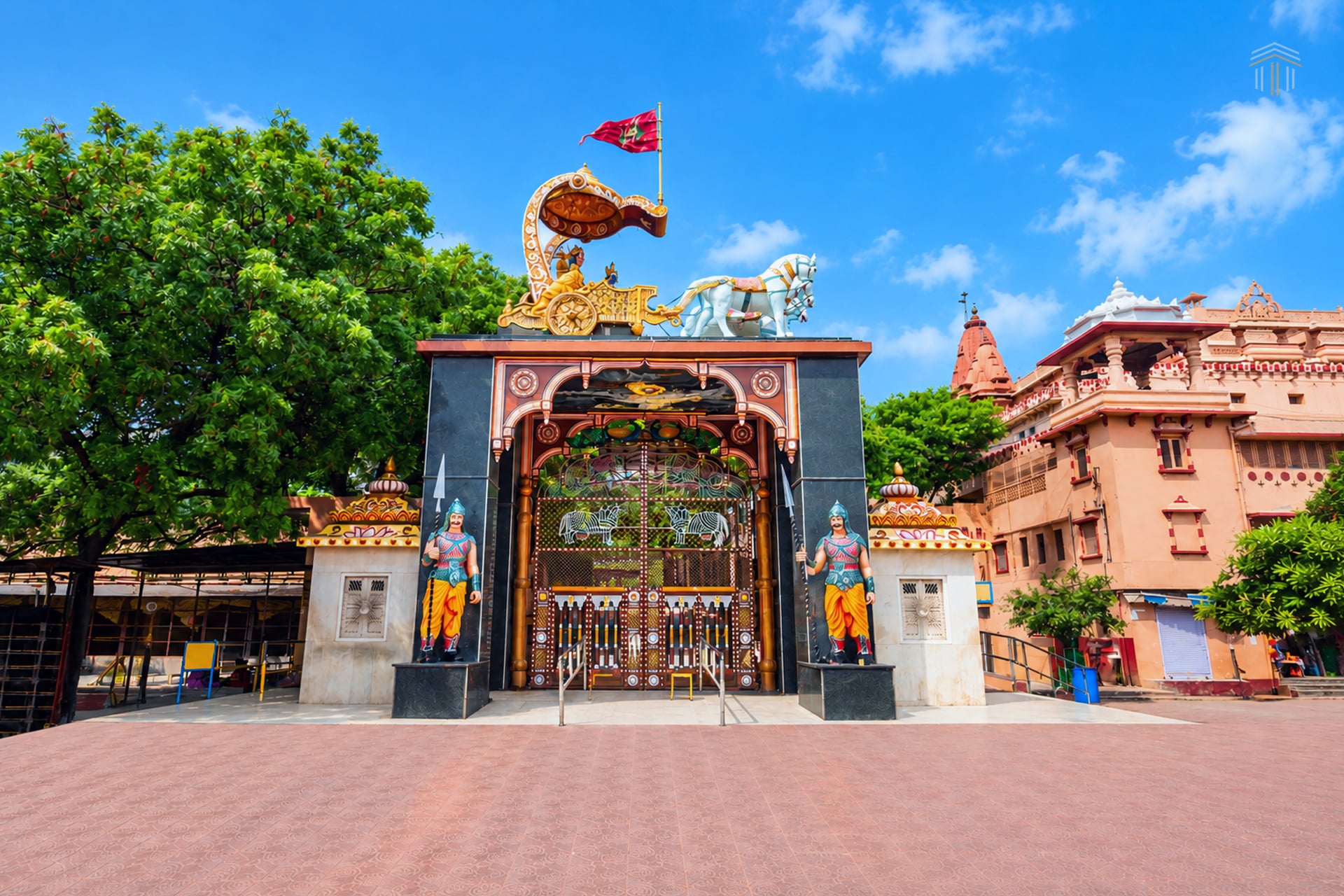
Shri Krishna Janmabhoomi in Mathura is revered as the birthplace of Lord Krishna, where devotees worship at the prison-cell shrine of his birth, the Keshav Dev temple and the Bhagavata Bhavan.
- ReligionHindu
- DeityLord Krishna
- TimingsMorning: 05:00 AM – 12:00 PM, Evening: 04:00 PM – 08:30 PM
About the temple
About the temple
Shri Krishna Janmabhoomi, also called Krishna Janmasthan, is a temple complex in Mathura, Uttar Pradesh, revered by Hindus as the birthplace of Lord Krishna. According to tradition, Krishna was born here at midnight to Devaki and Vasudeva in the prison of the tyrant King Kamsa. The present complex, spread over about 13.37 acres, was developed from the 1950s by the Shri Krishna Janmasthan Seva Sansthan and includes three main shrines: the Garbha Griha, a shrine built at the spot venerated as the prison cell of Krishna's birth; the Keshav Dev temple, completed in 1958; and the Bhagavata Bhavan, completed in 1982. The site has a long history of temples built and destroyed over the centuries, and it adjoins the Shahi Eidgah mosque, the subject of ongoing litigation. It is one of the most important pilgrimage sites of the Braj region, especially on Janmashtami.
Shri Krishna Janmabhoomi Temple
Shri Krishna Janmabhoomi Temple
The Sacred Legacy of Shri Krishna Janmabhoomi in Numbers
Discover the history and devotion of Shri Krishna Janmabhoomi in Mathura, revered as the birthplace of Lord Krishna. From ancient shrines to the modern complex, the site connects centuries of faith with the living celebrations of Braj.
- Approximate Area of the Janmabhoomi Site
- 13.37 acres
- Main Shrines - Garbha Griha, Keshav Dev Temple and Bhagavata Bhavan
- 3
- Approximate Date of a Gupta-Era Temple at the Site
- c.400 CE
- Year Raja Bir Singh Deo Bundela Built the Grand Keshav Dev Temple
- 1618
- Year the Trust to Rebuild the Temple Was Formed
- 1951
- Year the Modern Keshav Dev Temple Was Completed
- 1958
- Year the Bhagavata Bhavan Was Completed
- 1982
- Approximate Height of the Radha-Krishna Murti in the Bhagavata Bhavan
- 1.8 m
- Shrines in the Bhagavata Bhavan
- 5
Approximate Area of the Janmabhoomi Site
Main Shrines - Garbha Griha, Keshav Dev Temple and Bhagavata Bhavan
Approximate Date of a Gupta-Era Temple at the Site
Year Raja Bir Singh Deo Bundela Built the Grand Keshav Dev Temple
Year the Trust to Rebuild the Temple Was Formed
Year the Modern Keshav Dev Temple Was Completed
Year the Bhagavata Bhavan Was Completed
Approximate Height of the Radha-Krishna Murti in the Bhagavata Bhavan
Shrines in the Bhagavata Bhavan
Historical Background
The site revered as Krishna's birthplace has seen a long succession of shrines. Tradition credits the first temple to Vajranabh, Krishna's great-grandson, and archaeological finds in the area include pottery and terracotta from about the 6th century BCE. A large temple complex is recorded from the Gupta period, around 400 CE. Mathura's temples were attacked by Mahmud of Ghazni in 1017-1018; a Vishnu temple was built on the site by a person named Jajja around 1150; and Mathura's temples were again damaged under Sikandar Lodi in the 16th century. In 1618 Raja Bir Singh Deo Bundela of Orchha built a grand Keshav Dev temple, described by European travellers. In 1670 the Mughal emperor Aurangzeb ordered its destruction, and the Shahi Eidgah mosque was built on part of the site. Under British rule the land was auctioned in 1815 and bought by Raja Patnimal of Banaras. In 1944 Madan Mohan Malaviya acquired the land with the help of Jugal Kishore Birla, and in 1951 a trust was formed to build a new temple. The Keshav Dev temple was completed in 1958 and the Bhagavata Bhavan in 1982. In 1968 an agreement was signed between the temple body and the Eidgah committee, but its validity and the status of the wider site are the subject of 18 suits now heard by the Allahabad High Court.
Ancient tradition
Ancient tradition
Krishna is believed to have been born at this spot in Kamsa's prison; tradition credits the first temple to his great-grandson Vajranabh.6th century BCE
6th century BCE
Archaeological finds of pottery and terracotta indicate early settlement in the area.c. 400 CE
c. 400 CE
A large temple complex is recorded at the site in the time of the Gupta emperor Chandragupta II.1017-1018 CE
1017-1018 CE
Mahmud of Ghazni attacked Mathura and its temples.c. 1150 CE
c. 1150 CE
A Vishnu temple was built on the site by a person named Jajja, according to an inscription.16th century CE
16th century CE
Mathura's temples were damaged under Sikandar Lodi.1618 CE
1618 CE
Raja Bir Singh Deo Bundela of Orchha built a grand Keshav Dev temple at a reported cost of 33 lakh rupees.1670 CE
1670 CE
Aurangzeb ordered the destruction of the Keshav Dev temple; the Shahi Eidgah was built on part of the site.1815 CE
1815 CE
The East India Company auctioned the land (about 13.37 acres), which was bought by Raja Patnimal of Banaras.1944 CE
1944 CE
Madan Mohan Malaviya acquired the land with financial support from Jugal Kishore Birla.1951 CE
1951 CE
Jugal Kishore Birla formed a trust, later the Shri Krishna Janmasthan Seva Sansthan, to build a new temple.1958 CE
1958 CE
The Keshav Dev temple, built with support from Ramkrishna Dalmia, was completed.1968 CE
1968 CE
An agreement was signed between the temple body and the Shahi Eidgah committee over the site.1982 CE
1982 CE
The Bhagavata Bhavan was completed and its deities installed, completing the present complex.2020 onward
2020 onward
Suits challenging the 1968 agreement were filed; from 2023 they were heard together by the Allahabad High Court, with some issues taken to the Supreme Court.


Synopsis
Shri Krishna Janmabhoomi in Mathura, Uttar Pradesh, is the temple complex revered as the birthplace of Lord Krishna, at the heart of the Braj pilgrimage region. Devotees visit the Garbha Griha, venerated as the prison cell where Krishna was born, the Keshav Dev temple and the Bhagavata Bhavan, with its large Radha-Krishna murti and painted walls. The site's temple history reaches back to tradition and to a Gupta-era temple, through successive rebuildings and destructions, to the modern complex completed in 1982. Janmashtami brings lakhs of pilgrims for the midnight celebration of Krishna's birth, and the complex is open daily with strict security.
Shri Krishna Janmabhoomi is the site revered by Hindus as the birthplace of Lord Krishna, born to Devaki and Vasudeva in Kamsa's prison according to the Bhagavata Purana and other texts. Tradition holds that the first temple was built by Vajranabh, and the site has been a centre of Krishna worship in Mathura for many centuries.
A Gupta-era temple complex (about 400 CE), a 12th-century Vishnu temple recorded in an inscription, and the Keshav Dev temple built by Raja Bir Singh Deo Bundela in 1618 are documented. European travellers such as Tavernier described the 17th-century temple before it was destroyed in 1670 under Aurangzeb, when the Shahi Eidgah was built on part of the site.
Historic patrons included the Gupta rulers and Raja Bir Singh Deo Bundela. In the 20th century, Madan Mohan Malaviya, Jugal Kishore Birla, Ramkrishna Dalmia and Hanuman Prasad Poddar of Gita Press, supported the rebuilding of the complex.
As Krishna's birthplace, Janmabhoomi is one of the holiest sites of the Braj region and of Vaishnava Hinduism. Janmashtami celebrations here draw lakhs of devotees, and the site is part of the wider Braj pilgrimage that includes Vrindavan, Gokul, Govardhan, Barsana and Nandgaon. Conservation & Recognition: The complex is managed by the Shri Krishna Janmasthan Seva Sansthan and protected by a multi-tier security arrangement. The status of the adjoining Shahi Eidgah and the 1968 agreement are the subject of 18 suits being heard by the Allahabad High Court, with some questions before the Supreme Court.
Sacred significance
The Birthplace of Lord Krishna
Janmabhoomi is revered as the place where Lord Vishnu was born as Krishna at midnight in Kamsa's prison. For devotees, standing in the Garbha Griha is a direct connection with the moment of the divine birth, making it one of the holiest places in Vaishnava Hinduism.
Janmashtami at the Birthplace
Krishna Janmashtami is celebrated here with special intensity. At midnight, the deity is bathed with milk, curd, honey, ghee and sugar, including from a silver Kamdhenu cow, and lakhs of devotees gather in Mathura for the celebration.
Heart of the Braj Pilgrimage
Janmabhoomi is at the heart of the Braj pilgrimage, which includes Gokul, Vrindavan, Govardhan, Barsana and Nandgaon, places linked to Krishna's childhood and youth. Many pilgrims undertake the Braj Chaurasi Kos Parikrama around the region.
Keshav Dev - Lord of Mathura
Krishna is worshipped here as Keshav Dev, a name long associated with the main deity of Mathura, linking the modern temple with the Keshav Dev temples of earlier centuries.
One of the Sapta Puri
Mathura is one of the Sapta Puri, the seven holy cities of Hinduism believed to grant moksha, along with Ayodhya, Haridwar, Varanasi, Kanchipuram, Ujjain and Dwarka.
Architecture
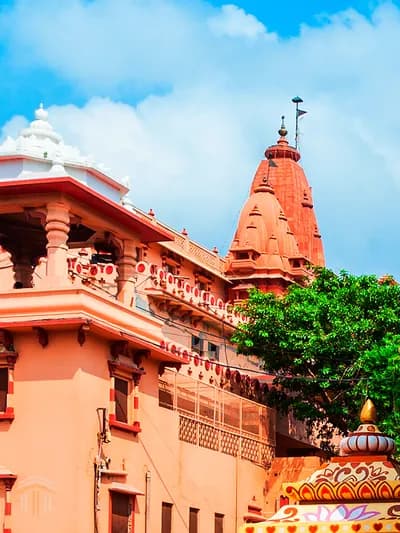
The present Shri Krishna Janmabhoomi complex is a modern ensemble built between the 1950s and 1982 on a site of about 13.37 acres, combining North Indian temple forms with marble halls and painted interiors. Its three main shrines are the Garbha Griha, a marble pavilion built over the spot venerated as Krishna's birthplace; the Keshav Dev temple, completed in 1958; and the Bhagavata Bhavan, a large temple completed in 1982 with five shrines and walls painted with scenes from Krishna's life. The complex also includes the Potra Kund tank, gardens, a guest house, an Ayurveda centre, a library, shops and space for cultural programmes. It stands beside the Shahi Eidgah, with which it shares a boundary.
Layout
Layout of the Complex
Visitors enter through security gates and visit the Keshav Dev temple, the Garbha Griha and the Bhagavata Bhavan in turn, with gardens and open spaces between them.
Sanctum
Garbha Griha (Birthplace Shrine)
A shrine built at a lower level, designed to evoke the prison cell, with a marble pavilion marking the spot of Krishna's birth. A shrine beside it houses an image of the eight-armed goddess Yogmaya.
Temple
Keshav Dev Temple
Built between 1957 and 1958 with support from Ramkrishna Dalmia, this temple to Krishna as Keshav Dev stands to the south of the Shahi Eidgah.
Temple
Bhagavata Bhavan
Completed in 1982, this is the largest temple of the complex, with a tall shikhara, five shrines, a Radha-Krishna murti about 1.8 metres tall and walls covered with paintings of Krishna's life.
Murals
Frescoes and Paintings
The interior of the Bhagavata Bhavan is decorated with colourful paintings depicting events from Krishna's life and other sacred stories.
Water Body
Potra Kund
A large stepped tank to the south-east of the complex, traditionally linked to the newborn Krishna. Its steps were built by Mahadji Scindia in 1782 and restored in 1850.
Facilities
Guest House and Cultural Spaces
The complex includes an International Guest House, an Ayurveda Bhavan, a library and areas for religious and cultural events.
Security
Security Perimeter
The complex lies within a multi-tier security zone, with screening at the gates and restricted items not allowed inside.
Interesting facts

The Garbha Griha is designed to recall the prison cell of Kamsa, so devotees experience the setting of Krishna's birth as described in the scriptures.
Deities & Shrines
Shri Krishna (Bal Krishna) at the Garbha Griha
In the Garbha Griha, devotees worship the infant Krishna at the spot venerated as his birthplace. Prayers here are offered for blessings of children, protection and devotion.
Goddess Yogmaya
An eight-armed image of Yogmaya, the goddess who warned Kamsa of Krishna's birth, is worshipped in a shrine near the Garbha Griha. She is revered as Krishna's divine sister and protector.
Shri Keshav Dev
The Keshav Dev temple enshrines Krishna as Keshav Dev, the traditional presiding deity of Mathura, worshipped for prosperity and protection.
Radha-Krishna (Bhagavata Bhavan)
The main shrine of the Bhagavata Bhavan holds a Radha-Krishna murti about 1.8 metres tall, worshipped as the embodiment of divine love.
Rama, Lakshmana and Sita
A shrine in the Bhagavata Bhavan honours Lord Rama with Lakshmana and Sita, another incarnation of Vishnu. Devotees pray here for righteousness and family harmony.
Lord Hanuman
An image of Hanuman stands in front of the Rama shrine in the Bhagavata Bhavan, honouring Rama's devoted servant.
Jagannath, Balabhadra and Subhadra
A shrine to the deities of Puri is found in the Bhagavata Bhavan, linking Mathura with the Jagannath tradition. Jagannath is revered as a form of Krishna.
Chaitanya Mahaprabhu and Garuda Stambha
In front of the Jagannath shrine in the Bhagavata Bhavan stand the Garuda Stambha and an image of Chaitanya Mahaprabhu, the saint who revived Krishna devotion in Braj.
Lord Shiva
A shrine to Shiva in the Bhagavata Bhavan honours him as a great devotee and protector of Krishna's realm. In Braj tradition Shiva is also worshipped as Gopeshwar Mahadev, who longed to join Krishna's Raas Leela.
Goddess Durga
A shrine to the goddess Durga in the Bhagavata Bhavan completes its five shrines, honouring the Divine Mother. Devotees pray here for strength and protection.
Darshan & Service Offerings
| Service | Timing | Price | Notes |
|---|---|---|---|
| General Darshan (Free Darshan) | About 05:00/05:30 AM - 12:00 PM and 03:00/04:00 PM - 08:30/09:30 PM, depending on season. | Free | Entry and darshan at the Garbha Griha, the Keshav Dev temple and the Bhagavata Bhavan are free for all visitors. Everyone passes through strict, airport-style security at the gates, so allow 1-1.5 hours for the visit on normal days and much longer on weekends and festivals. |
| Garbha Griha Darshan | During temple hours. | Free | Devotees visit the shrine at the spot venerated as Krishna's birthplace, the most sacred part of the complex. The shrine is designed to evoke Kamsa's prison, and visitors move through in a single queue, offering prayers before the marble pavilion and at the nearby shrine of Yogmaya. |
| Keshav Dev Temple Darshan | During temple hours. | Free | Darshan of Krishna as Keshav Dev, the traditional presiding deity of Mathura, in the temple completed in 1958. The temple carries forward the name of the great Keshav Dev temples of earlier centuries. |
| Bhagavata Bhavan Darshan | During temple hours. | Free | Darshan of the 1.8-metre Radha-Krishna murti and the shrines of Jagannath, Rama, Shiva and Durga. Visitors can also see the colourful paintings of Krishna's life that cover the walls and ceilings of this large temple. |
| Mangala and Shringar Aarti | About 05:30-06:00 AM and 07:30 AM. | Free | The early-morning aartis, when the deities are woken and adorned, are among the most peaceful times for darshan. |
| Raj Bhog, Sandhya and Shayan Aarti | Midday, about 06:00 PM (summer) / 05:00 PM (winter) and before closing. | Free | The midday offering and the evening and night aartis are open to all devotees present in the complex. |
| Janmashtami Midnight Darshan | Night of Janmashtami (4-5 September in 2026). | Free | The midnight celebration of Krishna's birth, with the grand abhishek and aarti, draws lakhs of devotees. Vehicles are barred from the city centre, so devotees walk to the complex through barricaded routes under heavy security. |
| Holi Celebrations | Holi week (February-March). | Free | Holi programmes with flowers, colours and devotional songs are held in the complex as part of Braj's famous celebrations. |
| Offerings and Prasad | During temple hours. | Varies | Devotees offer Mathura pedas, makhan-mishri, flowers and tulsi, available at shops near the complex, and receive prasad after darshan. |
| Donations | During temple hours. | Any amount | Donations can be made at official counters of the Shri Krishna Janmasthan Seva Sansthan against receipts, supporting temple services and festivals. |
| Bhagavata Katha and Programmes | As announced. | Free to attend | Religious discourses, bhajans and cultural programmes are held in the complex, especially during festivals. |
| International Guest House | Year-round, subject to availability. | As set by the Sansthan | The Sansthan's guest house within the complex offers accommodation to pilgrims close to the shrines. |
Visitor information
Location
Shri Krishna Janmabhoomi is located on Janmabhoomi Marg (Deeg Gate area) in Mathura, Uttar Pradesh, about 3.4 km from Mathura Junction railway station and in the heart of the old city.
Opening Hours
In summer the complex is generally open about 05:00/05:30 AM to 12:00 PM and 04:00 PM to 09:00/09:30 PM; in winter about 05:30/06:00 AM to 12:00 PM and 03:00 PM to 08:30 PM.
Darshan Arrangements
Visitors take darshan at the Garbha Griha, the Keshav Dev temple and the Bhagavata Bhavan. Allow 1-1.5 hours on normal days and much longer on festivals.
Entry and Ticket Information
Entry and darshan are free. There are no paid darshan tickets.
Dress and Attire
Modest, respectful clothing is expected inside the complex.
Security and Prohibited Items
Mobile phones, cameras, bags, pens and electronic items are not allowed inside. All visitors go through airport-style security screening at the gates.
Leaving Belongings
Leave phones and bags in your vehicle or hotel, or use the cloakroom and shops near the entrance where available, to avoid delays at security.
Time Needed
Plan 1-1.5 hours for the complex, and a half day if combining it with Dwarkadhish Temple and Vishram Ghat.
Temple Administration
The complex is managed by the Shri Krishna Janmasthan Seva Sansthan, with an office within the complex for enquiries.
Accessibility
The complex has paved paths, but the Garbha Griha and some shrines involve steps. Elderly visitors should visit on quieter weekday mornings.
Getting There
Mathura Junction is the main railhead, about 3.4 km away. The nearest airport is Agra (about 50-63 km), and Delhi's IGI Airport is about 150-180 km away by road. Noida International Airport at Jewar, open for commercial flights since June 2026, is about 70 km away.
Important Visitor Notice
On Janmashtami and other festivals, vehicles are barred from the area and devotees must walk through barricaded routes. Check local police and administration advisories before visiting.
Location
Mathura, Uttar Pradesh, India
Best Time to Visit
Ideal Time to Visit (October-March)
The cooler months are the most comfortable for exploring Mathura and Vrindavan, with pleasant days and cool nights. They are also the busiest tourist months, and December-January can bring fog that slows road and rail travel.
Janmashtami (August-September)
Krishna's birthday is the grandest festival at Janmabhoomi, with midnight celebrations. In 2026 it fell on 4 September. Expect huge crowds and vehicle restrictions.
Holi (February-March)
Braj is famous for its week-long Holi, including Lathmar Holi in Barsana and Nandgaon and flower Holi in Vrindavan.
Radhashtami and Annakut (Autumn)
Radhashtami and Govardhan Puja (Annakut) are major Braj festivals.
Summer Visit (April-June)
Summers are very hot, often above 40°C. Visit early in the morning or in the evening. Carry water and use the shaded areas of the complex.
Monsoon Visit (July-September)
Rains cool the region, and the Yamuna ghats are full. Expect humidity and occasional waterlogging.
Weekday Mornings
Weekday mornings soon after opening are the least crowded times. Weekends and public holidays bring large crowds from Delhi and nearby cities.
Plan a Braj Circuit
Allow two to three days to cover Mathura, Vrindavan, Gokul, Govardhan and Barsana.
Nearby places
Potra Kund
Adjacent to the complex
- A large stepped tank traditionally linked to the newborn Krishna, with steps built by Mahadji Scindia in 1782.
Vishram Ghat
Approximately 3.5 km
- The principal ghat of Mathura on the Yamuna, where Krishna is believed to have rested after slaying Kamsa; known for its evening aarti.
Festivals & culture
Shri Krishna Janmabhoomi celebrates the festivals of Krishna and of the Braj region. Janmashtami is by far the most important, with a midnight celebration of Krishna's birth that draws lakhs of devotees to Mathura. Holi, Radhashtami, Diwali and Annakut are also celebrated with special worship and decorations. Festival dates follow the Hindu lunar calendar and vary each year.
Krishna Janmashtami
August-September (Bhadrapada Krishna Ashtami; 4 September in 2026)
The birth of Krishna is celebrated at midnight with a grand abhishek using milk, curd, honey, ghee and sugar, including from a silver Kamdhenu cow, followed by aarti and festivities. The city is under heavy security and vehicles are restricted.
Holi
February-March (varies)
Braj celebrates Holi for over a week, with Lathmar Holi in Barsana and Nandgaon, flower Holi in Vrindavan and colourful programmes in Mathura, including at Janmabhoomi.
Additional information
Shri Krishna Janmasthan Seva Sansthan
The complex is managed by the Shri Krishna Janmasthan Seva Sansthan, which grew out of the trust formed in 1951 by Jugal Kishore Birla.
Address
Shri Krishna Janmabhoomi, Janmabhoomi Marg, Deeg Gate, Mathura, Uttar Pradesh 281001, India.
Enquiries
Enquiries can be made at the Sansthan office within the complex.
Free Entry
Entry and darshan are free.
Prohibited Items
Phones, cameras, bags, pens and electronic items are not allowed inside.
Opening Hours
About 05:00/05:30 AM - 12:00 PM and 03:00/04:00 PM - 08:30/09:30 PM depending on season.
International Guest House
The Sansthan runs an International Guest House within the complex.
Legal Proceedings
18 suits concerning the adjoining Shahi Eidgah and the 1968 agreement are being heard by the Allahabad High Court; the Supreme Court stayed a court-monitored survey in January 2024, and hearings were continuing in 2026.
Janmashtami Advisory
On Janmashtami, vehicles are barred from the city centre and devotees must walk; follow police advisories.
Important Visitor Advisory
Confirm timings and security arrangements locally before visiting, especially on festivals.
Temple facilities
Security Screening
Airport-style security screening at the gates, with separate queues on busy days. Metal detectors and frisking are used, and the complex lies within a red-zone security perimeter, so leave prohibited items behind.
Three Main Shrines
Darshan at the Garbha Griha, Keshav Dev temple and Bhagavata Bhavan, connected by paved paths. Signs guide visitors through the complex in sequence.
International Guest House
A guest house within the complex run by the Sansthan. Its location allows pilgrims to attend the early-morning aarti easily.
Ayurveda Bhavan
An Ayurveda centre within the complex. It reflects the Sansthan's interest in traditional Indian knowledge.
Library
A library with religious and cultural books. It holds works on Krishna, the Bhagavata and Braj culture.
Shops and Canteen
Shops for prasad, books and devotional items, and a canteen serving simple vegetarian food. Prices are generally modest.
Accessible Paths
Paved paths around the complex; some shrines involve steps. Elderly visitors should allow extra time and visit at quieter hours.
Drinking Water and Toilets
Drinking water and toilets are available. Facilities can be busy on festival days.
Cultural Programme Space
Open spaces for festivals, discourses and cultural programmes. Large gatherings are held here during Janmashtami and Holi.
Emergency services
India Emergency Response
Not location-specific
Contact
112
- Call 112 for urgent police, medical or fire assistance.
Top picks

Mathura Peda
Buy the city's famous milk sweet from a traditional shop. Pedas are also the traditional offering to Krishna at the temple.
Brijwasi Pede Wale
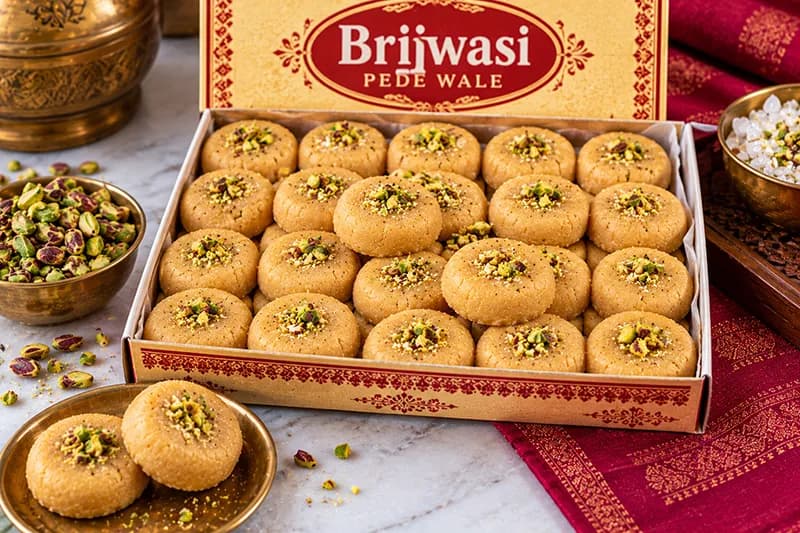
One of Mathura's best-known sweet shops, near Janmabhoomi, famous for flat, round pedas made from khoya and garnished with pistachio or saffron.
Kesariya Lassi
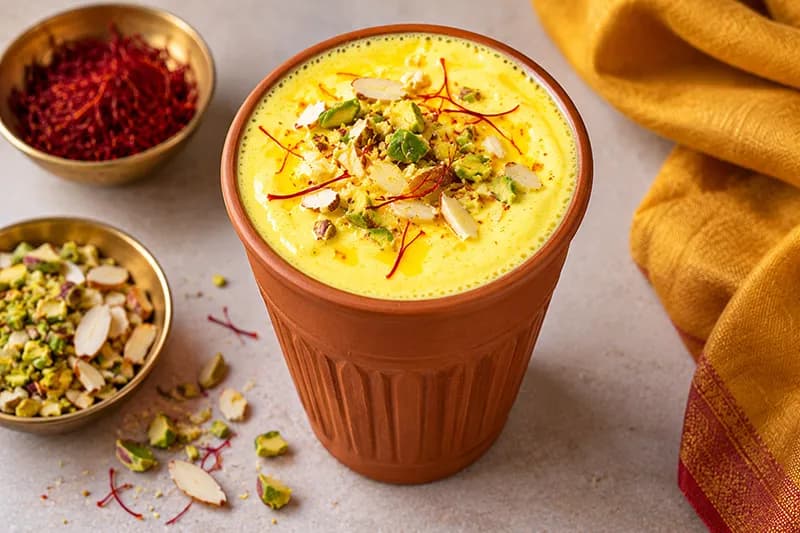
A popular stop near Janmabhoomi for thick lassi and thandai, especially refreshing after darshan and during festivals.
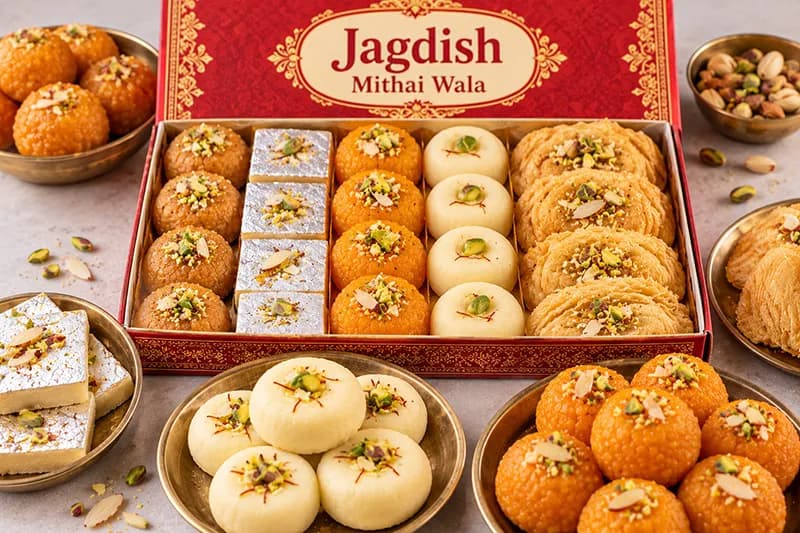
Jagdish Mithai Wala
On Janmabhoomi Marg, known for hot aloo puri, a filling breakfast close to the complex.
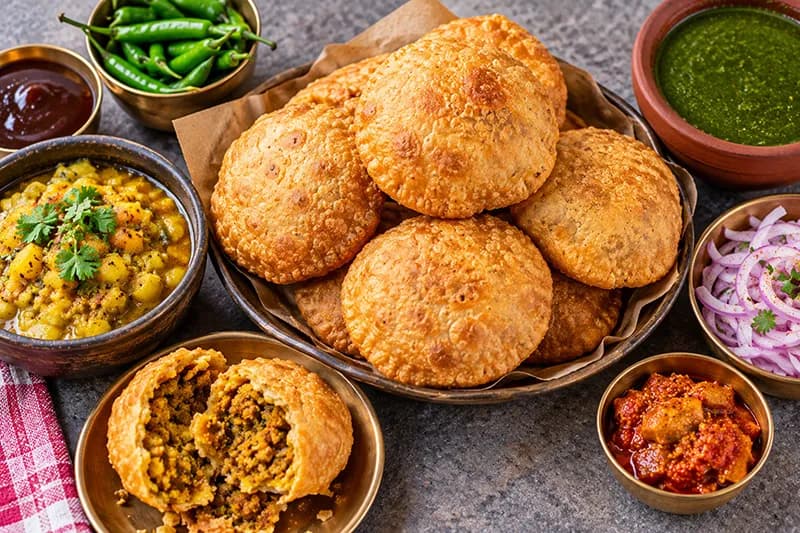
Oma Pahalwan Kachodi Wale
In Chatta Bazar, opposite Brijwasi Mithai Wala near Tilak Dwar, famous for bedai and kachori with spicy aloo sabzi, Mathura's classic breakfast.
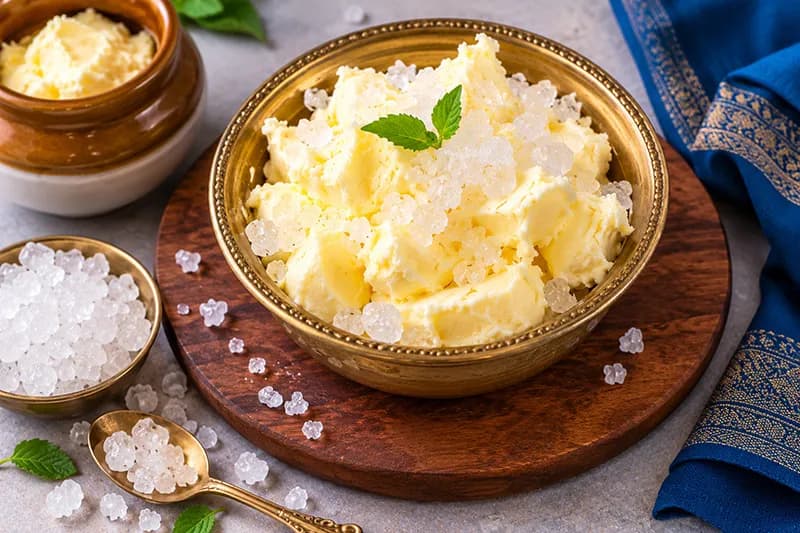
Makhan-Mishri
Fresh white butter with sugar crystals, Krishna's favourite food, sold at sweet shops across Mathura and a must-try in the city of his birth.
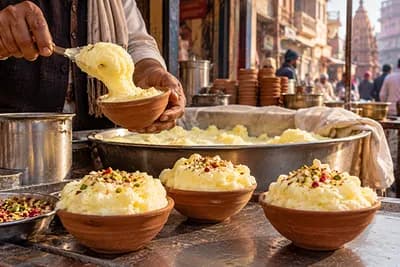
Malaiyo (Winter Special)
A light, airy winter sweet of milk foam, sugar and saffron, available at shops such as Shyam Yadav Mithai Wala in Dholi Pyau.
Visitor guide
Agra Airport (AGR)
Approximately 50-63 km
- The nearest airport, with limited domestic flights.
Noida International Airport, Jewar
Approximately 70 km
- Open for commercial flights since June 2026, offering an alternative to Delhi for travellers to Mathura.
Indira Gandhi International Airport, Delhi (DEL)
Approximately 150-180 km
- The main international airport for the region, about 3-4 hours by road via the Yamuna Expressway or NH 19.
Gallery
Videos
Third-party videos may include ads or external commentary.
Frequently Asked Questions
In Mathura, Uttar Pradesh, on Janmabhoomi Marg near Deeg Gate, about 3.4 km from Mathura Junction.
It is revered as the birthplace of Lord Krishna.
The Garbha Griha, the Keshav Dev temple and the Bhagavata Bhavan.
Generally about 05:00 AM - 12:00 PM and 03:00/04:00 PM - 08:30/09:30 PM, depending on season.
No, entry and darshan are free.
No. Phones, cameras, bags, pens and electronics are not allowed.
On Bhadrapada Krishna Ashtami (August-September), with a midnight celebration; in 2026 it fell on 4 September.
The complex was built from the 1950s by the trust founded by Jugal Kishore Birla, with the Keshav Dev temple completed in 1958 and the Bhagavata Bhavan in 1982.
Temples stood here from ancient times; a grand temple built in 1618 was destroyed in 1670, and the Shahi Eidgah was built on part of the site.
Yes. Suits about the adjoining Shahi Eidgah and a 1968 agreement are being heard by the Allahabad High Court.
About 1-1.5 hours on normal days.
By train to Mathura Junction, then auto or e-rickshaw; Agra airport is the nearest airport.
Dwarkadhish Temple, Vishram Ghat, Vrindavan, Gokul and Govardhan.
In hotels near the complex, in the Sansthan's guest house, or in Vrindavan.