

20°C
Chhatarpur
Khajuraho Group of Monuments
 Chhatarpur, Madhya Pradesh, India
The Khajuraho Group of Monuments in Madhya Pradesh is a UNESCO World Heritage Site, renowned for its Chandela-era Hindu and Jain temples, Nagara architecture and intricate stone sculptures.
- ReligionHindu, Jain
- DeityLord Shiva,
Lord Vishnu,
the Goddess (Devi),
Lord Surya,
Jain Tirthankaras - TimingsSunrise to sunset, open every day

About the temple
About the temple
The Khajuraho Group of Monuments in Chhatarpur district, Madhya Pradesh, is one of the finest temple complexes in India and a UNESCO World Heritage Site since 1986. The temples were built by the Chandela dynasty, whose early capital was Khajuraho, mostly between about 950 and 1050 CE. Of about 85 temples once built, about 25 survive across an area of about 6 sq km, in three groups: Western, Eastern and Southern. They are dedicated to Shiva, Vishnu, the Goddess, Surya and the Jain Tirthankaras. The temples are the high point of the North Indian Nagara style, with tall shikharas rising like mountain peaks. Their walls carry thousands of sculptures of gods, goddesses, celestial maidens (apsaras), musicians, warriors and scenes of daily life, along with the erotic sculptures for which Khajuraho is widely known. The Kandariya Mahadeva Temple, about 31 metres high, is the largest. The Matangeshwar Temple beside the Western Group is still in active worship, and the annual Khajuraho Dance Festival in February brings India's classical dance to the temple setting.
Khajuraho Group of Monuments
Khajuraho Group of Monuments
The Sacred Legacy of Khajuraho in Numbers
Discover the history and artistry of the Khajuraho Group of Monuments, the Chandela kings' city of temples. From its granite Yogini temple to the soaring Kandariya Mahadeva, the site preserves a thousand years of devotion and craftsmanship in stone.
- Temples Believed to Have Been Built by the Chandelas
- 85
- Temples That Survive Today
- 23
- Main Period of Temple Building
- 950-1050 CE
- Approximate Height of the Kandariya Mahadeva Temple
- 31 m
- Sculptures on the Kandariya Mahadeva Temple
- 870+
- Year the Lakshmana Temple Was Dedicated
- 954 CE
- Yoginis Honoured in the Chausath Yogini Temple
- 64
- Area Covered by the Three Groups of Temples
- 6 sq km
- Year of UNESCO World Heritage Inscription
- 1986
- Edition of the Khajuraho Dance Festival in 2026
- 52nd
Temples Believed to Have Been Built by the Chandelas
Temples That Survive Today
Main Period of Temple Building
Approximate Height of the Kandariya Mahadeva Temple
Sculptures on the Kandariya Mahadeva Temple
Year the Lakshmana Temple Was Dedicated
Yoginis Honoured in the Chausath Yogini Temple
Area Covered by the Three Groups of Temples
Year of UNESCO World Heritage Inscription
Edition of the Khajuraho Dance Festival in 2026
Historical Background
Khajuraho was the early capital and religious centre of the Chandela dynasty, which ruled Bundelkhand (then Jejakabhukti) from the 9th century until 1315 CE. Once feudatories of the Gurjara-Pratiharas, the Chandelas became practically independent in the 10th century, and most of the temples were built between about 950 and 1050 CE, at the height of their power. King Yashovarman commissioned the Lakshmana Temple, his son Dhanga built the Vishvanatha Temple in about 1002 CE, and King Vidyadhara, who resisted Mahmud of Ghazni, built the Kandariya Mahadeva Temple in about 1025-1050. Jain temples such as Parshvanatha were raised in the same period by Jain patrons, reflecting the dynasty's religious tolerance. Al-Biruni mentioned Khajuraho as the capital of Jajahuti in 1022, and Ibn Battuta described its temples and yogis in about 1335. After the Chandelas moved their capital to Mahoba in the 11th century, Khajuraho declined, and its remote location helped protect the temples. The British army captain T.S. Burt brought them to wide attention in 1838, and Alexander Cunningham surveyed them in the 1850s-60s. Protected by the Archaeological Survey of India, the site was inscribed as a UNESCO World Heritage Site in 1986.
875 to 900 CE
875 to 900 CE
The Chausath Yogini Temple, the oldest surviving temple at Khajuraho, was built of granite with shrines for 64 yoginis.900 to 925 CE
900 to 925 CE
The Matangeshwar Temple was built, and is still in active worship today.930 to 950 CE
930 to 950 CE
The Lakshmana Temple, dedicated to Vaikuntha Vishnu, was built by King Yashovarman; a Khajuraho inscription of 953 to 954 CE records his achievements.950 to 970 CE
950 to 970 CE
The Parshvanatha Jain Temple of the Eastern Group was built; an inscription of 954 CE records gifts to it in Dhanga's reign.1002 CE
1002 CE
The Vishvanatha Temple, dedicated to Shiva, was completed under King Dhanga.1020s CE
1020s CE
Al-Biruni recorded Khajuraho as the capital of Jajahuti (1022); King Vidyadhara resisted the campaigns of Mahmud of Ghazni.1025 to 1050 CE
1025 to 1050 CE
The Kandariya Mahadeva Temple, the largest at Khajuraho, was built in the reign of Vidyadhara.1100 to 1150 CE
1100 to 1150 CE
The later temples, including Chaturbhuja and Duladeo of the Southern Group, were built.1182 to 1183 CE
1182 to 1183 CE
Prithviraj Chauhan defeated the Chandela king Paramardi.1202 to 1203 CE
1202 to 1203 CE
Qutb-ud-din Aibak captured the Chandela fort of Kalinjar, and Chandela power declined.1335 CE
1335 CE
The traveller Ibn Battuta described Khajuraho's temples and the yogis living near them.1838 CE
1838 CE
British army captain T.S. Burt visited the temples and brought them to wide attention.1850s to 1860s CE
1850s to 1860s CE
Alexander Cunningham of the Archaeological Survey surveyed and documented the temples.1952 CE
1952 CE
The Archaeological Museum, Khajuraho (formerly the Jardine Museum), came under the ASI.1975 CE
1975 CE
The first Khajuraho Dance Festival was held.1986 CE
1986 CE
The Khajuraho Group of Monuments was inscribed as a UNESCO World Heritage Site.8 November 2025
8 November 2025
The Banaras to Khajuraho Vande Bharat Express was flagged off by Prime Minister Narendra Modi from Varanasi.20 to 26 February 2026
20 to 26 February 2026
The 52nd Khajuraho Dance Festival was held at the Western Group.


Synopsis
The Khajuraho Group of Monuments in Madhya Pradesh is a UNESCO World Heritage Site of about 25 surviving Hindu and Jain temples, built by the Chandela kings mostly between about 950 and 1050 CE. Its Western Group, with the Kandariya Mahadeva, Lakshmana, Vishvanatha and Chitragupta temples, is one of India's best-known heritage sites, while the Eastern Group holds the Jain temples of Parshvanatha and Adinatha. The Matangeshwar Temple remains in daily worship and is the focus of the Maha Shivaratri celebrations, and the week-long Khajuraho Dance Festival is held every February against the backdrop of the temples.
Khajuraho was the early capital and religious centre of the Chandela dynasty, who, according to legend, traced their descent from the Moon god Chandra and Hemavati. They built about 85 temples here, mostly between about 950 and 1050 CE, dedicated to Shiva, Vishnu, Ganesha, the Goddess, Surya and the Jain Tirthankaras. Historical Records: Inscriptions associated with the Lakshmana (954 CE), Vishvanatha (c. 1002 CE) and Parshvanatha (954 CE) temples record the Chandela kings and their gifts. Al-Biruni (1022) and Ibn Battuta (about 1335) mention Khajuraho. T.S. Burt (1838) and Alexander Cunningham (1850s-60s) documented the temples for modern scholarship. Major Patrons: The Chandela kings Yashovarman, Dhanga and Vidyadhara were the chief patrons, while wealthy Jain patrons such as Pahila, honoured by King Dhanga, built the Jain temples of the Eastern Group. Religious Significance: Khajuraho brings together Shaiva, Vaishnava, Shakta, Saura and Jain worship in one sacred landscape. The Matangeshwar Temple is still in daily worship, the Jain temples remain active places of Jain devotion, and the sculptures reflect the four goals of life (dharma, artha, kama and moksha) and Tantric ideas. Conservation & Recognition: The temples are protected by the Archaeological Survey of India under the Ancient Monuments and Archaeological Sites and Remains Act, 1958, with a prohibited area of 100 m around each monument and a regulated area extending a further 200 m. The group was inscribed as a UNESCO World Heritage Site in 1986 under criteria (i) and (iii) as the culmination of northern Indian temple art and architecture.
Sacred significance
A Sacred Landscape of Many Faiths
Khajuraho brings together temples of Shiva, Vishnu, Ganesha, the Goddess, Surya and the Jain Tirthankaras in one sacred city. This shows the religious harmony of the Chandela kingdom, where Hindu and Jain communities built side by side.
Matangeshwar, the Living Temple
The Matangeshwar Temple is the only Hindu temple at Khajuraho still in continuous worship. Its great lingam, about 2.5 metres high, draws thousands of devotees on Maha Shivaratri, when the wedding of Shiva and Parvati is celebrated in a three-day festival.
The Temple as Cosmic Mountain
The rising shikharas of Khajuraho are built in the form of a mountain range, symbolising Mount Meru, the mythical centre of creation, and Mount Kailash, the abode of Shiva. A devotee moving around and into the temple is traditionally understood to journey from the world of the senses to the sanctum, where the divine resides.
The Four Goals of Life
The sculptures show the whole of human life, from worship and war to music, family and love. Many scholars and devotees read them as a picture of the four goals of life (dharma, artha, kama and moksha), leading towards liberation in the sanctum.
Shiva and Shakti
Some scholars link the erotic sculptures to Tantric tradition, in which the union of male and female can be read as the union of Shiva and Shakti, consciousness and energy. The Chausath Yogini Temple, the oldest at Khajuraho, shows the importance of goddess worship in its early history.
Jain Devotion
The Parshvanatha, Adinatha and Shantinatha temples of the Eastern Group remain active Jain places of worship, visited by Jain pilgrims and devotees throughout the year.
Surya, the Sun God
The Chitragupta Temple, built in about 1020–1025 CE, is dedicated to Surya. Its sanctum holds a 2.1-metre image of the Sun god riding a chariot drawn by seven horses.
Varaha, the Saviour of the Earth
The Varaha shrine of the Western Group holds a 2.6-metre monolithic sandstone boar, Vishnu's avatar who rescued the Earth goddess Bhudevi from the cosmic ocean. Its body is covered with numerous small carved figures of gods.
Architecture
The Khajuraho temples are among the finest examples of the North Indian Nagara style. Most are built of fine-grained buff, pink and pale yellow sandstone, likely from the Panna quarries east of the Ken river, while the Chausath Yogini, Brahma and Lalguan Mahadeva temples are of granite. The stones were fitted together without mortar, held by their weight and by mortise-and-tenon joints. Each temple stands on a high platform (jagati), and all but one, the Chaturbhuja, face east towards the sunrise. The main temples follow a sequence of entrance porch (ardhamandapa), hall (mandapa), and vestibule (antarala) leading to the sanctum (garbhagriha), with a great hall (mahamandapa), corner shrines and an inner ambulatory (pradakshina path) in the larger temples. The roofs rise in steps towards the main spire (shikhara), surrounded by many smaller spires (urushringas), giving the temple the shape of a mountain range. The walls carry bands of sculpture of gods, celestial maidens, musicians, animals and scenes of life. The temples are grouped into Western, Eastern and Southern groups, spread over about 6 sq km.
Masterpiece
Kandariya Mahadeva Temple
The largest temple at Khajuraho, dedicated to Shiva and about 31 metres high. It stands on a 4-metre plinth, its main spire is surrounded by 84 miniature spires, and it carries over 870 sculptures, most of them about half life-size.
Vaishnava
Lakshmana Temple
Dedicated in 954 CE to Vaikuntha Vishnu, this is a sandhara temple of the panchayatana plan, with four subsidiary shrines at the corners of its platform. Friezes along its plinth depict daily life, love and war, many recalling events of the Chandela period.
Shaiva
Vishvanatha Temple
Built in about 1002 CE, this Shiva temple faces a separate Nandi shrine with a 2.2-metre statue of Nandi, and its sculptures of surasundaris (celestial maidens) are among the finest at the site.
Earliest
Chausath Yogini Temple
The oldest surviving temple at Khajuraho (875 to 900 CE), built of rough granite on a rectangular plan, with small cells around an open courtyard for the 64 yoginis. Unlike most yogini temples, which are circular, it is rectangular.
Shrine
Varaha Shrine
A pavilion opposite the Lakshmana Temple holds a monolithic sandstone boar, Vishnu's Varaha avatar, about 2.6 metres long, carved with numerous small figures of gods.
Saura
Chitragupta Temple
A temple of Surya, the Sun god, built in about 1020 to 1025 CE, whose sanctum holds a 2.1-metre image of Surya driving a chariot drawn by seven horses.
Shakta
Devi Jagadambi Temple
A small, elegant temple first dedicated to Vishnu, whose image remains over the sanctum door. It now holds an image of the Goddess, worshipped as Devi Jagadambi, and is one of the most finely decorated temples at Khajuraho.
Jain
Parshvanatha Temple
The largest Jain temple at Khajuraho, with fine sculptures of celestial maidens, an inscription of 954 CE and one of the oldest known 4×4 magic squares.
Late Style
Duladeo and Chaturbhuja Temples
The later temples of the Southern Group, built around 1100 to 1150 CE. Chaturbhuja, the only temple at Khajuraho that does not face east, holds a 2.7-metre four-armed image identified by the ASI as Dakshinamurti Shiva, and is the only major temple without erotic sculpture.
Material
Sandstone Construction
The temples are built of sandstone likely quarried at Panna, east of the Ken river, and fitted without mortar using precise mortise-and-tenon joints.
Sculpture
Surasundaris and Mithunas
Celestial maidens shown applying kohl and vermilion, wringing their hair after bathing, removing a thorn from the foot or gazing into a mirror, and loving couples (mithunas), are among the most admired sculptures in Indian art.
Interesting facts

The Chandelas are believed to have built about 85 temples, of which 23 survive today, including one partly excavated. They are spread over about 6 sq km.
Deities & Shrines
Matangeshwar Mahadev
The great lingam of the Matangeshwar Temple, about 2.5 metres high, is the principal living deity of Khajuraho. Devotees offer water, milk and bel leaves, and celebrate Shiva's wedding here on Maha Shivaratri, when the lingam is dressed and decorated as a bridegroom.
Kandariya Mahadeva and Vishvanatha
The two great Shiva temples of the Western Group enshrine lingams in their sanctums. Vishvanatha once held two lingams, one of emerald and one of stone, of which only the stone lingam survives, and it faces a 2.2-metre Nandi in its own pavilion.
Vaikuntha Vishnu (Lakshmana Temple)
The three-headed Vaikuntha form of Vishnu, with a human face flanked by the lion (Narasimha) and boar (Varaha) heads, is enshrined in the Lakshmana Temple.
Varaha
The monolithic boar in the Varaha shrine, carved with numerous small deities, represents Vishnu's avatar who rescued the Earth.
Dakshinamurti Shiva (Chaturbhuja Temple)
A large four-armed image, about 2.7 metres tall, stands in the Chaturbhuja Temple of the Southern Group. Popularly called Vishnu, it is identified by the Archaeological Survey of India as Dakshinamurti Shiva.
Surya (Chitragupta Temple)
The Sun god, standing in his chariot drawn by seven horses, is the main image of the Chitragupta Temple, a partly broken statue about 2.1 metres tall.
Devi Jagadambi
The temple was first dedicated to Vishnu. Its present image, an ancient figure of the Goddess painted black, is worshipped as Devi Jagadambi and is often identified with Parvati or Kali.
The 64 Yoginis
The Chausath Yogini Temple was built for the 64 yoginis, goddesses of Tantric worship; their images no longer survive in the cells, though three mother-goddess statues found in the ruins are now in the Khajuraho museum.
Parshvanatha, Adinatha and Shantinatha
The Jain temples of the Eastern Group enshrine the Tirthankaras Parshvanatha, Adinatha (Rishabhanatha) and Shantinatha, whose 4.6-metre standing image, inscribed in 1028 CE, is worshipped by Jain devotees.
Ganesha
Images of Ganesha appear on many temples at Khajuraho, and one temple of the group is dedicated to him.
Hanuman
A colossal image of Hanuman in the town, still in worship, bears an inscription of 922 CE, the oldest dated inscription at Khajuraho.
Darshan & Service Offerings
| Service | Timing | Price | Notes |
|---|---|---|---|
| Matangeshwar Temple Darshan | From about 06:00 AM to 09:00 PM. | Free | Darshan of the great lingam is free. Devotees climb the steps to the sanctum and offer water, milk, flowers and bel leaves. On Maha Shivaratri and Mondays of Shravan, queues are long. |
| Western Group of Temples | Sunrise to sunset. | About ₹40 (Indians and SAARC/BIMSTEC; ₹35 online), ₹600 (other foreigners; ₹550 online); children under 15 free | The main ticketed group, with the Kandariya Mahadeva, Lakshmana, Vishvanatha, Chitragupta, Devi Jagadambi and Varaha shrines; the Matangeshwar and Chausath Yogini temples lie close by. Tickets can be bought online through the ASI portal or at the counter. Allow 2-3 hours. |
| Eastern Group of Temples | Sunrise to sunset. | Free | The Jain temples of Parshvanatha, Adinatha and Shantinatha, and the Hindu temples of Brahma, Vamana and Javari. Jain temples remain in active worship. Visitors should dress modestly and remove leather items before entering. |
| Southern Group of Temples | Sunrise to sunset. | Free | The Duladeo and Chaturbhuja temples, about 3-5 km from the Western Group. Chaturbhuja, the only temple at Khajuraho facing west, is especially beautiful at sunset. An auto or bicycle is the easiest way to reach them. |
| Archaeological Museum, Khajuraho | About 09:00/10:00 AM - 05:00 PM; closed on Fridays. | Nominal ASI fee (confirm at the counter; reported as included with the Western Group ticket) | The ASI museum near the Western Group displays sculptures and antiquities of the Chandela period in five galleries. |
| Light and Sound Show | Evenings, in English and Hindi. | ₹300 (Indian adults), ₹150 (Indian children), ₹800 (foreign adults), ₹400 (foreign children) | A 35-minute show at the Western Group narrated by Amitabh Bachchan, lighting up the temples as it tells the story of the Chandelas. |
| Adivart Tribal and Folk Art Museum | 12:00 noon - 08:00 PM; closed on Mondays and government holidays. | ₹20 (Indians), ₹400 (foreigners), ₹100 camera | A museum of the tribes of Madhya Pradesh, with reconstructed homes of seven tribes and tribal art, jewellery and paintings. |
| Guided Tours | During visiting hours. | Rates set by the approved guide association | Government-approved guides are available at the Western Group, and audio guides are also offered. A guide greatly helps in understanding the sculptures. |
| Puja and Abhishek at Matangeshwar | During temple hours. | As fixed by the temple or priest | Devotees can arrange rudrabhishek and special puja with the priests, especially on Mondays and festivals. Priests take the devotee's name and gotra for the sankalp. |
Visitor information
Location
The Khajuraho Group of Monuments is in Khajuraho town, Chhatarpur district, Madhya Pradesh, in the Bundelkhand region. The Western Group and Matangeshwar Temple are in the town centre; the Eastern Group is about 2 km east and the Southern Group about 3-5 km south.
Visiting Hours
The ASI monuments are open from sunrise to sunset every day. The Matangeshwar Temple is open from about 6:00 AM to 9:00 PM.
Tickets
The Western Group is ticketed (about ₹40 for Indians and SAARC/BIMSTEC visitors, ₹600 for other foreigners, free for children under 15, with a small discount online). The Eastern and Southern Groups and Matangeshwar are free. Online tickets are available on the ASI portal.
Guides and Audio Guides
Government-approved guides and audio guides are available at the Western Group entrance. Agree on the rate and duration before starting.
Archaeological Museum
The ASI museum near the Western Group (closed on Fridays) displays sculptures from the site and makes a good introduction before touring the temples.
Light and Sound Show
The evening show at the Western Group runs in English and Hindi. Book tickets at the counter or through MP Tourism.
Dress Code
Modest clothing is recommended, especially at Matangeshwar and the Jain temples. Footwear must be removed before entering the temples.
Photography
Photography for personal use is generally allowed at the ASI monuments; tripods, drones and commercial filming need permission. Do not photograph inside active shrines without permission.
Accessibility
The Western Group has level paths and lawns, but the temples stand on high platforms reached by steep steps. Elderly visitors should take care.
Getting There
Khajuraho Airport (HJR) is about 3 km south of the town, and Khajuraho railway station about 6 km from the temples. Autos, taxis and bicycles are used to move between the groups.
Important Visitor Notice
The town is crowded during the Dance Festival in February and on Maha Shivaratri. Summer days are very hot; visit early in the morning.
Location
Chhatarpur, Madhya Pradesh, India
Best Time to Visit
Ideal Time to Visit (October-March)
Cool, pleasant weather makes this the best time to explore the temples on foot.
Khajuraho Dance Festival (February)
A week of classical dance at the Western Group from 20 to 26 February; book hotels well ahead.
Maha Shivaratri (February-March)
The wedding of Shiva and the fair at Matangeshwar draw crowds from across Bundelkhand.
Sunrise and Late Afternoon
The sandstone glows in the soft light of early morning and late afternoon, the best times for photography.
Monsoon (July-September)
The countryside turns green and nearby waterfalls such as Raneh and Pandav are at their best, though the Panna Tiger Reserve is closed for safaris.
Summer Visit (April-June)
Very hot, often above 40°C; visit early in the morning and rest at midday.
Weekdays
Weekdays outside festival periods are quieter at the Western Group.
Panna Tiger Reserve Season
The reserve is open from 1 October to 30 June (core-zone safaris are closed on Wednesday evenings), so combine a temple visit with a safari in this season.
Nearby places
Raneh Falls and Ken Canyon
About 20 km
- A canyon of pink, red and grey granite on the Ken river, with waterfalls that are best in the monsoon. The Ken Gharial Sanctuary lies further downstream.
Pandav Falls and Caves
About 35 km
- A 30-metre waterfall with caves and shrines associated in legend with the Pandavas, near Panna.
Festivals & culture
Khajuraho celebrates both its living worship and its artistic heritage. Maha Shivaratri at the Matangeshwar Temple is the great religious festival, with the wedding of Shiva and Parvati and a fair; the Khajuraho Dance Festival in February brings India's classical dance to the temples; and the Jain temples celebrate Mahavir Jayanti and Paryushan (Das Lakshana Parva). Festival dates follow the Hindu and Jain calendars and the state's programme.
Khajuraho Dance Festival
February
A week-long festival of classical dance (Kathak, Bharatanatyam, Odissi, Kuchipudi, Manipuri, Gaudiya Nritya and Kathakali, with modern Indian dance added in recent years) against the Western Group, organised by the Madhya Pradesh Kala Parishad since 1975. The 52nd edition was held from 20 to 26 February 2026, with performances from 7:00 PM.
Maha Shivaratri
Phalguna (February-March)
The wedding of Shiva and Parvati is celebrated at Matangeshwar in a three-day ceremony, with the lingam dressed as a bridegroom, worship through the night and a fair, drawing devotees from across Bundelkhand.
Shravan Mondays
Shravan (July-August)
Devotees offer water and bel leaves to the Matangeshwar lingam on the Mondays of the holy month.
Mahavir Jayanti
Chaitra (March-April)
The birth of Lord Mahavira is celebrated at the Jain temples with puja and processions.
Paryushan (Das Lakshana Parva)
Bhadrapada (August-September)
The Jain festival of fasting and forgiveness is observed at the Eastern Group temples, where it is celebrated as Das Lakshana Parva in the Digambara tradition.
World Heritage Day
18 April
The ASI usually offers free entry to protected monuments, including the Western Group, on World Heritage Day.
Diwali and Holi
October-November and March
The town celebrates the major Hindu festivals with lamps, colours and Bundeli folk music.
Additional information
Site Management
The temples are protected by the Archaeological Survey of India. Worship at the Matangeshwar Temple, itself an ASI-protected monument, is conducted locally, and the Jain temples are managed by the Shri Digambar Jain Atishay Kshetra trust.
World Heritage Site
The Khajuraho Group of Monuments was inscribed by UNESCO in 1986 under criteria (i) and (iii).
The Three Groups
The Western Group holds the most famous temples; the Eastern Group has the Jain temples of Parshvanatha, Adinatha, Shantinatha and Ghantai and the Brahma, Vamana and Javari temples; the Southern Group has Duladeo and Chaturbhuja.
Understanding the Sculptures
The erotic sculptures make up less than a tenth of the whole and are best understood with a guide.
Names of the Site
The site is known as Khajuraho Temples, Khajuraho Group of Monuments and, by its ancient name, Kharjuravahaka.
Time Needed
Allow at least one full day for the temples and museum, and two days with Raneh Falls or Panna.
Online Tickets
ASI tickets for the Western Group can be bought online.
Visitor Information
MP Tourism runs hotels and information services in Khajuraho, and the ASI office manages the monuments.
Temple facilities
Ticket Counter
Counters at the Western Group entrance, with online tickets also available. Cards and UPI are usually accepted.
Guides and Audio Guides
Government-approved guides and audio guides at the entrance.
Archaeological Museum
An ASI museum with five galleries near the Western Group.
Interpretation Centre
An interpretation centre at the Western Group, with an audio-visual auditorium and display galleries introducing the temples.
Cafeteria
A cafeteria near the Western Group main entrance offers refreshments.
Drinking Water
Drinking water is available at the Western Group. Carry your own bottle when visiting the Eastern and Southern Groups.
Toilets
Toilets are available near the Western Group entrance.
Landscaped Gardens
Lawns and paths connect the temples of the Western Group, with sit-outs and benches for rest between temples.
Footwear Areas
Footwear is left at the base of each temple's steps.
Security
ASI staff and security guards patrol the monuments, and parts of the Western Group are monitored by CCTV.
Parking
A parking area at the Western Group main entrance, with limited roadside parking near the Eastern and Southern Groups.
Souvenir and Book Shops
A publication counter at the Western Group and shops nearby sell books, postcards and souvenirs.
Emergency services
India Emergency Response
Not location-specific
Contact
112
- Call 112 for urgent police, medical or fire assistance. In Madhya Pradesh, one call to 112 alerts the police, ambulance and fire services together.
Top picks
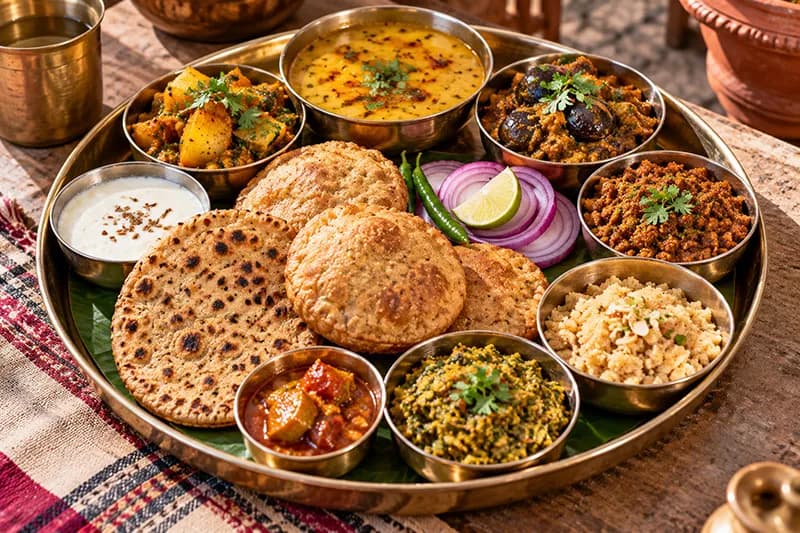
Bundeli Thali
Try a traditional Bundelkhand meal with dishes such as bara, meeda, maheri and fara, served with local breads and buttermilk-based curries.

Bara
Taste split black-lentil dumplings soaked in buttermilk and tempered with mustard seeds, a Bundeli favourite.
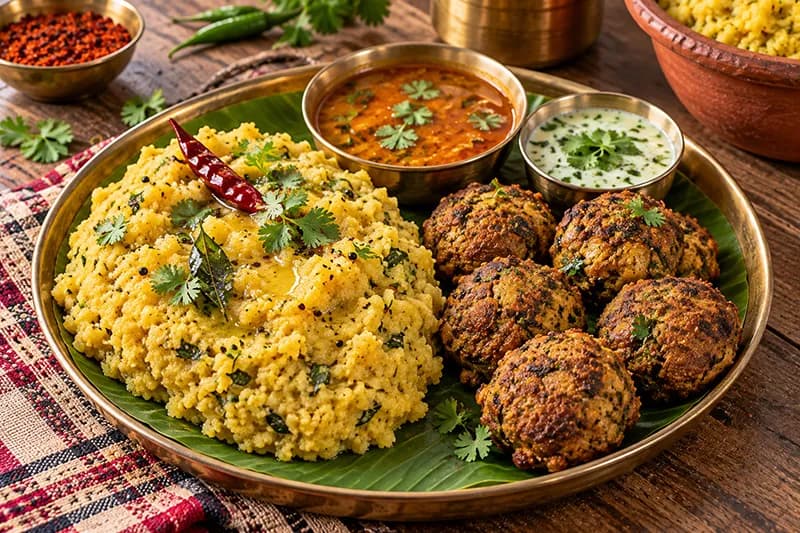
Thopa and Baffori
Sample the gram-flour specialities of Bundelkhand: thopa, cut into diamond shapes, and baffori, small dumplings steamed over cloth and spiced.

Kadaknath Chicken
Non-vegetarian visitors can try Kadaknath, the prized black-meat chicken of Madhya Pradesh, cooked in Bundeli spices.
Visitor guide
Khajuraho Airport (HJR)
Approximately 3 km
- Flights connect Khajuraho with Delhi and Varanasi, including daily Air India services from the 2026 winter schedule, with services varying by season. Taxis and autos take about 10 minutes to the temples.
Gallery
Videos
Third-party videos may include ads or external commentary.
Frequently Asked Questions
They are in Khajuraho, Chhatarpur district, Madhya Pradesh, in the Bundelkhand region of central India.
The Chandela kings built them, mostly between about 950 and 1050 CE.
About 85 were built, and 23 survive in the Western, Eastern and Southern Groups.
Yes, it was inscribed in 1986.
The ASI monuments are open from sunrise to sunset every day; the museum is closed on Fridays.
The Western Group costs about ₹40 for Indians and ₹600 for foreigners, with children under 15 free. The Eastern and Southern Groups are free.
Yes. The Matangeshwar Temple and the Jain temples of the Eastern Group are in active worship.
They are interpreted in several ways, including Tantric symbolism, auspicious protection and the depiction of all aspects of life. They form only a small part of the sculpture.
The Kandariya Mahadeva Temple, dedicated to Shiva, about 31 metres high.
The Chausath Yogini Temple, built in about 875-900 CE.
It is held every February; in 2026 it ran from 20 to 26 February.
Yes, every evening at the Western Group, in English and Hindi, narrated by Amitabh Bachchan.
By air to Khajuraho Airport, by train to Khajuraho station, or by road from Jhansi or Satna.
At least one full day for the temples and museum, and two days with Panna or Raneh Falls.