

24°C
Mysuru
Sri Chamundeshwari Temple
 Mysuru, Karnataka, India
Sri Chamundeshwari Temple on Chamundi Hills is the hilltop shrine of Mysuru's guardian goddess, who slew the buffalo demon Mahishasura and is honoured as Nada Devi, the State Goddess of Karnataka.
- ReligionHindu
- DeityChamundeshwari
- TimingsMorning: 07:30 AM - 02:00 PM, Afternoon: 03:30 PM - 06:00 PM, Evening/Night: 07:30 PM - 09:00 PM

About the temple
About the temple
Sri Chamundeshwari Temple stands on the summit of Chamundi Hills, about 1,060 metres above sea level and some 13 km by road from the centre of Mysuru, Karnataka. It is dedicated to Goddess Chamundeshwari, the fierce form of Durga who slew the buffalo demon Mahishasura on this very hill, which gave Mysuru (Mahishuru) its name. The original shrine is attributed to the Hoysalas in the 12th century, and the temple was greatly expanded by the Wadiyar kings of Mysore, who revered the goddess as their family deity. Its seven-tiered gopuram, the 1,000-step stone stairway and the monolithic Nandi are landmarks of the city. Honoured as Nada Devi, the State Goddess, Chamundeshwari is at the heart of the Mysuru Dasara, which begins on the hill each year, and of the sacred Ashada Fridays.
Sri Chamundeshwari Temple
Sri Chamundeshwari Temple
The Sacred Legacy of Sri Chamundeshwari Temple in Numbers
Discover the sacred history and enduring spiritual significance of Sri Chamundeshwari Temple, the hilltop shrine of Mysuru's guardian goddess. From Hoysala beginnings to the royal Dasara of the Wadiyars, the temple connects centuries of devotion to Karnataka's living traditions.
- Period to Which the Original Shrine Is Attributed (Hoysala)
- 12th Century
- Elevation of Chamundi Hills Above Sea Level
- About1060 m
- Steps in the Stone Stairway, Built in 1659
- About1000
- Tiers of the Gopuram Added in 1827
- 7
- Height and Length of the Monolithic Nandi
- About4.9 m x 7.6 m
- Arms of the Goddess (Ashtabhuja) in the Sanctum
- 8
- Shakti Peethas, Among Which Some Traditions Count the Krouncha Peetha of Chamundi Hills
- 18
- Road Distance from Mysuru City to the Temple
- About13 km
- Daily Darshan Hours, with Afternoon and Evening Breaks
- 7:30 AM - 9:00 PM
- Duration of the Mysuru Dasara 2026 (11-21 October)
- 11 Days
- Date the City Was Officially Renamed Mysuru
- 1 November 2014
Period to Which the Original Shrine Is Attributed (Hoysala)
Elevation of Chamundi Hills Above Sea Level
Steps in the Stone Stairway, Built in 1659
Tiers of the Gopuram Added in 1827
Height and Length of the Monolithic Nandi
Arms of the Goddess (Ashtabhuja) in the Sanctum
Shakti Peethas, Among Which Some Traditions Count the Krouncha Peetha of Chamundi Hills
Road Distance from Mysuru City to the Temple
Daily Darshan Hours, with Afternoon and Evening Breaks
Duration of the Mysuru Dasara 2026 (11-21 October)
Date the City Was Officially Renamed Mysuru
Historical Background
Sri Chamundeshwari Temple crowns Chamundi Hills, which rise about 250 metres (some 800 feet) above the city of Mysuru. The hill was a sacred site from early times, and the Mahabaleshwara Temple nearby is regarded as the older of the two shrines. The original Chamundeshwari shrine is attributed to the Hoysala rulers in the 12th century, and the tower is credited to the Vijayanagara period. The Wadiyar kings of Mysore, who adopted the goddess as their family deity, transformed the site: in the mid-17th century Dodda Devaraja Wadiyar built the stone stairway of about 1,000 steps and the monolithic Nandi on the hillside. In 1827 Krishnaraja Wadiyar III renovated the temple, added the seven-tiered gopuram and presented ornaments and vehicles to the goddess. The temple became the spiritual centre of the royal Mysore Dasara, which continues today as Karnataka's state festival. Long managed under the Muzrai (Endowments) Department, the temple is now administered by the Sri Chamundeshwari Kshetra Development Authority, created by a state law in 2024.
Ancient tradition
Ancient tradition
Goddess Chamundeshwari slays Mahishasura on the hill, giving the region the name Mahishuru.Early period
Early period
The hill is sacred to Shiva as Mahabaleshwara, whose temple is regarded as the older shrine on the hill.12th century
12th century
The original Chamundeshwari shrine is attributed to the Hoysala rulers.17th century
17th century
The temple tower is credited to the Vijayanagara period.1659
1659
Dodda Devaraja Wadiyar builds the stone stairway of about 1,000 steps up Chamundi Hills.17th century (c. 1659-1664)
17th century (c. 1659-1664)
The monolithic Nandi, about 4.9 m tall and 7.6 m long, is carved from a single block of granite on the hillside.1827
1827
Krishnaraja Wadiyar III renovates the temple and adds the seven-tiered gopuram.19th century
19th century
The Mysore rulers present ornaments and vahanas, and the royal Dasara centres on the goddess.1 November 2014
1 November 2014
The city's name is officially changed from Mysore to Mysuru.2024
2024
The Sri Chamundeshwari Kshetra Development Authority Act is passed, placing the temple and hill under a new authority. The law has been challenged in the Karnataka High Court.11 October 2026
11 October 2026
The Mysuru Dasara 2026 is scheduled to be inaugurated on Chamundi Hills, with the Jamboo Savari on 21 October.


Synopsis
Sri Chamundeshwari Temple on Chamundi Hills, Mysuru, is dedicated to Goddess Chamundeshwari, the slayer of Mahishasura and the guardian deity of the Wadiyar kings and of Karnataka. The shrine dates back to the Hoysala period and was expanded by the Mysore rulers, who added the stone stairway, the great Nandi and the seven-tiered gopuram. Regarded in some traditions as one of the eighteen Shakti Peethas, the Krouncha Peetha, the temple is the starting point of the world-famous Mysuru Dasara and draws huge crowds on Ashada Fridays, Navaratri and the goddess's Vardhanti. It is administered today by the Sri Chamundeshwari Kshetra Development Authority.
Sri Chamundeshwari Temple, dedicated to Goddess Chamundeshwari, stands on the summit of Chamundi Hills near Mysuru. Tradition places the goddess's victory over Mahishasura on this hill, and the original shrine is attributed to the Hoysala rulers of the 12th century. The older Mahabaleshwara Temple on the same hill shows that it was a sacred site even earlier.
The temple's history is preserved in tradition, in royal records of the Mysore kingdom and in the monuments of the hill: the 17th-century stone stairway and monolithic Nandi built under Dodda Devaraja Wadiyar, and the gopuram added by Krishnaraja Wadiyar III in 1827.
The Wadiyar dynasty of Mysore was the temple's principal patron, adopting Chamundeshwari as its family deity and funding the stairway, the Nandi, the gopuram, ornaments and festival vehicles. The temple was later managed under the Muzrai (Endowments) Department of Karnataka, and since 2024 by the Sri Chamundeshwari Kshetra Development Authority.
As the shrine of the slayer of Mahishasura and the guardian goddess of Mysuru, the temple is one of the most important Shakti shrines of South India. It is regarded in some traditions as the Krouncha Peetha among the eighteen Shakti Peethas, and the goddess is honoured as Nada Devi, the State Goddess of Karnataka.
The temple, the stairway and the Nandi are among the best-known landmarks of Mysuru. Chamundi Hills is also a protected green space with rich plant, bird and butterfly life, and the temple's role in the Mysuru Dasara gives it national and international recognition.
Sacred significance
Slayer of Mahishasura
Chamundeshwari is worshipped as the form of the Divine Mother who destroyed the buffalo demon Mahishasura on this hill. Devotees pray to her for courage, protection and victory over evil.
Nada Devi, the State Goddess
Chamundeshwari is honoured as Nada Devi, the State Goddess of Karnataka, and her worship is woven into the identity of Mysuru and the Kannada land.
The Krouncha Peetha
Some traditions count Chamundi Hills among the eighteen great Shakti Peethas, naming it the Krouncha Peetha, a sacred seat of the Divine Mother.
Ashtabhuja, the Eight-Armed Goddess
In the sanctum the goddess is worshipped as Ashtabhuja, with eight arms bearing divine weapons, a form described in the Devi Mahatmya tradition.
Ashada Fridays
The Fridays of the Kannada month of Ashada (June-July) are especially sacred. The goddess is decorated in a special alankara each Friday, and lakhs of devotees climb the hill for darshan.
Navaratri and Vijayadashami
The nine nights of Navaratri recall the goddess's battle with Mahishasura, and Vijayadashami celebrates her victory. Special worship is held at the temple every day of the festival.
Chamundeshwari Vardhanti
The anniversary of the goddess, celebrated in Ashada, is marked by special abhishekas and a procession of the goddess in a golden palanquin around the temple.
The Royal Utsava Murthy
The Utsava Murthy (procession idol) of the goddess was presented to the temple by Krishnaraja Wadiyar III about two centuries ago, and the Vardhanti is held on the Revathi Nakshatra to mark that occasion.
Rathotsava and Theppotsava
After Dasara, on Ashwayuja Pournima, the temple's annual Rathotsava (car festival) is held on the hilltop, followed by the Theppotsava (float festival) at night.
The 1,000 Steps as Penance
Many devotees climb the ancient stone stairway of about 1,000 steps as a vow, often applying turmeric and kumkum to the steps as an act of devotion.
Architecture
Sri Chamundeshwari Temple is built in the Dravidian style of South India. Its most striking feature is the seven-tiered gopuram over the entrance, richly decorated and crowned with golden kalashas, added by Krishnaraja Wadiyar III in 1827. Inside, the temple follows the classic plan of a Navaranga (pillared hall), an Antarala (vestibule) and the Garbhagriha (sanctum), surrounded by a prakara wall, with a smaller vimana tower above the sanctum. The temple's doors are covered in silver with images of the forms of the goddess. On the hillside below stand the ancient stone stairway and the monolithic Nandi, and at the summit a large, brightly painted statue of Mahishasura greets visitors.
Gopuram
Seven-Tiered Gopuram
The tall entrance tower rises in seven tiers, covered with sculpted figures of deities and crowned with golden kalashas. It was added during the renovation by Krishnaraja Wadiyar III in 1827.
Doors
Silver-Plated Doors
The main doors are covered with silver plates showing images of the goddess in her various forms, guarded by the dwarapalakas (door-guardians) of the goddess.
Sanctum
Sanctum of Chamundeshwari
The Garbhagriha houses the eight-armed (Ashtabhuja) image of the goddess, adorned with gold ornaments and fresh flowers. A small vimana tower rises above the sanctum.
Mandapa
Navaranga and Antarala
The pillared Navaranga hall and the Antarala vestibule lead devotees to the sanctum, following the classic South Indian temple plan.
Royal Statues
Statue of Krishnaraja Wadiyar III
A statue of Krishnaraja Wadiyar III, the temple's great 19th-century patron, stands within the temple as a devotee of the goddess.
Nandi
The Monolithic Nandi
About two-thirds of the way up the stairway stands a monolithic Nandi, about 4.9 m tall and 7.6 m long, carved from a single block of black granite in the 17th century, with finely carved bells. It is one of the largest Nandi statues in India.
Stairway
The 1,000-Step Stairway
The stone stairway of about 1,000 steps, built under Dodda Devaraja Wadiyar in 1659, leads from the foot of the hill to the summit and passes the great Nandi on the way.
Mahishasura Statue
Statue of Mahishasura
At the summit, a large, colourful statue of Mahishasura holding a sword and a cobra stands near the temple.
Interesting facts

The name Mysuru comes from Mahishuru, the town of Mahishasura, the buffalo demon whom the goddess slew on Chamundi Hills. The city was officially renamed from Mysore to Mysuru on 1 November 2014.
Deities & Shrines
Utsava Murthy of Chamundeshwari
The festival image of the goddess is carried in processions on silver and golden vehicles during the Vardhanti and other festivals.
Sri Mahabaleshwara
The temple of Shiva as Mahabaleshwara, a short walk from the goddess's temple, is regarded as the oldest shrine on the hill.
Sri Narayanaswamy
A temple of Vishnu as Narayanaswamy stands near the Chamundeshwari Temple on the hilltop and is part of the pilgrimage on Chamundi Hills.
Lord Ganapathi
Ganapathi is worshipped at the start of the darshan for the removal of obstacles.
The Great Nandi
The monolithic Nandi on the hillside, Shiva's sacred bull, is worshipped with milk and flowers by devotees who climb the stairway.
Door-Guardians of the Goddess
Door-guardians (dwarapalakas) stand at the entrance to the sanctum, protecting the goddess's abode.
Jwalamukhi Tripura Sundari, Uttanahalli
At the foot of the hills in Uttanahalli stands the temple of Jwalamukhi Tripura Sundari, regarded in tradition as a sister of Chamundeshwari who helped in the battle against the demons.
Mahishasura at the Summit
The large statue of Mahishasura at the hilltop is not worshipped as a deity, but it reminds every visitor of the legend of the goddess's victory.
Darshan & Service Offerings
| Service | Timing | Price | Notes |
|---|---|---|---|
| General Darshan (Free Darshan) | 07:30 AM - 02:00 PM, 03:30 PM - 06:00 PM and 07:30 PM - 09:00 PM. | Free | General darshan allows devotees to worship the goddess without a ticket. Queues are longest on Fridays, weekends, Ashada Fridays and during the Dasara. |
| Special Entry Darshan | During darshan hours. | Paid; rates are displayed at the counters | A paid queue offering quicker darshan, with tickets sold at the temple counters and through the official website. |
| Ashada Friday Special Tickets | Ashada Fridays (July-August in 2026). | Rs 2,000 (Ashada 2026; the Rs 300 ticket was withdrawn) | On Ashada Fridays, special tickets are sold for faster entry. |
| Morning Abhisheka | 06:00 AM - 07:30 AM (05:00 AM - 06:30 AM on Fridays). | Paid; confirm the current rate. | Devotees may sponsor or witness the morning abhisheka of the goddess. |
| Evening Abhisheka | 06:00 PM - 07:30 PM. | Paid; confirm the current rate. | The evening abhisheka, which devotees may sponsor through the temple. |
| Saree Offering (Draping Saree Seva) | Booked for the current month; future bookings open 5 days in advance. | Paid; confirm the current rate. | Devotees offer a saree to be draped on the goddess. |
| Chandika Homa | Group homa dates arranged by the temple. | Paid; confirm the current rate. | A fire ritual with the chanting of the Devi Mahatmya (Chandi Path), performed for the goddess's blessings and protection. |
| Kumkumarchana | During darshan hours. | Paid; confirm the current rate. | An offering of kumkum with the chanting of the goddess's names. |
| Archana and Ashtottara | During darshan hours. | Paid; confirm the current rate. | The chanting of 108 names of the goddess in the devotee's name. |
| Prasada (Laddu) | At the prasada counter. | Paid; confirm the current rate. | Laddu prasada is sold to devotees at the temple counter. |
| Dasoha (Free Meals) | 07:30 AM - 10:00 AM, 12:00 PM - 03:30 PM and 07:30 PM - 09:00 PM. | Free | The temple's Dasoha serves free meals to devotees three times a day. |
| e-Kanike (Online Donation) | Through the official website. | Donation-based | Devotees can make offerings and donations to the temple online. |
| Temple Accommodation | Booked through the official website. | As listed on the portal | The temple administration offers rooms for devotees, bookable online through the e-Book Rooms service. |
| Dasara Darshan | Navaratri, 11-21 October 2026. | Free and paid queues | Special worship and alankaras are held through the Dasara, with extended crowd arrangements on the hill. |
| Vardhanti Darshan | In Ashada (July-August). | Free and paid queues | Darshan of the goddess on her anniversary, with the procession of the utsava murthy in a golden palanquin. |
Visitor information
Location
Sri Chamundeshwari Temple is on the summit of Chamundi Hills, Mysuru, Karnataka - 570010, India, about 13 km by road from the city centre.
Temple Opening Hours
Darshan is open from 7:30 AM to 2:00 PM, 3:30 PM to 6:00 PM and 7:30 PM to 9:00 PM. Hours are extended on Ashada Fridays and during the Dasara.
Abhisheka Timings
Abhisheka is performed from 6:00 to 7:30 AM and 6:00 to 7:30 PM, with the Friday morning abhisheka from 5:00 to 6:30 AM.
Entry and Ticket Information
General darshan is free. Paid special-entry tickets are sold at the counters and online, with higher-priced tickets on Ashada Fridays.
Online Booking
The official website, chamundeshwaritemple.in, offers e-tickets, seva booking, room booking and online donations (e-Kanike).
Dress Code
Wear modest, traditional clothing.
Climbing the Steps
The stairway of about 1,000 steps starts at the foot of the hill and takes about 45 minutes to an hour to climb. Start early in the morning, carry water and rest at the Nandi.
Photography and Phones
Photography is not allowed inside the temple. Follow the posted rules and staff instructions on phones and cameras.
Temple Office
The temple office can be contacted at +91 821 259 0027 and the temple at +91 821 259 0127 for information on sevas, rooms and festivals.
Plastic-Free Zone
Chamundi Hills is a plastic-free zone. Do not carry plastic bags or bottles to the hilltop.
Accessibility
The road reaches the summit, so elderly and differently-abled devotees can avoid the steps. Approach staff for help in the queues.
Getting There
KSRTC city buses run frequently from the Mysuru City Bus Stand to the hilltop. Mysuru Junction railway station and the city bus stand are each about 13 km by road, and Mysuru Airport about 15 km.
Important Visitor Notice
On Ashada Fridays and the Vardhanti, private vehicles are restricted on the hill and devotees travel by shuttle bus from parking areas at the foot of the hill. Check announcements before travelling.
Location
Mysuru, Karnataka, India
Best Time to Visit
Ideal Time to Visit (October-February)
The months from October to February bring pleasant, dry weather to Mysuru, ideal for climbing the steps and enjoying the views from the hill.
Mysuru Dasara (September-October)
The Dasara is the most spectacular time to visit, with the inauguration on Chamundi Hills, the illuminated palace and the Jamboo Savari on Vijayadashami. In 2026 the Dasara runs from 11 to 21 October. Book accommodation well in advance and expect traffic restrictions.
Ashada Fridays (June-July)
The Fridays of Ashada are the most sacred days at the temple, with special alankaras of the goddess and lakhs of devotees. Private vehicles are restricted, so use the shuttle buses and expect long queues.
Chamundeshwari Vardhanti (July-August)
The goddess's anniversary in Ashada brings a golden palanquin procession and large crowds to the hill.
Fridays and Weekends
Fridays are especially sacred to the goddess, and weekends bring many tourists. Both are busy.
Early Morning
Arrive by 7:30 AM for the opening darshan, cooler weather and the best light for views of the city from the hilltop.
Monsoon Visit (June-September)
Mysuru receives moderate rain, and the hill turns green. The steps can be slippery, so wear sturdy footwear.
Summer Visit (March-May)
Summer days are hot. Climb the steps early in the morning and carry water.
Nearby places
Sri Mahabaleshwara Temple
About 100 m
- The oldest temple on Chamundi Hills, dedicated to Shiva, a short walk from the Chamundeshwari Temple.
Jwalamukhi Tripura Sundari Temple, Uttanahalli
About 10 km
- The temple of the goddess regarded as Chamundeshwari's sister, at the foot of the hills.
Festivals & culture
Sri Chamundeshwari Temple celebrates a rich calendar of festivals of the Divine Mother. The Mysuru Dasara, which begins on Chamundi Hills, is the greatest, followed by the Ashada Fridays and the goddess's Vardhanti. Festival dates follow the Hindu lunar calendar and vary each year.
Mysuru Dasara (Navaratri)
September-October (Ashvayuja; 11-21 October 2026)
Karnataka's state festival begins with worship of the goddess on Chamundi Hills. In 2026 the inauguration is scheduled for 11 October at 11:50 AM. The goddess receives special alankaras every day, and on Vijayadashami her image is carried through Mysuru in the Golden Howdah during the Jamboo Savari (21 October 2026).
Ashada Shukravara (Ashada Fridays)
June-July (Ashada; varies)
Every Friday of Ashada is celebrated with special alankaras of the goddess. The temple stays open from early morning to late night, and shuttle buses carry lakhs of devotees up the hill.
Chamundeshwari Vardhanti
July-August (Ashada; varies)
The anniversary of the goddess is marked by abhishekas and a procession of the utsava murthy in a golden palanquin, with the participation of the Mysore royal family.
Additional information
Sri Chamundeshwari Kshetra Development Authority
The temple is administered by the Sri Chamundeshwari Kshetra Development Authority, created by a Karnataka state law in 2024. A member of the Mysore royal family has challenged the law in the Karnataka High Court, and the case is pending.
Temple Address
Sri Chamundeshwari Temple, Chamundi Hill, Mysuru - 570010, Karnataka, India.
Temple Office
Office: +91 821 259 0027; Temple: +91 821 259 0127; Email: eochamunditemple@gmail.com - For enquiries about sevas, rooms and festivals.
Official Website and Booking
The official website, chamundeshwaritemple.in, offers e-tickets, seva booking, room booking and online donations.
Temple Hours
Darshan is open from 7:30 AM to 2:00 PM, 3:30 PM to 6:00 PM and 7:30 PM to 9:00 PM, with abhisheka from 6:00 to 7:30 AM and PM.
Free Meals
The Dasoha serves free meals from 7:30 to 10:00 AM, 12:00 to 3:30 PM and 7:30 to 9:00 PM.
Dress Code
Wear modest, traditional clothing.
Plastic-Free Hill
Chamundi Hills is a plastic-free zone, and the ban is strictly enforced on festival days.
Monkeys on the Hill
Bonnet macaques live on the hill. Do not feed them, and keep food and bags secure.
Festival Vehicle Restrictions
On Ashada Fridays and the Vardhanti, private vehicles are restricted and KSRTC shuttle buses run from the foot of the hill.
Important Visitor Advisory
Check timings, ticket rates and festival arrangements with the temple office or official website immediately before travel.
Temple facilities
Temple Office
The temple office assists devotees with sevas, rooms, donations and festival information. Contact +91 821 259 0027.
Ticket and Seva Counters
Counters at the temple sell special-entry tickets and book sevas such as abhisheka, kumkumarchana and saree offerings.
Online Booking Portal
e-tickets, e-seva booking, e-Kanike donations and room booking are available on the official website.
Footwear Counter
Footwear facilities are available near the temple entrance.
Road Access to the Summit
The road reaches the hilltop, so elderly and differently-abled devotees can avoid the steps. Approach staff for help in the queues.
Dasoha Bhavan
Free meals are served to devotees three times a day.
Prasada Counter
Laddu prasada is sold at the temple counter.
Drinking Water and Restrooms
Drinking water and restroom facilities are available at the hilltop, with extra facilities during festivals.
Temple Rooms
The temple administration offers rooms for devotees, bookable online. Many more hotels are available in Mysuru city.
Primary Health Care Unit
A Primary Health Care Unit atop Chamundi Hills provides first aid and basic medical help to devotees.
Temple Guest House
The temple runs a 20-room guest house for devotees. For details, call 0821 259 0180.
Vehicle Parking
Parking is available for two-wheelers and four-wheelers at the hilltop.
Emergency services
India Emergency Response
Not location-specific
Contact
112
- Call 112 for urgent police, medical or fire assistance through India's integrated emergency response system.
Top picks
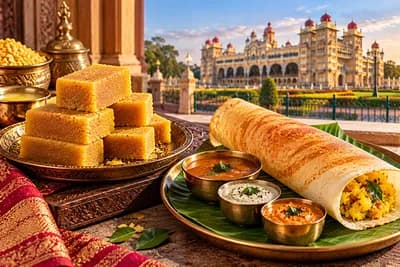
Mysore Pak and Masala Dosa
End your visit with Mysuru's famous sweet and a crisp masala dosa with filter coffee at one of the city's long-established eateries.
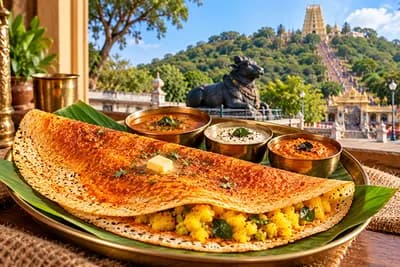
Mylari Dosa
Try the soft Mylari dosa topped with white butter at Hotel Vinayaka Mylari, a small, long-running eatery, served with a cup of filter coffee.

Nanjangud Rasabale Banana
Look out for this GI-tagged local banana, short and thick with a deep yellow skin, known for its rich aroma and sweetness.
Visitor guide
Mysuru Airport (MYQ), Mandakalli
Approximately 15 km
- A small airport with limited domestic flights. Taxis reach the temple in about 30-40 minutes.
Kempegowda International Airport, Bengaluru (BLR)
Approximately 185 km
- The nearest major airport, with domestic and international flights. The drive to Mysuru takes about 3 hours.
Gallery
Videos
Third-party videos may include ads or external commentary.
Frequently Asked Questions
It is on the summit of Chamundi Hills, Mysuru, Karnataka - 570010, about 13 km by road from the city centre.
Goddess Chamundeshwari, the eight-armed form of Durga who slew Mahishasura, honoured as Nada Devi, the State Goddess of Karnataka.
Darshan is open from 7:30 AM to 2:00 PM, 3:30 PM to 6:00 PM and 7:30 PM to 9:00 PM. Timings are extended on Ashada Fridays and during the Dasara.
No. General darshan is free. Paid special-entry tickets are sold at the counters and online.
The stone stairway built in 1659 has about 1,000 steps. The road also reaches the summit.
The Fridays of Ashada (June-July) are the most sacred days at the temple, with special alankaras of the goddess and lakhs of devotees.
The Dasara runs from 11 to 21 October 2026, with the inauguration on Chamundi Hills on 11 October and the Jamboo Savari on 21 October.
Wear modest, traditional clothing that covers the shoulders and knees.
Yes, on normal days. On Ashada Fridays, the Vardhanti and during the Dasara, private vehicles are restricted and shuttle buses run from the foot of the hill.
Yes. The temple's Dasoha serves free meals from 7:30 to 10:00 AM, 12:00 to 3:30 PM and 7:30 to 9:00 PM.
The Sri Chamundeshwari Kshetra Development Authority, set up under a 2024 state law.
KSRTC city buses run from the Mysuru City Bus Stand to the hilltop. Mysuru Junction is about 13 km away and Bengaluru airport about 185 km.
Yes. e-tickets, sevas, rooms and donations can be booked on chamundeshwaritemple.in.
Call the temple office at +91 821 259 0027 or the temple at +91 821 259 0127.