
-9°C
Anantnag
Amarnath Cave Temple
 Anantnag, Jammu and Kashmir, India
Amarnath Cave is the high Himalayan shrine of Lord Shiva as Baba Barfani, where a naturally formed ice lingam draws lakhs of pilgrims on the sacred summer yatra.
- ReligionHindu
- DeityLord Shiva
- TimingsOpen only during the annual Yatra period (usually July–August)

About the temple
About the temple
Amarnath Cave Temple is one of the holiest shrines of Lord Shiva, set in a glacial valley of the Kashmir Himalaya at an altitude of about 3,888 metres (12,756 ft) in Pahalgam tehsil of Anantnag district, Jammu and Kashmir. Inside the cave, an ice stalagmite that forms naturally from freezing water drops is worshipped as a Shiva lingam, known affectionately as Baba Barfani, alongside smaller ice formations revered as Parvati and Ganesha. According to tradition, this is where Shiva revealed the secret of immortality, the Amar Katha, to Parvati. The cave can be reached only during the annual Shri Amarnath Ji Yatra in summer, by trekking routes from Pahalgam and Baltal, and the pilgrimage is managed by the Shri Amarnathji Shrine Board.
Amarnath Cave Temple
Amarnath Cave Temple
The Sacred Legacy of Amarnath Cave in Numbers
Discover the scale and spirit of the Amarnath Yatra, one of India's most demanding pilgrimages, to the Himalayan cave shrine of Baba Barfani. From its altitude to its pilgrim numbers, the yatra brings together faith, endurance and a vast seasonal effort of service and security.
- Altitude of the Holy Cave (12,756 ft) Above Sea Level
- 3888 m
- Approximate Height of Amarnath Peak Above Sea Level
- 5186 m
- Height of Mahagunas Pass, the Highest Point on the Pahalgam Route
- 4276 m
- Approximate One-Way Distance from Pahalgam via Chandanwari
- 46-48 km
- Approximate One-Way Distance from Baltal to the Holy Cave
- 14 km
- Length of the 2026 Yatra (3 July - 28 August)
- 57 days
- Pilgrims Who Undertook the Yatra in 2026
- 4.8 lakh+
- Highest Recorded Number of Pilgrims, in 2011
- 6.34 lakh
- Age Range of Pilgrims Permitted to Register
- 13-70
Altitude of the Holy Cave (12,756 ft) Above Sea Level
Approximate Height of Amarnath Peak Above Sea Level
Height of Mahagunas Pass, the Highest Point on the Pahalgam Route
Approximate One-Way Distance from Pahalgam via Chandanwari
Approximate One-Way Distance from Baltal to the Holy Cave
Length of the 2026 Yatra (3 July - 28 August)
Pilgrims Who Undertook the Yatra in 2026
Highest Recorded Number of Pilgrims, in 2011
Age Range of Pilgrims Permitted to Register
Historical Background
Amarnath Cave has been revered as a shrine of Shiva since early times. The Nilamata Purana (about 6th-7th century) refers to the sacred sites of the region, and Kalhana's Rajatarangini (12th century) records that Queen Suryamati, wife of King Ananta (11th century), granted endowments and set up sacred emblems associated with Amareshwara. Medieval and later accounts describe pilgrims travelling through the Lidder valley to the cave, and in folk tradition a Muslim shepherd, Buta Malik, is credited with rediscovering it, after which his family shared in the shrine's custodianship with Hindu priests. Swami Vivekananda visited the cave on 2 August 1898 and described a profound spiritual experience. From the 1990s onward the yatra grew from tens of thousands to several lakh pilgrims, and after a deadly storm in 1996, arrangements were strengthened. The Shri Amarnathji Shrine Board was constituted under the Jammu and Kashmir Shri Amarnathji Shrine Act, 2000, with the Governor (now the Lieutenant Governor) as chairman, and it has since managed registration, camps, langars, medical facilities and security for the annual yatra.
Ancient era
Ancient era
Amarnath is revered in Shaiva tradition as the cave where Shiva revealed the Amar Katha to Parvati; the date of the earliest worship is not established.c. 6th-7th century CE
c. 6th-7th century CE
The Nilamata Purana, an early Kashmiri text, refers to the sacred geography of the region associated with the pilgrimage.11th century CE
11th century CE
According to Kalhana's Rajatarangini, Queen Suryamati, wife of King Ananta (r. c. 1028-1063), made endowments and installed sacred emblems connected with Amareshwara.12th century CE
12th century CE
Kalhana's Rajatarangini (c. 1148-1149) mentions Amareshwara among the sacred places of Kashmir.15th century CE (folk tradition)
15th century CE (folk tradition)
The shepherd Buta Malik is said to have rediscovered the cave after a sadhu's bag of coal turned to gold; his family later shared in the shrine's traditions.2 August 1898
2 August 1898
Swami Vivekananda visited the cave and described a deeply moving darshan of the ice lingam.August 1996
August 1996
A severe storm on the route killed more than 200 pilgrims, leading to an inquiry and major reforms in yatra management.2000 CE
2000 CE
The Shri Amarnathji Shrine Board was constituted under the Jammu and Kashmir Shri Amarnathji Shrine Act, 2000, with the Governor as chairman.2011 CE
2011 CE
About 6.34 lakh pilgrims visited the cave, the highest recorded number.2020-2021 CE
2020-2021 CE
The yatra was cancelled due to the COVID-19 pandemic; the Shrine Board arranged live telecasts of the aarti. 8 July 2022: A cloudburst near the cave killed at least 15 pilgrims.2023 CE
2023 CE
Two 100-bed hospitals were set up at Baltal and Chandanwari for pilgrims.2026 CE
2026 CE
The yatra ran for 57 days, from 3 July to 28 August (Raksha Bandhan), with more than 4.8 lakh pilgrims; helicopter services were suspended as the routes were declared no-fly zones.


Synopsis
Amarnath Cave Temple in Anantnag district, Jammu and Kashmir, is a natural cave shrine of Lord Shiva at about 3,888 metres, where a self-formed ice lingam is worshipped as Baba Barfani. Linked in tradition to Shiva's narration of the Amar Katha to Parvati, and mentioned in Kashmiri texts such as the Nilamata Purana and Kalhana's Rajatarangini, the cave is visited during the summer yatra, which runs from about early July to Raksha Bandhan. Pilgrims register in advance and trek by the traditional Pahalgam route (about 46-48 km) or the shorter Baltal route (about 14 km), with the Shri Amarnathji Shrine Board organising camps, langars, medical care and security.
Amarnath Cave is a natural cave in a glacial gorge of the Kashmir Himalaya, at about 3,888 metres in Pahalgam tehsil of Anantnag district. Its sanctity rests on the naturally formed ice lingam, believed by devotees to be a self-manifested (swayambhu) form of Shiva, and on the tradition that Shiva narrated the Amar Katha to Parvati here. The date of the earliest worship at the cave is not established.
The Nilamata Purana refers to the region's sacred sites, and Kalhana's Rajatarangini mentions Amareshwara, recording endowments by Queen Suryamati in the 11th century. Later travellers and pilgrims described the journey through the Lidder valley, and Swami Vivekananda's visit in 1898 is well documented by his disciples.
Through history, the pilgrimage was supported by Kashmiri rulers, the Dashnami Akhara of Srinagar, which keeps the Chhari Mubarak (holy mace), and local communities, including the Malik family of Batakot linked by tradition to the cave's rediscovery. Today the Shri Amarnathji Shrine Board, the Jammu and Kashmir administration, security forces and more than 100 voluntary langar committees support the yatra.
Amarnath is among the most sacred Shiva shrines in India, and the yatra is regarded as a pilgrimage of great merit. The ice lingam, flanked by ice formations of Parvati and Ganesha, is worshipped as Baba Barfani, and the season ends on Shravan Purnima (Raksha Bandhan) with the arrival of the Chhari Mubarak.
The Shri Amarnathji Shrine Board, constituted under the Jammu and Kashmir Shri Amarnathji Shrine Act, 2000 and chaired by the Lieutenant Governor, manages the shrine and yatra. Daily pilgrim numbers are regulated, and environmental, health and security measures protect both pilgrims and the fragile Himalayan landscape.
Sacred significance
Baba Barfani - The Self-Formed Ice Lingam
The ice stalagmite that forms each year inside the cave is worshipped as a swayambhu (self-manifested) Shiva lingam, known as Baba Barfani, "the Lord of the Snows". Devotees regard its natural formation as a sign of Shiva's living presence, and its darshan is considered one of the most auspicious in Hinduism.
The Amar Katha - Secret of Immortality
The cave is revered as the place where Shiva revealed the secret of immortality to Parvati. The name Amarnath, "Lord of the Immortals", reflects this tradition, and listening to or reciting the Amar Katha is part of the pilgrim's devotion.
Shiva, Parvati and Ganesha in Ice
Beside the main lingam, smaller ice formations are worshipped as Parvati and Ganesha, so pilgrims take darshan of Shiva's divine family together in the cave.
The Yatra as Spiritual Discipline
The trek through high passes, cold and thin air is seen as tapasya (austerity). Pilgrims chant "Bam Bam Bhole" and "Har Har Mahadev" along the way, and completing the yatra is believed to bring great spiritual merit.
Mahamaya Shakti Peetha
The cave is also revered as the Mahamaya Shakti Peetha, one of the 51 Shakti Peethas, where the neck of Goddess Sati is believed to have fallen. This makes Amarnath sacred to both Shaiva and Shakta devotees.
Architecture
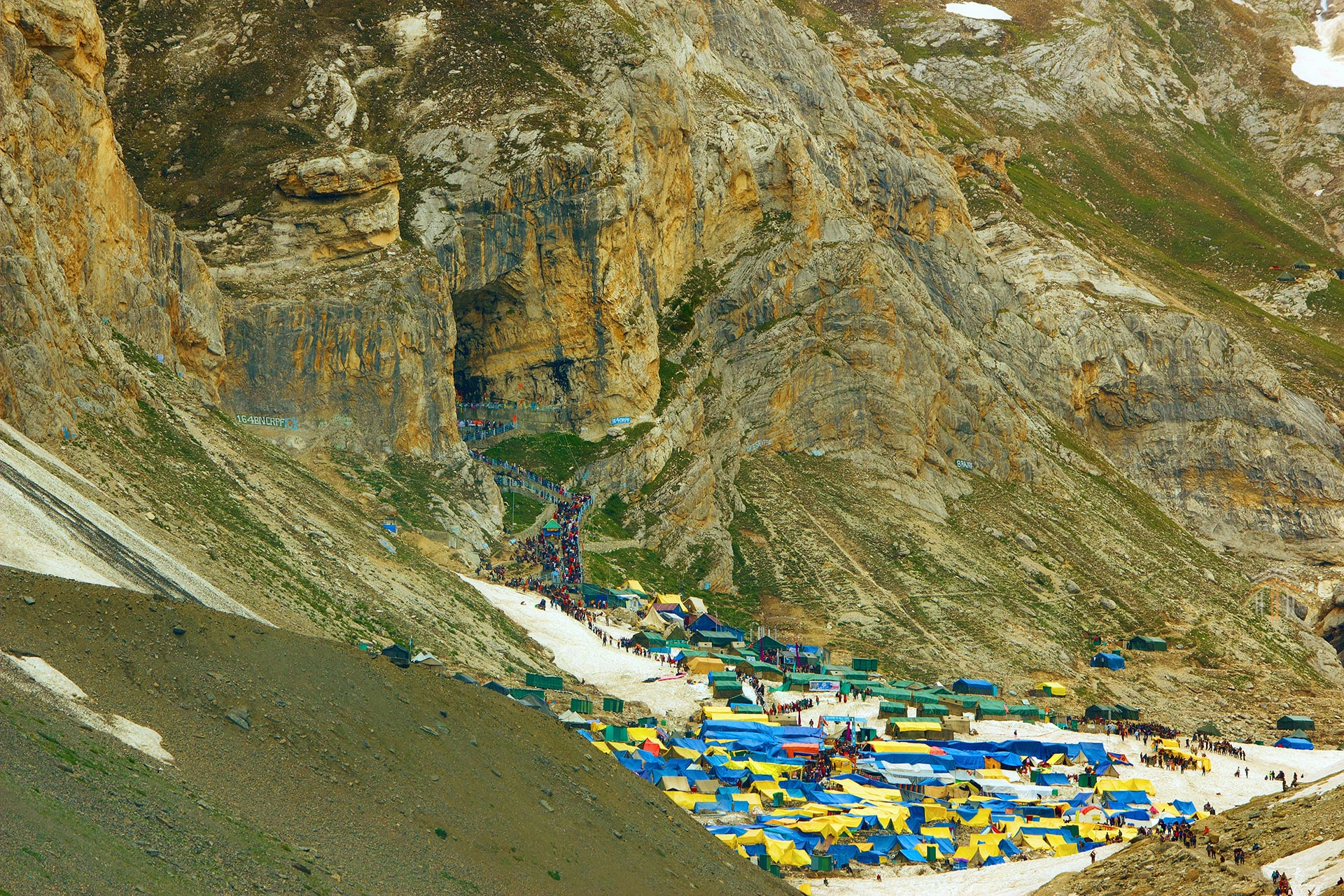
Amarnath is a natural cave rather than a built temple. The cave, about 40 metres high at its mouth by most accounts, opens on the side of a mountain in a glacial gorge at about 3,888 metres, below Amarnath Peak (about 5,186 m). Water seeping through cracks in the rock freezes as it drips, forming the ice lingam on the cave floor along with smaller formations of Parvati and Ganesha. A raised platform with railings, steps up to the cave mouth, and modest structures for priests, security and the Shrine Board are the only human additions, preserving the cave as a natural sanctuary.
Layout
The Cave and Its Approach
Pilgrims climb a final stretch of steps from the camp area below the cave to a railed platform at the cave mouth, where they file past the ice lingam in queues.
Sanctum
The Ice Lingam
The main ice stalagmite forms on the cave floor. Its height varies from year to year with weather and snowfall, and it is usually at its fullest early in the season.
Formations
Parvati and Ganesha Formations
Two smaller ice formations beside the lingam are worshipped as Parvati and Ganesha.
Geology
A Natural Ice Cave
The cave is formed in the rock of the Amarnath massif and is covered by snow for most of the year. Ice formations develop from water dripping through the roof and freezing at high altitude.
Platform
Darshan Platform and Railings
A railed platform and barricades guide pilgrims in single file past the lingam, allowing many devotees to take darshan safely in a short time.
Camp
Lower Holy Cave Camp
Tents, langars, medical posts and Shrine Board facilities are set up seasonally in the valley below the cave.
Route
Mountain Tracks
The approach routes are mountain tracks maintained each year by the Border Roads Organisation, with railings on exposed stretches.
Interesting facts

The ice lingam is not carved but forms naturally each year from freezing water. Its size varies with the year's snowfall and temperatures, and it is usually largest early in the season.
Deities & Shrines
Baba Barfani (Ice Lingam)
The principal object of worship is the ice lingam of Lord Shiva, known as Baba Barfani. Devotees offer prayers, chant "Bam Bam Bhole" and seek blessings for health, protection and liberation.
Goddess Parvati (Ice Formation)
A smaller ice formation beside the lingam is worshipped as Goddess Parvati, to whom Shiva revealed the Amar Katha. Devotees pray to her for family welfare and blessings.
Lord Ganesha (Ice Formation)
Another ice formation is revered as Lord Ganesha, the remover of obstacles. Pilgrims pray to him for a safe journey through the mountains and the removal of hardships on the difficult trek.
Sheshnag
The lake of Sheshnag on the Pahalgam route is associated with the serpent king Shesha, where Shiva is said to have left his serpents. Pilgrims offer prayers at the lake, which is believed to be the abode of Shesha, and many camp overnight beside it on the way to the cave.
Bhairav at Panchtarni
Panchtarni lies at the foot of Bhairav Mountain, and the five streams there are said to flow from Shiva's matted hair. Pilgrims bathe or sprinkle water here before the final climb.
Mahagunas (Ganesh Top)
The high pass of Mahagunas, at about 4,276 metres, is associated with the place where Shiva left Ganesha. It is the highest point on the Pahalgam route.
Amareshwar Temple, Srinagar
The Chhari Mubarak is kept at the Amareshwar Temple at the Dashnami Akhara in Srinagar, where its yearly journey to the cave begins.
Mamleshwar Temple, Pahalgam
The ancient stone Mamleshwar Shiva temple is near Pahalgam.
Darshan & Service Offerings
| Service | Timing | Price | Notes |
|---|---|---|---|
| Advance Registration (Online and Bank Branches) | During the notified yatra, on the date and route on the yatra permit. | Registration fee about ₹150 per pilgrim (2026); no darshan fee. | Darshan of Baba Barfani is free, but every pilgrim must register in advance for a specific date and route. Pilgrims queue on the platform at the cave mouth and file past the ice lingam. |
| Service 2 | From mid-April (15 April in 2026) until the yatra, subject to daily quotas. | About ₹150 per pilgrim (2026); confirm current fee. | Registration is through the Shrine Board's online portal and app or at designated branches of J&K Bank, PNB, SBI and Yes Bank, with Aadhaar-based eKYC. Each pilgrim needs a Compulsory Health Certificate (CHC) from an authorised doctor. |
| On-Spot Registration | During the yatra, at designated centres in Jammu. | As fixed by the Shrine Board. | Limited on-spot registration is offered at designated centres in Jammu, subject to daily caps. |
| RFID Yatra Card | Collected before the yatra at designated centres. | Included in the yatra process. | Each registered pilgrim must collect an RFID card, which is checked at access control points on the routes and helps track pilgrims for safety. |
| Pony, Pithu and Palki (Dandi) Services | During track hours. | Fixed by the district administrations each year; confirm on the official rate list. | Registered pony-wallas, porters (pithus) and palki bearers carry pilgrims or luggage on both routes. Hire only registered providers and pay the official rate. |
| Helicopter Services | In earlier years, from Baltal and Pahalgam to Panchtarni. | As fixed by the Shrine Board in years when offered. | Helicopter services have been offered in some years, but in 2026 the routes were declared no-fly zones and helicopter services were suspended. Check the current year's notice. |
| Tented Accommodation | At base camps and halting points during the yatra. | Rates fixed by the administration each year. | Tents with bedding are available at Baltal, Nunwan, Chandanwari, Sheshnag, Panchtarni and the lower cave area, run by registered tent providers and the Shrine Board. |
| Langar (Free Community Kitchens) | Throughout the yatra, along both routes. | Free | Langars run by registered committees serve free food, tea and refreshments to pilgrims at base camps and along the tracks. |
| Medical Check and Assistance | Throughout the yatra. | Free at government facilities. | Medical posts, oxygen booths and hospitals along the routes provide free care to pilgrims. |
| Group Registration | During the advance registration period. | As per the per-pilgrim fee. | Groups of pilgrims travelling together can register through the Shrine Board's group registration process, subject to quotas. Each member still needs individual eKYC and a health certificate. |
| Pilgrim Insurance Cover | Valid for the registered yatra. | Arranged by the Shrine Board for registered pilgrims. | Registered pilgrims have been covered by group insurance arranged by the Shrine Board, and service providers are also insured. Check the current year's terms on the official website. |
Visitor information
Location
The Holy Cave lies at about 3,888 metres in the Amarnath valley, Pahalgam tehsil, Anantnag district, Jammu and Kashmir, about 141 km from Srinagar. It is reached only on foot (or by pony or palki) from Pahalgam via Chandanwari or from Baltal near Sonamarg.
Yatra Season
The cave is open only during the notified yatra, usually from late June or early July until Raksha Bandhan. In 2026 the yatra ran from 3 July to 28 August.
Darshan Arrangements
Pilgrims take darshan in queues at the railed platform at the cave mouth after the morning aarti. Track movement is allowed only during set hours and may be stopped in bad weather.
Registration and Permit
Every pilgrim must register in advance through the Shrine Board's portal, app or designated bank branches, with Aadhaar-based eKYC and a Compulsory Health Certificate. The permit specifies the route and date.
Age and Health Rules
Pilgrims must be between 13 and 70 years old. Women more than six weeks pregnant are not permitted. A Compulsory Health Certificate from an authorised doctor, issued on or after the notified date, is mandatory.
RFID Yatra Card
Registered pilgrims must collect an RFID card at designated centres in Jammu or Kashmir before the yatra and carry it at all times; it is scanned at access control points.
Base Camps
Main camps include Bhagwati Nagar Yatri Niwas (Jammu), Nunwan (Pahalgam) and Baltal, with transit and halting camps at Chandanwari, Sheshnag, Panchtarni, Domail and the lower Holy Cave area.
Shrine Board Helpline
The Shri Amarnathji Shrine Board helpline is 14464, with an alternate number 0194-2313146. The control room operates 24 hours during the yatra.
Official Website
Registration, notices, rates, health forms and daily updates are published on the official website, jksasb.nic.in, and the Shrine Board's app.
Weather Conditions
Weather at the cave and passes can change quickly, with rain, snow and sub-zero temperatures possible even in July and August. Carry warm, waterproof clothing.
Physical Difficulty
Both routes are steep, high-altitude mountain tracks. Elderly or less fit pilgrims can hire ponies or palkis, but should consult a doctor before registering.
Getting There
Srinagar International Airport is the nearest airport. Jammu Tawi and Katra are the main railheads, and Srinagar is also reached by train via the Udhampur-Srinagar-Baramulla line. Pahalgam is about 96 km and Baltal about 93 km from Srinagar by road.
Important Visitor Notice
Yatra dates, quotas, helicopter availability, rules and track timings change every year and can be suspended for weather or security. Follow the Shrine Board's notices and instructions from security forces.
Location
Anantnag, Jammu and Kashmir, India
Best Time to Visit
Yatra Season (July-August)
The cave can be visited only during the notified yatra, usually from early July to Raksha Bandhan in August. In 2026 it ran from 3 July to 28 August.
First Weeks of the Yatra (Early July)
The ice lingam is usually at its fullest early in the season, making these weeks especially popular. Expect heavy crowds, snow bridges and patches of ice on parts of the track, and very cold nights at the higher camps.
Shravan Month (July-August)
The yatra overlaps with Shravan, the month sacred to Shiva. Daily quotas apply, so book as soon as registration opens.
Raksha Bandhan (Shravan Purnima)
The final day of the yatra, when the Chhari Mubarak reaches the cave. By this time the ice lingam may have melted considerably, but the day is spiritually significant.
Mountain Weather
Days can be sunny and mild, but temperatures can drop below freezing at night, and rain or snow can stop the yatra temporarily. Carry warm and waterproof gear, and be prepared to wait at camps if the Shrine Board halts movement for safety.
Rain and Landslide Risk
Heavy rain during July and August can cause landslides, flash floods and track closures. Follow Shrine Board weather advisories closely.
Weekdays and Mid-Season
Mid-season weekdays, away from Shravan Mondays and holidays, may be less crowded, though daily pilgrim quotas keep numbers regulated.
Plan Extra Days
Keep one or two buffer days for acclimatisation and possible weather delays, and book registration as soon as it opens in April.
Nearby places
Sheshnag Lake
About 12-13 km from Chandanwari on the Pahalgam route
- A glacial lake at about 3,590 m below seven peaks said to resemble the hoods of a serpent; the overnight halt on the traditional route.
Panchtarni
About 6 km from the Holy Cave
- A high meadow at about 3,657 m where five streams meet at the foot of Bhairav Mountain; the last halt before the cave on the Pahalgam route.
Chandanwari
About 16 km from Pahalgam
- The start of the trek on the Pahalgam route, beside the Lidder river, often with a snow bridge in early summer.
Festivals & culture
The Amarnath Cave has no year-round festival calendar, since it is accessible only during the summer yatra. The pilgrimage itself is the great festival of the shrine, beginning with the Pratham Puja on Jyeshtha Purnima, running through the holy month of Shravan and ending with the Chhari Mubarak rituals on Shravan Purnima (Raksha Bandhan). Dates follow the Hindu lunar calendar and are announced each year by the Shrine Board.
Shri Amarnath Ji Yatra
Late June / early July to August (3 July - 28 August in 2026)
The annual pilgrimage to the Holy Cave by the Pahalgam and Baltal routes, with lakhs of pilgrims, langars and devotional singing along the way.
Shravan Purnima / Raksha Bandhan
August (28 August in 2026)
The final and most sacred day of the yatra, when the Chhari Mubarak reaches the cave and special prayers are offered.
Additional information
Shri Amarnathji Shrine Board (SASB)
The shrine and yatra are administered by the Shri Amarnathji Shrine Board, constituted under the Jammu and Kashmir Shri Amarnathji Shrine Act, 2000, and chaired by the Lieutenant Governor of Jammu and Kashmir.
Holy Cave Location
Shri Amarnathji Holy Cave, Amarnath Valley, Pahalgam tehsil, Anantnag district, Jammu and Kashmir, India.
Shrine Board Helpline
Phone: 14464 / 0194-2313146 - 24-hour control room during the yatra for pilgrim queries and assistance.
Official Website and App
Registration, health certificate formats, rates for service providers, notices and live updates are available at jksasb.nic.in and on the Shrine Board's app.
Registration Rules
Advance registration opens in April at designated bank branches and online, with Aadhaar-based eKYC; the fee was about ₹150 per pilgrim in 2026.
Eligibility
Pilgrims must be aged 13-70, hold a Compulsory Health Certificate and, for women, not be more than six weeks pregnant.
Helicopter Services
Helicopter services have operated in some years, but were suspended in 2026 when the routes were declared no-fly zones. Check the current year's notice.
Pilgrim Insurance
Registered pilgrims have been covered by group insurance arranged by the Shrine Board; check the current year's terms.
Security Arrangements
The yatra is protected by multiple security forces, with RFID tracking, CCTV, drones and convoy movement on the highway.
Important Visitor Advisory
Verify yatra dates, registration status, weather advisories and track timings immediately before travel, and follow all instructions from the Shrine Board and security forces.
Temple facilities
Base Camps and Yatri Niwas
Main base camps at Bhagwati Nagar (Jammu), Nunwan (Pahalgam) and Baltal provide tents, langars, toilets, registration and RFID counters, and medical help.
Tented Accommodation
Tents with bedding are available at base camps and halting points such as Chandanwari, Sheshnag, Panchtarni, Domail and the lower cave area.
Langars
Over 100 registered langars along both routes serve free food and tea.
Hospitals and Medical Posts
Two 100-bed hospitals at Baltal and Chandanwari, together with about 70 healthcare facilities including bedded hospitals, ambulances and oxygen booths, serve pilgrims during the yatra.
Drinking Water and Toilets
Drinking water points and toilets are provided at camps and along the tracks.
Ponies, Palkis and Pithus
Registered ponies, palkis (dandis) and porters help pilgrims who cannot walk the full distance, at officially fixed rates.
Mountain Rescue and Disaster Response
Mountain rescue teams, disaster response forces and security personnel are deployed along both routes.
Communication and Information
Information counters, public address systems, mobile connectivity at major camps and the 24-hour helpline (14464) help pilgrims stay informed.
Emergency services
India Emergency Response
Not location-specific
Contact
112
- Call 112 for urgent police, medical or fire assistance through India's integrated emergency response system. Coverage may be limited on remote stretches of the route.
Top picks
Kashmiri Kahwa
A traditional tea brewed from Kashmiri green tea leaves, whole spices, nuts and saffron. It is warming and well suited to the cold mountain weather.
Noon Chai with Bakarkhani
Noon Chai, also called Sheer Chai or Pink Tea, is a salty, pink Kashmiri tea, usually eaten with Bakarkhani, a crisp, buttery traditional bread.
Modur Pulao
A sweet, fragrant saffron rice cooked with nuts and dry fruits.
Visitor guide
Srinagar International Airport (SXR)
About 96 km to Pahalgam and about 100 km to Baltal
- The nearest airport, with flights from Delhi, Mumbai, Jammu and other cities. Taxis and buses connect to the base camps.
Jammu Airport (IXJ)
About 300-400 km to the base camps
- An alternative airport for pilgrims starting from the Jammu base camp at Bhagwati Nagar.
Videos
Third-party videos may include ads or external commentary.
Frequently Asked Questions
In the Amarnath valley of the Kashmir Himalaya, Pahalgam tehsil, Anantnag district, Jammu and Kashmir, at about 3,888 m.
Lord Shiva in the form of a naturally formed ice lingam, known as Baba Barfani, with ice formations of Parvati and Ganesha.
Every summer, usually from early July to Raksha Bandhan. In 2026 it ran from 3 July to 28 August.
Yes. Every pilgrim must register in advance with a Compulsory Health Certificate and Aadhaar-based eKYC.
Online through the Shrine Board's portal or app, or at designated branches of J&K Bank, PNB, SBI and Yes Bank. The fee was about ₹150 in 2026.
Pilgrims aged 13 to 70 with a valid health certificate. Women more than six weeks pregnant are not permitted.
The traditional Pahalgam route (about 46-48 km, 3-4 days) and the shorter, steeper Baltal route (about 14 km, 1-2 days).
They have been offered in some years, but in 2026 the routes were declared no-fly zones and helicopters were suspended. Check the current year's notice.
Yes. Free langars serve meals and tea at camps and along both routes.
In tents at the base camps and halting points, or in hotels in Pahalgam, Sonamarg and Srinagar before and after the trek.
Warm and waterproof clothing, trekking shoes, a walking stick, torch, medicines, ID, permit, RFID card and health certificate.
Yes. It is a high-altitude trek with steep climbs and cold weather. Physical preparation and acclimatisation are essential.
The holy mace of Shiva, carried from Srinagar by sadhus, whose arrival at the cave on Raksha Bandhan marks the end of the yatra.
From jksasb.nic.in, the Shrine Board's app, or the 24-hour helpline 14464.