
28°C
Gir Somnath
Shree Somnath Jyotirlinga Temple
 Gir Somnath, Gujarat, India
Shree Somnath Jyotirlinga Temple is revered as the first of Hinduism's twelve sacred Jyotirlingas, where Lord Shiva is worshipped as Somnath, the Lord of the Moon, on the Arabian Sea coast at Prabhas Patan.
- ReligionHindu
- DeityShiva
- Timings06:00 AM to 10:00 PM
About the temple
About the temple
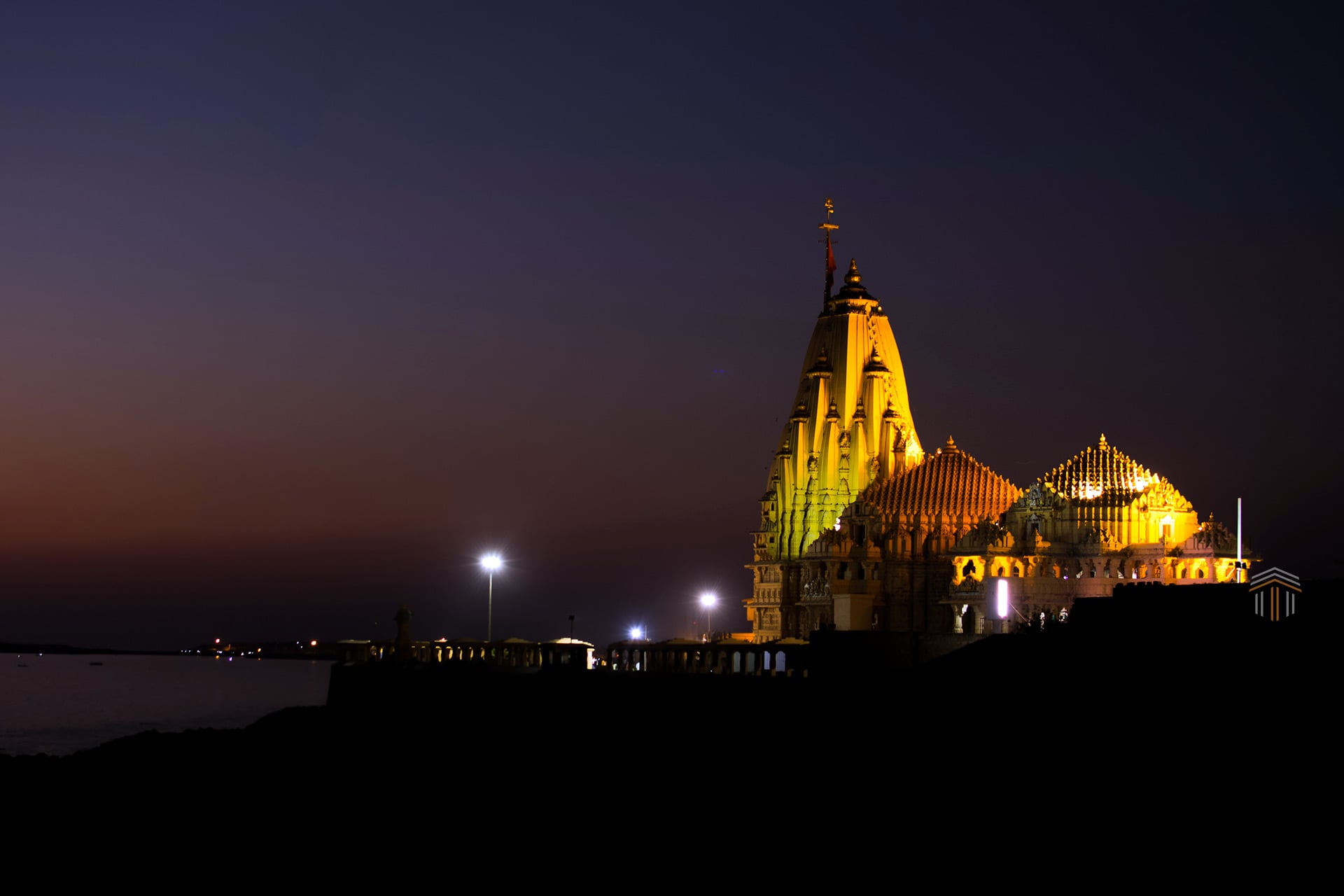
Shree Somnath Jyotirlinga Temple is one of the most revered Shiva temples in India and is traditionally honoured as the first of the twelve Jyotirlingas. Located at Prabhas Patan near Veraval in Gujarat, on the shore of the Arabian Sea, the temple is dedicated to Lord Shiva as Somnath, the Lord of Soma, the Moon. After centuries of destruction and rebuilding, the present temple was reconstructed in the Kailash Mahameru Prasad style at the resolve of Sardar Vallabhbhai Patel, and its Jyotirlinga was consecrated on 11 May 1951. The shrine is administered by the Shree Somnath Trust.
Shree Somnath Jyotirlinga Temple
Shree Somnath Jyotirlinga Temple
The Sacred Legacy of Shree Somnath Jyotirlinga Temple in Numbers
Discover the history and enduring spiritual significance of Shree Somnath Jyotirlinga Temple, revered as the first of the twelve Jyotirlingas of Lord Shiva. Standing on the Arabian Sea coast at Prabhas Patan, the temple is a major centre of Shaivite worship and pilgrimage, and a symbol of resilience rebuilt many times over a thousand years.
- Revered as the First of the Twelve Jyotirlingas of Lord Shiva
- 1 of 12
- Year the Present Temple's Jyotirlinga Was Consecrated (11 May 1951)
- 1951
- Year the Completed Temple Was Dedicated to the Nation (1 December 1995)
- 1995
- Approximate Height of the Temple's Shikhara, as Stated by the Shree Somnath Trust
- 155 ft
- Approximate Weight of the Kalash Crowning the Shikhara
- 10 tonnes
- Approximate Height of the Temple's Flagstaff (Dhwajdand)
- 27 ft
- Year Maharani Ahilyabai Holkar Built the Adjacent Somnath Temple
- 1783
- Daily Aartis, at 7:00 AM, 12:00 Noon and 7:00 PM
- 3
- Rooms in the Shree Somnath Trust's Guest Houses
- 200+
Revered as the First of the Twelve Jyotirlingas of Lord Shiva
Year the Present Temple's Jyotirlinga Was Consecrated (11 May 1951)
Year the Completed Temple Was Dedicated to the Nation (1 December 1995)
Approximate Height of the Temple's Shikhara, as Stated by the Shree Somnath Trust
Approximate Weight of the Kalash Crowning the Shikhara
Approximate Height of the Temple's Flagstaff (Dhwajdand)
Year Maharani Ahilyabai Holkar Built the Adjacent Somnath Temple
Daily Aartis, at 7:00 AM, 12:00 Noon and 7:00 PM
Rooms in the Shree Somnath Trust's Guest Houses
Historical Background
Shree Somnath Jyotirlinga Temple at Prabhas Patan, Gujarat, has a long and layered history. Prabhas is praised as a tirtha in the Mahabharata and the Puranas, and the name Someshvara appears in records from the 9th century. Archaeological excavations in 1950-51 found remains of a richly carved temple of around the 10th century. The shrine was raided by Mahmud of Ghazni in January 1026 and was attacked, rebuilt and converted repeatedly over the following centuries, including a major rebuilding by the Chaulukya king Kumarapala in 1169 and a final demolition order by Aurangzeb in 1706. In 1783 Maharani Ahilyabai Holkar built a separate Shiva temple nearby so that worship could continue. After Independence, Sardar Vallabhbhai Patel resolved in November 1947 to rebuild the temple, the Shree Somnath Trust was formed with K. M. Munshi at its head, and the Jyotirlinga was consecrated on 11 May 1951. The completed temple was dedicated to the nation on 1 December 1995 and remains a leading Shaivite pilgrimage centre.
Ancient era
Ancient era
Prabhas is described as a sacred tirtha in the Mahabharata, the Bhagavata Purana and the Skanda Purana; excavations show human settlement at the site from the Harappan period, though no early temple structure has been securely dated.9th-10th centuries CE
9th-10th centuries CE
The name Someshvara appears in records of the Gurjara-Pratihara king Nagabhata II, and excavations of 1950-51 found remains of a richly carved temple generally dated to this period.January 1026 CE
January 1026 CE
Mahmud of Ghazni raided and plundered the Somnath temple, according to historical accounts; some sources give 1024-1025.1169 CE
1169 CE
The Chaulukya (Solanki) king Kumarapala rebuilt the temple in stone, as recorded in an inscription of Bhava Brihaspati found at Prabhas Patan.1299 CE
1299 CE
The temple was sacked by Alauddin Khalji's army under Ulugh Khan.1308 CE
1308 CE
The temple was rebuilt by the Chudasama king Mahipala I; the linga was reinstalled by his son Khengara between 1331 and 1351.1395 and 1451 CE
1395 and 1451 CE
The temple was destroyed by Zafar Khan and later desecrated by Mahmud Begada of the Gujarat Sultanate, according to historical accounts.1665 and 1706 CE
1665 and 1706 CE
The Mughal emperor Aurangzeb ordered the temple's destruction; the 1706 order appears to have been carried out.1783 CE
1783 CE
Maharani Ahilyabai Holkar built a separate Somnath temple near the ruined shrine so that worship could continue; the date is given by the Shree Somnath Trust, while some sources give 1782-1786.1842 CE
1842 CE
Lord Ellenborough's Proclamation of the Gates ordered the so-called Gates of Somnath brought back from Ghazni; they proved not to be from Somnath and remain in Agra Fort.13 November 1947
13 November 1947
Sardar Vallabhbhai Patel visited the ruins at Prabhas and publicly resolved to rebuild the temple; the Shree Somnath Trust was set up with K. M. Munshi at its head.11 May 1951
11 May 1951
President Dr. Rajendra Prasad performed the Pran Pratishtha of the Jyotirlinga in the rebuilt temple.1 December 1995
1 December 1995
The completed temple was dedicated to the nation by President Dr. Shankar Dayal Sharma.2026
2026
The Somnath Swabhiman Parv (8-11 January) marked 1,000 years since the 1026 raid, and the Somnath Amrut Parv on 11 May marked 75 years of the 1951 consecration.


Synopsis
Shree Somnath Jyotirlinga Temple in Prabhas Patan, Gir Somnath district, Gujarat, is revered as the first of the twelve sacred Jyotirlingas of Lord Shiva. Standing on the Arabian Sea coast within the ancient Prabhas Kshetra, it is a major centre of Hindu pilgrimage and Shaivite worship. The present temple was rebuilt after Independence at the resolve of Sardar Vallabhbhai Patel, consecrated on 11 May 1951 by President Dr. Rajendra Prasad, and dedicated to the nation on its completion in December 1995.
Shree Somnath Jyotirlinga Temple, dedicated to Lord Shiva as Somnath ("Lord of the Moon"), is traditionally the first of the twelve sacred Jyotirlingas and stands on the Arabian Sea coast at Prabhas Patan. The site has been a place of pilgrimage since ancient times because of the Triveni Sangam of the Hiran, Kapila and Saraswati rivers, and excavations have revealed the remains of a richly carved temple of around the 10th century beneath the present shrine.
Mahmud of Ghazni's raid of January 1026 is confirmed by the contemporary scholar Al-Biruni and other historians, and later attacks by Alauddin Khalji's army (1299), the Gujarat Sultanate (1395 and 1451) and Aurangzeb (1706) are also recorded. Kumarapala's reconstruction of 1169 is documented in the Bhava Brihaspati inscription, one of the key sources for the temple's medieval history, and colonial-era surveys in the 19th and early 20th centuries recorded the ruined temple after it had been partly converted into a mosque.
The Chaulukya kings Bhima I and Kumarapala, the Chudasama king Mahipala I and Maharani Ahilyabai Holkar of Indore are among the historical patrons of Somnath. The present temple was rebuilt at the resolve of Sardar Vallabhbhai Patel, with public funds raised through the Shree Somnath Trust on the advice of Mahatma Gandhi, and was designed by the architect Prabhashankar Oghadbhai Sompura.
As the first of the twelve Jyotirlingas in the Shiva Purana's list, Somnath holds a pre-eminent place in Shaiva worship and is one of the most visited pilgrimage sites in Gujarat. Its setting within the Prabhas Kshetra links it with Krishna's final earthly journey at Bhalka Tirth and Dehotsarg, making the area sacred to both Shaiva and Vaishnava devotees.
The temple is managed by the Shree Somnath Trust, which also maintains the Ahilyabai temple, the Golokdham tirth, guest houses, a free dining hall and other pilgrim facilities. National commemorations in 2026, the Somnath Swabhiman Parv and the Somnath Amrut Parv, marked 1,000 years since the 1026 raid and 75 years since the 1951 consecration, including the release of a commemorative postage stamp and coin.
Sacred significance
The First Jyotirlinga - Abode of Somnath
Somnath is revered as the first of the twelve Jyotirlingas, the sacred abodes where Lord Shiva is believed to have manifested as an infinite column of light. The Shiva Purana places Somnath at the head of its list, and the Shree Somnath Trust describes the shrine as the Aadi (first) Jyotirlinga, making it a starting point for many devotees undertaking the twelve-Jyotirlinga pilgrimage.
Lord of the Moon and the Cycle of Renewal
The temple's name and principal legend come from Chandra, the Moon God, who was relieved of Daksha Prajapati's curse by worshipping Shiva at Prabhas. Devotees see in this story Shiva's grace in restoring what was lost, and many pray at Somnath for healing, relief from affliction and renewal.
The Sacred Prabhas Kshetra
Somnath lies within the ancient Prabhas Kshetra, praised in the Mahabharata and the Skanda Purana as one of the holiest tirthas on India's western coast. The nearby Triveni Sangam of the Hiran, Kapila and Saraswati rivers is revered for ritual bathing and ceremonies for ancestors.
Maha Shivaratri, Shravan and Kartik Purnima
Maha Shivaratri and the holy month of Shravan draw large numbers of devotees for special worship and adornment of the Jyotirlinga. The five-day Kartik Purnima fair is among the Trust's major annual events, and Somnath Sthapana Divas on 11 May marks the anniversary of the 1951 consecration.
Architecture
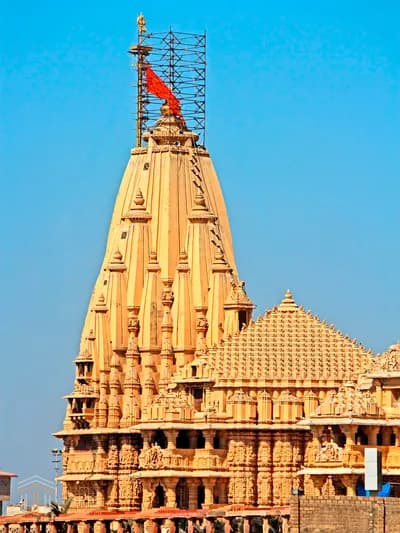
The present Somnath Temple is built in the Kailash Mahameru Prasad form of the Maru-Gurjara (Chaulukya or Solanki) style of western Indian temple architecture. According to the Shree Somnath Trust, the temple consists of a Garbhagriha (sanctum), Sabhamandap (assembly hall) and Nrityamandap (dance hall), crowned by a Shikhara about 155 feet high. The Kalash at its summit is said to weigh about 10 tonnes, and the flagstaff (Dhwajdand) is about 27 feet tall. Designed by the architect Prabhashankar Oghadbhai Sompura and built by traditional Sompura Salat stonemasons, the temple faces the Arabian Sea and is richly carved with sculptural panels.
Layout
Layout
The temple follows a traditional axial plan, with the Nrityamandap leading into the Sabhamandap and then to the Garbhagriha. It stands on raised ground directly beside the sea, with a seafront promenade and seating area where visitors can view the ocean.
Spire
Shikhara and Kalash
The main Shikhara rises above the sanctum in the curvilinear Nagara form, crowned by a massive Kalash and a flagstaff. Devotees sponsor the hoisting of the temple's flag through the Dhwajarohan offering.
Sanctum
Garbha Griha (Sanctum Sanctorum)
The sanctum houses the Somnath Jyotirlinga, consecrated on 11 May 1951. Devotees do not enter the Garbhagriha; darshan is taken from the hall outside it.
Sculpture
Carved Panels and Mandapa
The two-level temple has a pillared mandapa and around 212 relief panels. Some old, recovered carvings were integrated into the new structure and can be told apart from the new work by the colour of the stone.
Pillar
Baan Stambh (Arrow Pillar)
A pillar on the seafront, known as the Abadhit Samudra Marg Tirth Stambh, carries an arrow pointing south. According to the Trust, it marks a sea route to the South Pole unobstructed by land for about 9,936 km; this is a traditional geographical claim rather than a modern survey statement.
Heritage
Ahilyabai Temple
Adjacent to the main complex stands the smaller temple built by Maharani Ahilyabai Holkar in 1783, where the Somnath linga is enshrined in a cellar. It preserved worship at Somnath until the present temple was built.
Promenade
Samudra Darshan Path
A seafront walkway of about 1.5 km runs beside the temple, offering views of the temple against the sea; a small entry fee applies.
Interesting facts

Somnath is revered as the first of the twelve Jyotirlingas, the sacred sites where Lord Shiva is believed to have manifested as an infinite column of light. The Shiva Purana's list begins with Somnath, and the Trust describes it as the Aadi Jyotirlinga.
Deities & Shrines
Somnath Jyotirlinga
The presiding deity is Lord Shiva worshipped as Somnath, the Lord of the Moon, in the form of the Jyotirlinga in the sanctum. Revered as the first of the twelve Jyotirlingas, it is the focus of the daily aartis, abhishek and all the Trust's pooja vidhis.
Shri Kapardi Vinayak
Shri Kapardi Vinayak, a form of Lord Ganesha, is named by the Shree Somnath Trust among the shrines at the temple. Following Hindu custom, devotees seek Ganesha's blessings as the remover of obstacles before darshan of the Jyotirlinga.
Shri Hanuman Temple
A shrine to Lord Hanuman is also listed by the Trust among the sacred spots at the temple. Devotees pray to Hanuman for strength, courage and protection, and the Trust offers a Hanuman Chalisa (108) recitation as a pooja vidhi.
Nandi
As in all Shiva temples, a sculpted Nandi, Shiva's bull and devoted vahana, faces the sanctum. Devotees traditionally pay respects to Nandi before seeking darshan of the Jyotirlinga.
Ahilyabai Somnath Temple (Old Somnath)
Adjacent to the main complex, the temple built by Maharani Ahilyabai Holkar in 1783 enshrines Somnath Mahadev in a cellar. It sustained worship at Somnath during the period before the present temple was built and remains an important stop for pilgrims.
Shri Ram Mandir
Built by the Shree Somnath Trust in 2017, this temple in the Somnath precinct enshrines marble idols of Lord Rama, Sita Devi and Lord Lakshmana, with small shrines to Hanuman and Ganesha beside the sanctum. The Trust celebrates Ram Janmotsav here each year.
Golokdham and Geeta Mandir
At Dehotsarg on the banks of the Hiran, the Trust maintains the Golokdham tirth marking Lord Krishna's departure from the world. The Geeta Mandir here has the 18 chapters of the Bhagavad Gita inscribed on its pillars, alongside the Lakshminarayan Temple, Baldevji's Cave and Mahaprabhuji's Baithak.
Mahakali Temple
A Mahakali temple lies close to the Somnath temple in Prabhas Patan. Devotees visiting Somnath often include it in their darshan as part of the wider sacred landscape of Prabhas.
Darshan & Service Offerings
| Service | Timing | Price | Notes |
|---|---|---|---|
| General Darshan (Free Darshan) | 06:00 AM - 10:00 PM, subject to aarti schedules and crowd-management arrangements. | Free | General darshan of the Somnath Jyotirlinga is free for all devotees; the Trust's FAQ confirms there is no entry fee. Waiting times depend on the crowd, especially on Mondays, weekends and festival days. |
| Live Darshan (Online Darshan) | As available through the Trust's live feed. | Free | The Shree Somnath Trust streams live darshan of the Jyotirlinga through its official website and official YouTube channel, allowing devotees to take part in the daily aartis remotely. |
| Pratah Aarti (Morning Aarti) | 07:00 AM. | No separate ticket is listed by the Trust. | Devotees can witness the morning aarti during darshan, subject to crowd and security arrangements. |
| Madhyahna Aarti (Midday Aarti) | 12:00 PM. | No separate ticket is listed by the Trust. | The noon aarti forms part of the temple's daily worship and can be witnessed during darshan hours. |
| Sayam Aarti (Evening Aarti) | 07:00 PM. | No separate ticket is listed by the Trust. | The evening aarti is the busiest of the day. Arrive early to find a place in the hall, particularly on Mondays and during Shravan. |
| Someshwar Mahapooja (Special Worship) | One-hour slots between 08:00 AM - 11:00 AM and 03:00 PM - 06:00 PM. | ₹5,100 per pithika, as listed on the official website. | A special mahapooja performed in the devotee's physical presence, booked by date and slot. The website shows when a slot is already booked. |
| Rudrabhishek (Sacred Abhishek) | On the booked date; book at least 3 days in advance. | ₹200, as listed on the official website. | A Vedic ritual in which the Jyotirlinga is worshipped with abhishek and Rudra chanting in the devotee's name. Extended forms such as Laghurudra (₹5,100) and Maharudra Path (₹15,000) are also offered. |
| Gangajal Abhishek | On the booked date; book at least 3 days in advance. | ₹200, as listed on the official website. | Abhishek of the Jyotirlinga with holy Ganga water, performed by the temple priests in the devotee's name. |
| Bilva Pooja | On the booked date; book at least 3 days in advance. | ₹300; Bilva Pooja 1008 at ₹1,500, as listed on the official website. | Worship of Lord Somnath with bilva leaves, which are especially dear to Shiva. |
| Maha Pooja and Rajopachar Pooja | On the booked date; book at least 3 days in advance. | ₹3,100 each, as listed on the official website. | Elaborate forms of worship offered to Lord Somnath with the full sequence of traditional services and offerings. |
| Silk Dhvajarohan (Flag Offering) | On the booked date; book at least 3 days in advance. | ₹11,000, as listed on the official website. | Devotees sponsor the hoisting of a silk flag on the temple's Shikhara, one of Somnath's most cherished offerings. |
| "Jay Somnath" Light and Sound Show | Evening, after the Sayam Aarti; not held in the monsoon. | Nominal ticket; buy at the counter near the temple. | An open-air show that narrates the history and legends of Somnath against the illuminated temple. |
| Tirth Darshan Bus | Departs from the temple's Main Gate at 08:30 AM and 03:30 PM. | Nominal charge. | A Trust-run bus that takes pilgrims to nearby temples and tirthas of the Prabhas Kshetra for darshan. |
| Wheelchair and Golf Cart Assistance | During temple hours. | Free. | Wheelchairs and golf carts are available at the Main Gate for senior citizens and differently-abled devotees, and a lift is available inside the temple premises. |
Visitor information
Location
Shree Somnath Jyotirlinga Temple is located at Somnath, Prabhas Patan, Gir Somnath district, Gujarat - 362268, India. It stands on the Arabian Sea coast about 7 km from Veraval.
Temple Opening Hours
The temple is open for darshan daily from 6:00 AM to 10:00 PM. Timings may vary during festivals and special occasions.
Daily Aarti Timings
Three aartis are performed every day, at 7:00 AM, 12:00 Noon and 7:00 PM. The evening aarti draws the largest crowds.
Entry and Ticket Information
Entry to the temple is free of cost. Pooja vidhis, the Someshwar Mahapooja and the evening light and sound show are paid services.
"Jay Somnath" Light and Sound Show
An evening sound and light show narrates the history of Somnath. The Trust lists it at 7:45 PM and 8:00 PM - 9:00 PM on different pages, and it is not held during the monsoon.
Dress and Attire
Indian sarees, dhotis, trousers, T-shirts and skirts are allowed, but the Trust advises against mini skirts and any disrespectful dress. Footwear must be removed before entering the temple.
Security and Prohibited Items
All electronic and electrical items are strictly prohibited, including mobile phones, cameras, smartwatches, laptops, tablets and calculators. Smoking is not allowed anywhere near the temple, and visitors pass through security checks.
Cloak Room and Shoe House
Free cloak rooms with lockers are available for storing mobile phones and other prohibited items. A free shoe house is located near the cloak room.
Photography
Photography is strictly prohibited inside the temple. High-resolution photographs and frames can be purchased at the temple's souvenir counter.
Official Trust Contact
Shree Somnath Trust, Somnath, Prabhas Patan, Dist. Gir Somnath - 362268. Phone: +91 94282 14914; Landline: 02876-231212; Email: <a href="mailto:sompp@somnath.org">sompp@somnath.org</a>
Accessibility and Assistance
Wheelchairs and golf carts are available at the Main Gate for physically challenged devotees and senior citizens, and a lift is provided inside the temple premises.
Official Booking Only
The Trust accepts room bookings, pooja vidhis and donations only through its official website, somnath.org, its Ahmedabad office or the central booking office at Somnath. It warns devotees about fraud via WhatsApp, private numbers and UPI requests.
Getting There
Somnath railway station is close to the temple and Veraval Junction is about 7 km away. Keshod Airport (about 55 km) and Diu Airport (about 85 km) are the nearest airports, with limited flights.
Important Visitor Notice
Darshan timings, aarti arrangements, security rules and the light and sound show schedule may change during festivals, the monsoon and special occasions. Check the official website, somnath.org, for the latest information before travelling.
Location
Gir Somnath, Gujarat, India
Best Time to Visit
Ideal Time to Visit (October-March)
The months from October to March bring cooler, more comfortable weather for visiting Somnath and exploring the Prabhas pilgrimage sites. This is also the peak season, so expect larger crowds on weekends and holidays.
Shravan Month (July-August)
Shravan is especially sacred to Lord Shiva and is a major pilgrimage period at Somnath. Mondays are exceptionally busy, with special worship and adornment of the Jyotirlinga.
Maha Shivaratri (February-March)
Maha Shivaratri is one of the most important festivals at Somnath, with special worship and very large crowds. Plan for long queues and heightened security arrangements.
Kartik Purnima Fair (Usually November)
The Trust holds a five-day fair around Kartik Purnima, one of the year's biggest events at Somnath. The town is lively and festive but considerably busier.
Major Festival Periods
Festivals, long weekends and school holidays can bring substantial crowds and changes to normal access. Allow extra time for security, darshan and travel.
Summer Visit (April-June)
Coastal Saurashtra can be hot and humid in summer. Early-morning and evening visits are more comfortable; carry water and protect yourself from the sun.
Monsoon Visit (July-September)
The monsoon brings rain and rough seas, and the Trust states that the light and sound show is not held during this season. Take extra care on the seafront and plan flexibly.
Off-Peak Visit and Darshan Planning
For a calmer visit, come on a weekday outside festival periods, and aim for early-morning darshan around the 7:00 AM aarti. Evenings are busier but offer the aarti and light and sound show.
Nearby places
Ahilyabai Somnath Temple (Old Somnath)
Adjacent to the main temple complex
- The temple built by Maharani Ahilyabai Holkar in 1783, where Somnath Mahadev is enshrined in a cellar. It sustained worship at Somnath until the present temple was built.
Shri Ram Mandir
In the Somnath precinct
- Built by the Shree Somnath Trust in 2017, with marble idols of Rama, Sita and Lakshmana and small shrines to Hanuman and Ganesha.
Suraj Mandir (Sun Temple)
Approximately 1.5-2 km (near Triveni Ghat)
- An ancient Sun Temple on the Prabhas heritage trail, one of several Sun temple remains found in the area.
Festivals & culture
Shree Somnath Jyotirlinga Temple celebrates a rich calendar of Shaiva and Vaishnava festivals. The Shree Somnath Trust lists Shravan month, Maha Shivaratri, Golokdham Utsav, the five-day Kartik Purnima fair and Somnath Sthapana Divas as its major events. Festival dates follow the Hindu lunar calendar and vary each year.
Maha Shivaratri
February-March (varies by lunar calendar)
The most important Shiva festival of the year, marked by special worship, night-long devotion and very large gatherings of pilgrims at the first Jyotirlinga.
Shravan Month
July-August (varies)
The whole month is sacred to Lord Shiva, with special adornment (shringar) of the Jyotirlinga and heavy crowds, particularly on Shravan Mondays.
Kartik Purnima Fair
November (Kartik Purnima; varies)
A five-day fair held around Kartik Purnima, one of Somnath's biggest annual events, drawing pilgrims and visitors from across Saurashtra.
Additional information
Shree Somnath Trust
The temple is administered by the Shree Somnath Trust, which was formed after Independence to raise public funds for the reconstruction and today manages worship, pilgrim facilities, guest houses and charitable activities.
Shree Somnath Temple Address
Shree Somnath Trust, Somnath, Prabhas Patan, Dist. Gir Somnath - 362268, Gujarat, India.
Official Trust Contact
Phone: +91 94282 14914; Landline: 02876-231212; Email: sompp@somnath.org - for enquiries about darshan, pooja vidhis, rooms and temple services.
Official Online Services
The official website, somnath.org, provides online pooja vidhi and donation booking, room booking at the Trust's guest houses and live darshan. Vastra prasad and prasad are available through somnathprasad.com.
Shree Somnath Trust Ahmedabad Office
C12/A, Om Villa Flats, near Telephone Exchange, next to Om Tower, F.C.I. Godown Road, Shahibaug, Ahmedabad - 380004. Open 10:00 AM - 6:00 PM. Phone: +91-79-22686335 / +91-79-22686442.
Trust Guest Houses
The Trust runs a VIP guest house, eighteen other guest houses and an economical dormitory, with more than 200 rooms in total, including Sagar Darshan Atithi Gruh, Lilavati Atithi Gruh and Maheshwari Samaj Atithi Gruh.
Banquet Hall and Yagna Shala
Banquet and conference halls can be booked on 02876-233533 or +91 94282 14914. A Yagna Shala is available for havan and yagna by arrangement with the Trust's General Manager (gmsomnathtrust@gmail.com).
Assistance for Elderly and Differently-Abled Visitors
Wheelchairs and golf carts are available at the Main Gate, and a lift is provided inside the temple premises.
Booking Fraud Warning
The Trust accepts room bookings, pooja vidhis and donations only through somnath.org, its Ahmedabad office or the central booking office at Somnath. It has warned devotees not to pay through WhatsApp, private phone numbers, private accounts or UPI requests.
Online Booking Support
For help with online donations or room booking, contact the Trust's IT Officer on +91 94282 14993 or itsuper@somnath.org
Important Visitor Advisory
Verify timings, service availability, prices, security rules, festival arrangements and the light and sound show schedule immediately before travel.
Temple facilities
Free Cloak Room and Lockers
Free cloak rooms with lockers are available for mobile phones, cameras, smartwatches and other items that are not allowed inside the temple. Visitors are advised to carry only essentials.
Free Shoe House
A free shoe house is located near the cloak room, as footwear must be removed before entering the temple.
Wheelchairs, Golf Carts and Lift
Wheelchairs and golf carts are available at the Main Gate for senior citizens and physically challenged devotees, and a lift is provided inside the temple premises.
Tirth Darshan Bus
A Trust bus leaves the Main Gate at 8:30 AM and 3:30 PM for darshan at nearby temples and tirthas, for a nominal charge.
Nishulk Bhojanalay (Free Dining Hall)
The Trust's free dining hall serves Bhojan Prasad to visiting devotees at lunch and dinner. Every Trust guest house also has a restaurant or bhojanalay serving Gujarati, Punjabi and Chinese dishes and Indian thalis.
Prasad and Souvenir Counters
Ladu prasadi, Gangajal, prasadi vastra and pooja samagri are available at the temple counters, and official photographs of the temple can be bought at the souvenir counter.
Online Booking and Live Darshan
The official website, somnath.org, offers online pooja vidhi and donation booking, guest house booking and free live darshan of the Jyotirlinga.
Trust Guest Houses and Dormitories
The Trust's guest houses have more than 200 rooms, from sea-facing suites at Sagar Darshan Atithi Gruh to budget rooms at Lilavati and Maheshwari Atithi Gruh. Non-AC dormitory beds are listed at ₹90 and AC dormitory beds at ₹200 per person; cradles and extra beds are available in all guest houses.
Emergency services
India Emergency Response
Not location-specific
Contact
112
- Call 112 for urgent police, medical or fire assistance through India's integrated emergency response system.
Top picks
Kathiyawadi Thali
Try the spicy Saurashtra-style meal of bajra rotla, ringan no olo (smoked brinjal), sev tameta nu shaak, khichdi, kadhi, jaggery and buttermilk. Food around the temple is vegetarian.
Gujarati Thali
A milder, sweet-and-savoury spread of dal, kadhi, shaak, rotli, rice, farsan and a sweet, served unlimited in most local eateries.
Visitor guide
Somnath Railway Station (SMNH)
Approximately 0.5-2.5 km (the Trust lists 0.5 km)
- The nearest railway station, with direct trains to Ahmedabad and other cities. Auto-rickshaws are available for the short trip to the temple.
Veraval Junction (VRL)
Approximately 7 km
- The main railway junction of the area, with wider connections across Gujarat and India. Taxis and auto-rickshaws are available for onward travel.
Gallery
Videos
Third-party videos may include ads or external commentary.
Frequently Asked Questions
It is located at Prabhas Patan, near Veraval, in Gir Somnath district, Gujarat, India, on the shore of the Arabian Sea.
Lord Shiva is worshipped as Somnath, meaning Lord of the Moon.
Yes. Somnath is revered as the first of the twelve Jyotirlinga shrines of Lord Shiva.
Tradition says Chandra (Soma), the Moon God, was relieved of Daksha Prajapati's curse by worshipping Lord Shiva here, so Shiva is honoured as Somnath, the Lord of Soma.
The present temple was rebuilt at the resolve of Sardar Vallabhbhai Patel through the Shree Somnath Trust. Its Jyotirlinga was consecrated on 11 May 1951 by President Dr. Rajendra Prasad, and the completed temple was dedicated to the nation in 1995.
The temple is open for darshan from 6:00 AM to 10:00 PM, and aartis are performed at 7:00 AM, 12:00 Noon and 7:00 PM. Timings may change on special days.
No. The Trust's FAQ states that entry is free of cost.
No. All electronic items, including mobile phones, cameras and smartwatches, are strictly prohibited. They can be deposited free of charge in the cloak room lockers.
Sarees, dhotis, trousers, T-shirts and skirts are allowed, but mini skirts and disrespectful dress should be avoided. Footwear must be removed before entering.
Yes. Pooja vidhis, donations and the Someshwar Mahapooja can be booked on the official website, somnath.org, usually at least 3 days in advance.
Yes. Wheelchairs and golf carts are available at the Main Gate, and a lift is available inside the temple premises.
Yes. The Trust runs more than 200 rooms, including Sagar Darshan, Lilavati and Maheshwari Atithi Gruh, bookable online through somnath.org.
The "Jay Somnath" show narrates the history of Somnath each evening after the Sayam Aarti. It is not held during the monsoon.
Somnath railway station is close to the temple and Veraval Junction is about 7 km away. The nearest airports are Keshod (about 55 km) and Diu (about 85 km), with limited flights; Rajkot and Ahmedabad are better connected.
Check the official website, somnath.org, or contact the Trust on +91 94282 14914 before travel, especially during festivals.